Scientists Discover a Way to Build Massive Quantum Computers Using Imperfect Chips
New research suggests modular quantum computers can achieve fault tolerance even with noisy inter-chip connections, mimicking modern data center designs.

Scaling up quantum computers is widely considered one of the greatest engineering hurdles in modern physics, but new research suggests a modular approach could bypass the need for monolithic, flawless processors. A study led by physicists at the University of California, Riverside, demonstrates that smaller quantum chips can be stitched together to form a larger, functional system, even if the interconnects between them are significantly noisier than the internal operations of the chips themselves.
The findings indicate that modular quantum architectures remain fault-tolerant even when boundary links are up to ten times noisier than the processors they connect. This discovery provides a viable blueprint for constructing high-performance quantum machines using existing hardware, shifting the focus from building a single, massive chip to integrating interconnected, high-quality modules.
Overcoming the Fragility of Qubits
Quantum computers rely on qubits, which are inherently volatile and susceptible to environmental interference. To combat this instability, researchers employ quantum error correction, where multiple physical qubits are grouped to form a single, robust logical qubit. The surface code has emerged as a primary method for this process, as it allows for continuous monitoring and correction of errors using local interactions on a grid.
However, the manufacturing of large-scale, single-processor quantum chips is reaching physical and logistical limits. Complex cooling requirements and the difficulty of controlling thousands of qubits on a single substrate have driven interest in modular computing, where separate, specialized chips work in tandem. Until now, the increased noise levels inherent in these inter-chip connections raised concerns that error correction might fail, effectively neutralizing the benefits of a modular design.
Simulation Results Challenge Conventional Limits
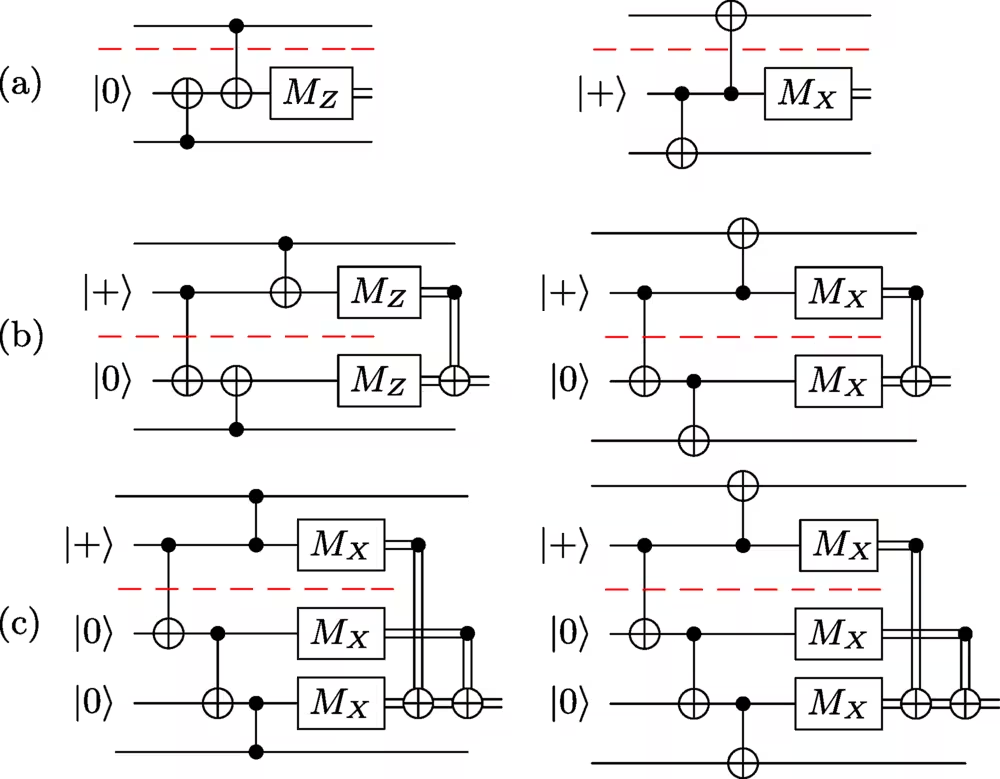
To determine if modular systems could overcome these noisy boundaries, the UCR-led team performed thousands of simulations based on current hardware architectures, such as those utilized by Google Quantum AI. By testing six modular configurations and three distinct linking strategies—direct links, gate teleportation, and CAT-state gadgets—the researchers modeled performance under intense stress.
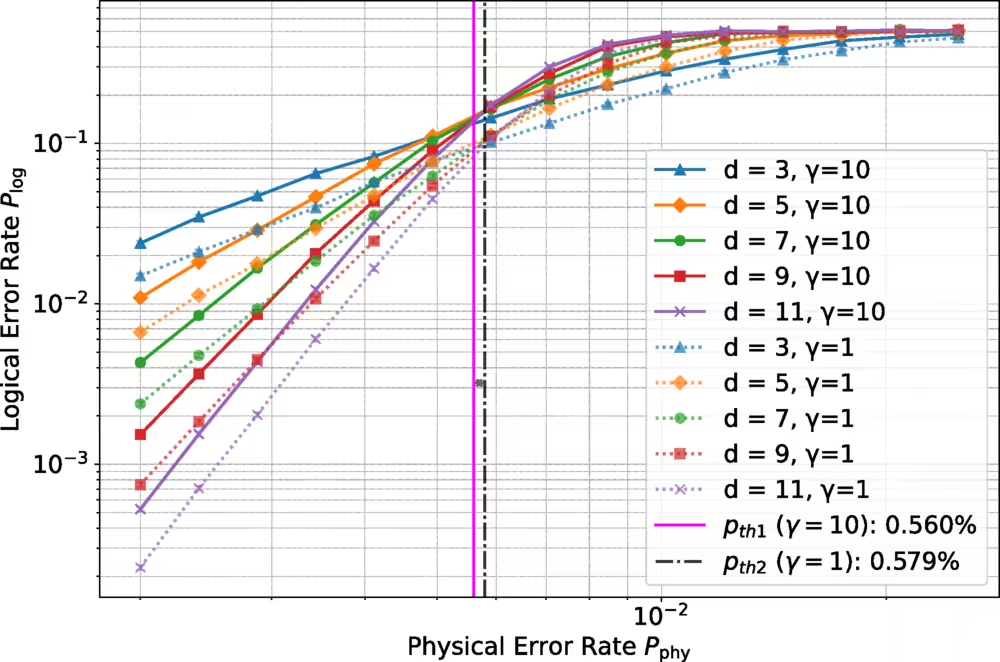
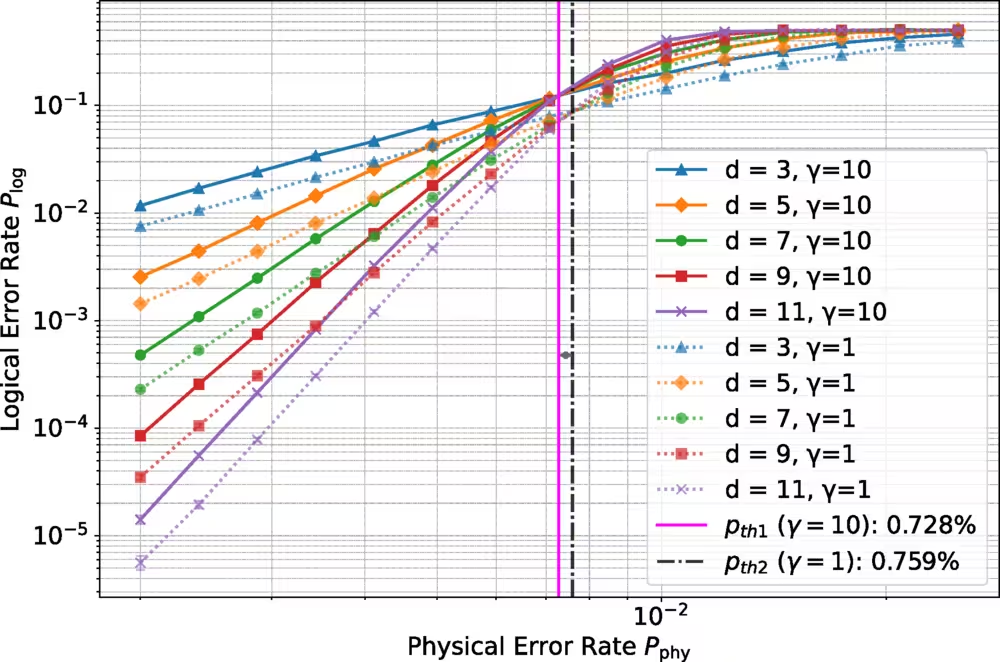
Even in scenarios where the interface was ten times noisier than the chip internals, the simulated systems maintained fault tolerance. According to Mohamed A. Shalby, a doctoral candidate and lead author of the study, this indicates that engineers do not require perfect hardware to achieve scale. As long as individual processors maintain high fidelity, the links between them can tolerate a degree of imperfection without crashing the entire system.
Refining Boundary Designs
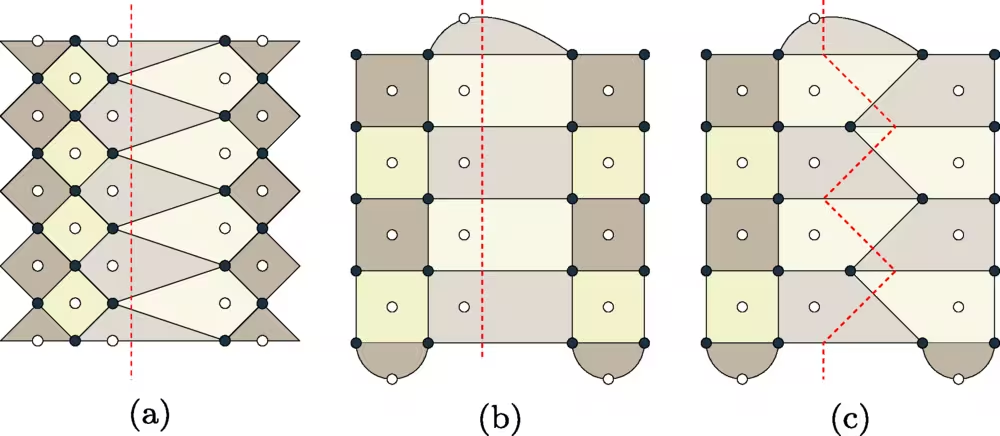
A critical component of the team’s success was the implementation of specialized boundary architectures designed to suppress “hook errors,” which are problematic noise patterns that can propagate through a system and compromise error correction. For rotated surface-code designs, the researchers utilized a zigzag boundary interface rather than a traditional straight line, successfully preventing the spread of errors and preserving the code distance required for stability.
By leveraging the Stim stabilizer simulator and the Pymatching decoder, the team validated these configurations across code distances ranging from 3 to 11. The simulations confirmed that modular systems can effectively distribute workloads similar to modern data centers, provided the interfaces are engineered to handle the expected noise threshold.

A Pragmatic Path Toward Utility
The study highlights a shift in the field’s priorities. While the “qubit race” has historically emphasized raw quantity, these results suggest that reliability and modularity are the true keys to utility. By accepting some noise at the interfaces, researchers can prioritize the optimization of individual modules, making the goal of fault-tolerant quantum computing more attainable in the near term.
The research, which builds upon foundational work from MIT and utilizes tools supported by the National Science Foundation, provides a clear roadmap for the future of quantum networking. Whether through direct links or more complex gate teleportation, the ability to maintain error correction across modular boundaries marks a significant step forward in building practical, large-scale quantum computers.
Foundational References
- Surface codes: Towards practical large-scale quantum computation(Physical Review A, 2012)
- High-threshold universal quantum computation on the surface code(Physical Review A, 2009)
- Fault-tolerant quantum computation by anyons(Annals of Physics, 2003)
- Stim: a fast stabilizer circuit simulator(Quantum, 2021)
- PyMatching: A Python Package for Decoding Quantum Codes with Minimum-Weight Perfect Matching(ACM Transactions on Quantum Computing, 2022)
This article has been fact checked for accuracy, with information verified against reputable sources. Learn more about us and our editorial process.
Last reviewed on .
Article history
- Latest version
Reference(s)
- Fowler, Austin G.., et al. “Surface codes: Towards practical large-scale quantum computation.” Physical Review A, vol. 86, no. 3, September 18, 2012 American Physical Society (APS), doi: 10.1103/PhysRevA.86.032324. <https://doi.org/10.1103/PhysRevA.86.032324>.
- Fowler, Austin G.., et al. “High-threshold universal quantum computation on the surface code.” Physical Review A, vol. 80, no. 5, November 11, 2009 American Physical Society (APS), doi: 10.1103/PhysRevA.80.052312. <https://doi.org/10.1103/PhysRevA.80.052312>.
- Kitaev, A.Yu.. “Fault-tolerant quantum computation by anyons.” Annals of Physics, vol. 303, no. 1, January 1, 2003, pp. 2-30. Elsevier BV, doi: 10.1016/S0003-4916(02)00018-0. <https://doi.org/10.1016/S0003-4916(02)00018-0>.
- Gidney, Craig. “Stim: a fast stabilizer circuit simulator.” Quantum, vol. 5, July 6, 2021, pp. 497 Verein zur Forderung des Open Access Publizierens in den Quantenwissenschaften, doi: 10.22331/q-2021-07-06-497. <https://doi.org/10.22331/q-2021-07-06-497>.
- Higgott, Oscar. “PyMatching: A Python Package for Decoding Quantum Codes with Minimum-Weight Perfect Matching.” ACM Transactions on Quantum Computing, vol. 3, no. 3, June 30, 2022, pp. 1-16. Association for Computing Machinery (ACM), doi: 10.1145/3505637. <https://doi.org/10.1145/3505637>.
Cite this page:
- Posted by Aisha Ahmed