Simple Math Matches Advanced AI in Decoding Universe Heat Maps
Combining classical topological summaries with power spectra recovers cosmic data just as well as complex neural networks under realistic instrument noise.
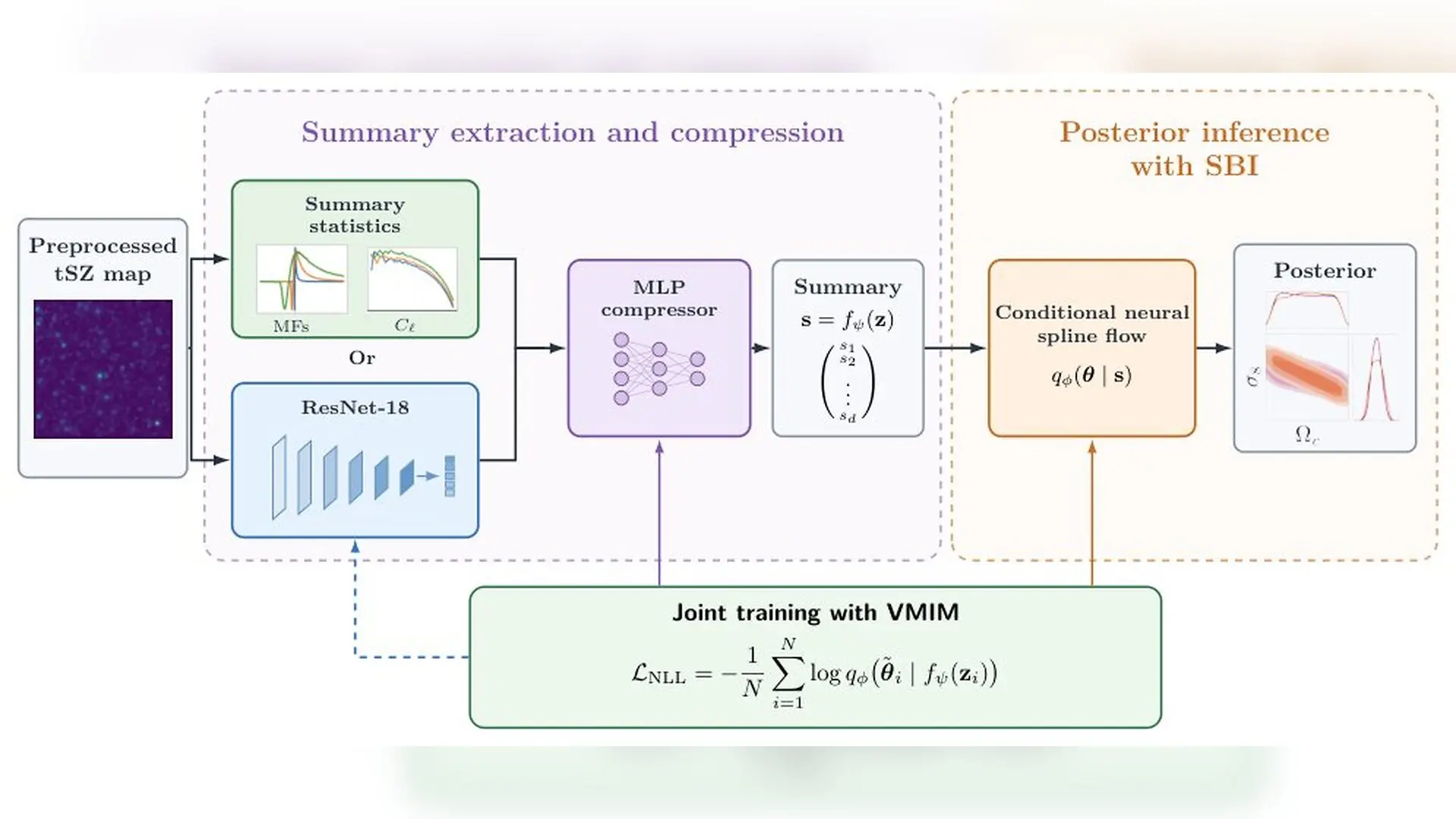
A new machine learning analysis reveals that simple statistical tools can match advanced artificial intelligence when decoding the hidden structure of the universe. Researchers tested whether standard mathematical summaries could extract as much cosmological information from cosmic heat maps as a complex neural network, finding surprising parity when instrument noise is added.
The study examines the thermal Sunyaev-Zel’dovich effect, a phenomenon where light from the primordial universe, known as the cosmic microwave background, collides with superheated gas trapped inside massive galaxy clusters spanning billions of light-years. This interaction leaves a distinct thermal footprint that helps astronomers track how cosmic structures grow over time. Because these gigantic clusters are scattered across vast cosmic distances, the resulting thermal maps are intensely complicated and packed with non-Gaussian patterns, meaning standard two-point statistics miss crucial details.
Led by Carmen Embil Villagra and an international team of astrophysicists, the work is available on the arXiv preprint server and builds on a suite of 10,000 computer-generated simulation maps. These virtual skies varied key cosmic parameters, including the cold dark matter density fraction and the matter clustering amplitude, alongside astrophysical factors describing electron pressure profiles inside galaxy groups.
How Artificial Intelligence Benchmarks the Cosmos
To measure the total information hidden in the thermal maps, the authors deployed a convolutional neural network, a type of deep learning model adept at recognizing spatial hierarchies. They paired this approach with simulation-based inference, a technique that maps parameter likelihoods directly from computer models without needing rigid analytical equations. In noiseless virtual environments, the neural network consistently extracted tighter constraints on cosmological parameters than traditional statistical summaries.
However, real astronomical observations are never noiseless. When the researchers factored in realistic noise levels expected from future instruments like the Simons Observatory, the landscape changed significantly. While the neural network still held a slight edge, combining traditional mathematical tools closed the performance gap entirely.
Can Simple Math Outsmart Deep Learning in Space?
The team evaluated two standard statistical tools: the angular power spectrum, which measures fluctuations across different angular scales, and Minkowski functionals, which describe the geometric and topological properties of patterns above specific threshold heights. Individually, these summaries have limitations. But when the researchers combined all three Minkowski functionals with the angular power spectrum, the resulting performance matched the deep learning network across key cosmological parameters.
This convergence happens because different statistical tools capture distinct degeneracies between parameters. For instance, the power spectrum exhibits opposite degeneracy directions compared to topological functionals and neural networks in certain parameter planes. Fusing these methods allows scientists to cancel out uncertainties.
What These Results Mean for Future Sky Surveys
The findings indicate that interpretable summary statistics can effectively saturate the cosmological information accessible to field-level artificial intelligence when realistic instrument noise is present. This is a significant advantage for astronomers, as neural networks often function as black boxes whose internal decision-making is difficult to audit. In contrast, topological summaries offer transparent mathematical insight into the physical structures shaping the universe.
The authors note several caveats, including the fact that their simulations treated galaxy clusters as perfect spheres rather than complex, distorted objects shaped by violent astrophysical feedback. Future work will test these methods against advanced hydrodynamical simulations and examine how foreground contamination from galactic dust impacts topological statistics. Nevertheless, the study demonstrates that classical statistical tools still hold immense power in the era of big-data cosmology.
The study was posted to the arXiv preprint server on October 29, 2026.
This article has been fact checked for accuracy, with information verified against reputable sources. Learn more about us and our editorial process.
Last reviewed on .
Article history
- Latest version
Reference(s)
- Villagra, Carmen. “Field-level inference under pressure: the information content of the thermal Sunyaev-Zel'dovich field.” arXiv.org <http://arxiv.org/abs/2610.40617v1>.
Cite this page:
- Posted by Aisha Ahmed