James Webb Telescope Discovers Clumpy Galaxy Pair Shining Brightly 13.4 Billion Years Ago
Observations of the distant system GHZ8 reveal an interacting pair of young galaxies with extreme star-formation rates and high escaping radiation.
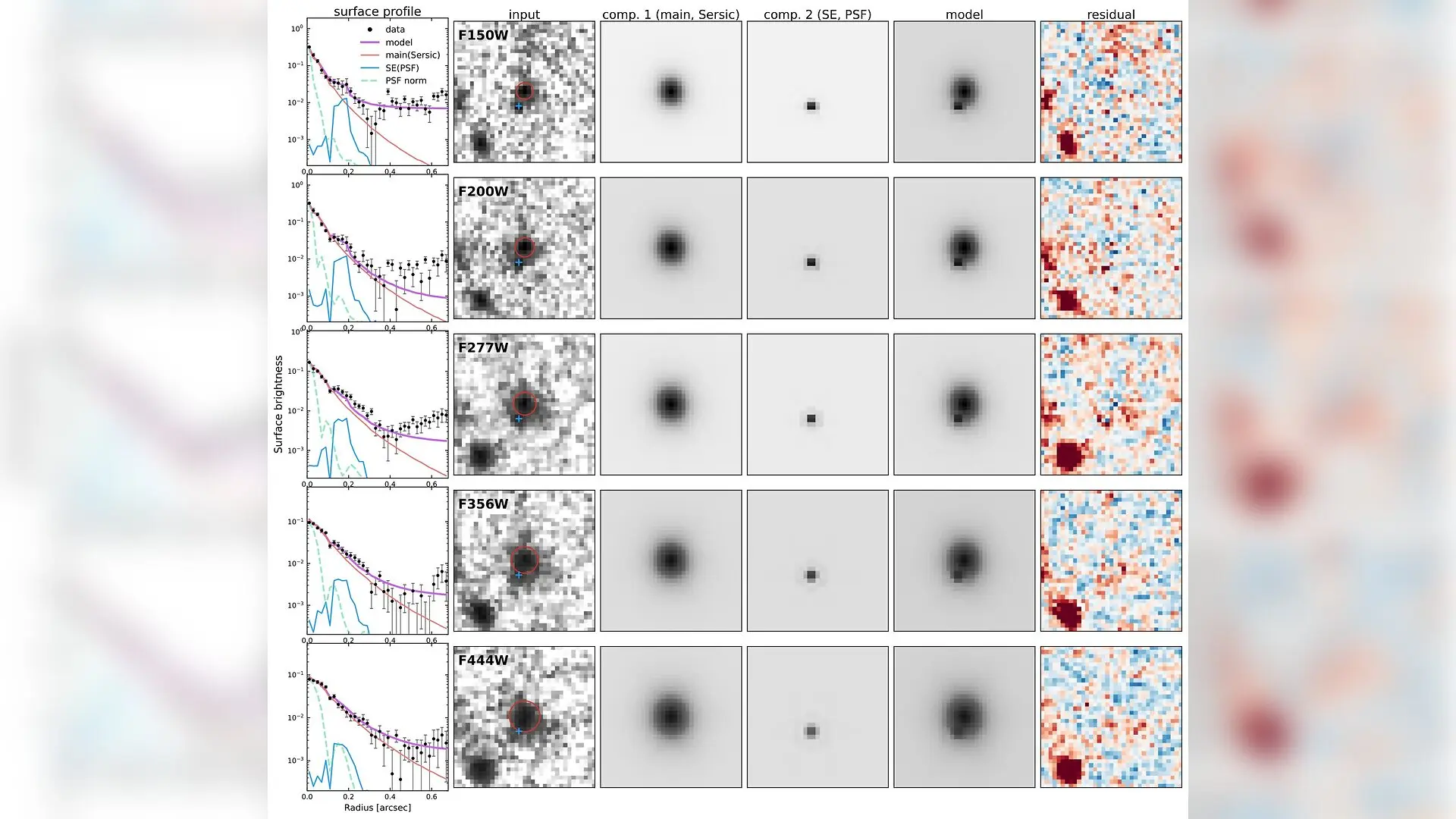
Astronomers using the James Webb Space Telescope have spotted an unexpected cosmic duo shining brightly in the early Universe at a redshift of 10.23, meaning its light took roughly 13.4 billion years to reach us. The target, a distant galaxy named GHZ8, is actually split into two distinct components separated by just 600 light-years, revealing a level of structural complexity that challenges standard models of how galaxies formed shortly after the Big Bang.
The research team, led by Ruqiu Lin from the University of Massachusetts Amherst and colleagues, detailed their findings in a study published on the arXiv preprint server. By combining high-resolution infrared imaging from the Near-Infrared Camera (NIRCam) with sensitive spectroscopy from the Mid-Infrared Instrument (MIRI), the researchers uncovered clues about how early galaxies rapidly build up stellar mass and drive cosmic reionization.
What makes the two parts of GHZ8 so different?
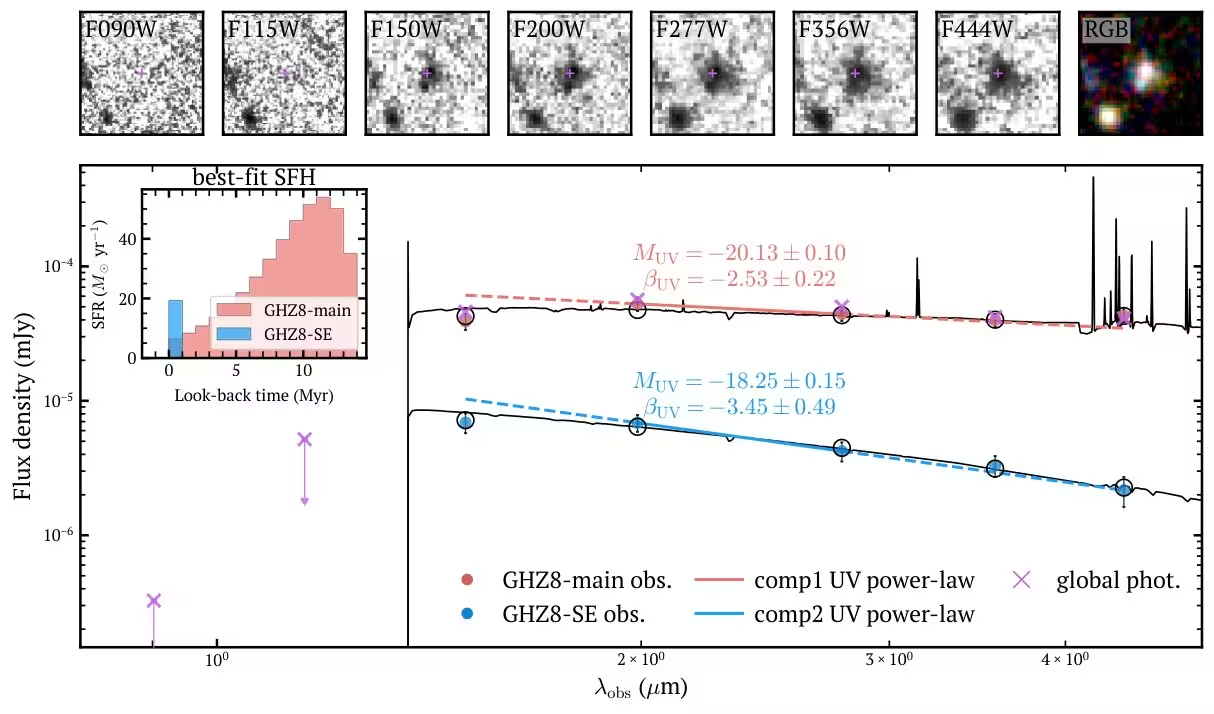
High-resolution imaging revealed that GHZ8 consists of a bright, extended main component dubbed GHZ8-main and a much fainter, compact southeastern companion called GHZ8-SE. Despite their close proximity, the two regions possess strikingly different physical properties. GHZ8-main has a demagnified absolute ultraviolet magnitude of -19.91 and shows moderate dust attenuation alongside a stellar age of about 40 million years. In contrast, the smaller companion GHZ8-SE is roughly two magnitudes fainter but features an exceptionally blue ultraviolet continuum slope.
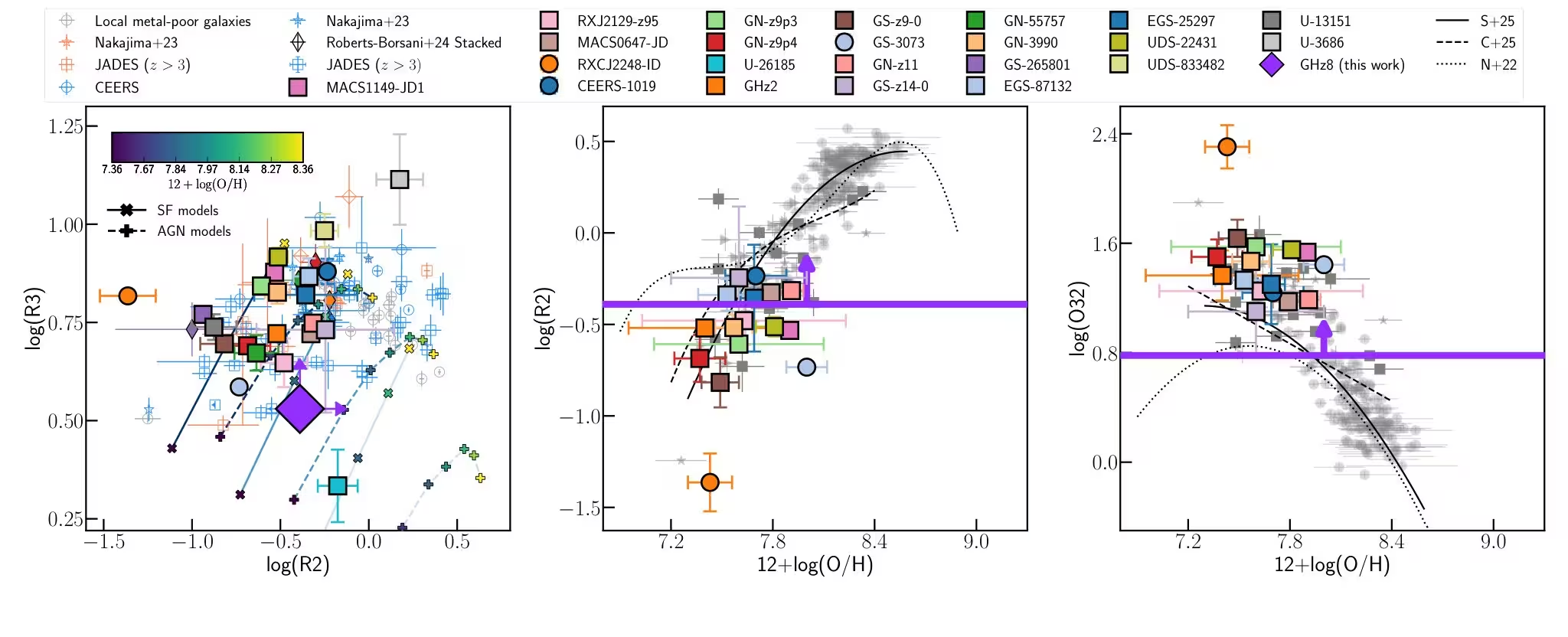
This intensely blue color points to an extremely young stellar population with an age of less than 10 million years and virtually no surrounding dust or gas blocking its light. The spectral analysis available on the arXiv preprint server indicates that GHZ8-SE is undergoing a short-lived and intense burst of star formation. Furthermore, its lack of a dense interstellar medium suggests that a high fraction of ionizing photons, ranging from 60 to 90 percent, are escaping directly into the surrounding intergalactic medium.
Could this be a minor merger driving early starbursts?
The tiny separation and massive difference in brightness suggest that GHZ8 is likely a minor merger or an interacting system rather than a single isolated galaxy. The mass ratio between the two components is roughly one-to-one hundred, which matches theoretical expectations for a dwarf galaxy accreting onto a larger early system. Gravitational interactions in such close encounters can compress gas and trigger intense, temporary bursts of star formation, explaining the active stellar nurseries observed in both components.
Alternatively, the researchers note that GHZ8-SE could theoretically represent an extreme in-situ star-forming clump born out of disk instabilities within the main galaxy. However, the distinct physical traits and lack of a symmetric multi-clump structure make the minor merger scenario a more natural fit for the observational data. Spatially resolved kinematic measurements from future observations will be necessary to definitively confirm whether the two components share the same velocity structure.
Why does this distant galaxy matter for cosmic reionization?
The discovery of systems like GHZ8 helps solve a long-standing mystery regarding the abundance of ultraviolet-bright galaxies in the early Universe. Standard cosmological models struggle to account for so many luminous galaxies existing less than 500 million years after the Big Bang. Bursty star-formation histories provide a neat solution by temporarily supercharging a galaxy’s ultraviolet luminosity, making it much easier for telescopes to detect.
Moreover, objects like GHZ8-SE may have played a vital role during the epoch of reionization by acting as efficient factories for leaking ionizing radiation. Even though it is relatively small, its high production rate of escaping photons demonstrates how faint, interacting dwarf galaxies could have collectively cleared the primordial fog shrouding the early Universe.
The study was posted to the arXiv preprint server on October 29, 2026.
This article has been fact checked for accuracy, with information verified against reputable sources. Learn more about us and our editorial process.
Last reviewed on .
Article history
- Latest version
Reference(s)
- Lin, Ruqiu. “PRISMS GHZ8: Evidence for a Young Burst and Potential Merger Activity at z=10.23.” arXiv.org <http://arxiv.org/abs/2610.40633v1>.
- Lin, Ruqiu. “PRISMS GHZ8: Evidence for a Young Burst and Potential Merger Activity at z=10.23.” arXiv.org <https://arxiv.org/abs/2610.40633>.
Cite this page:
- Posted by Aisha Ahmed