Extreme Spacetime Throats Could Bounce Gravitational Wave Echoes
A theoretical model shows how horizonless ultracompact objects might trap and release repeating gravitational wave signals.
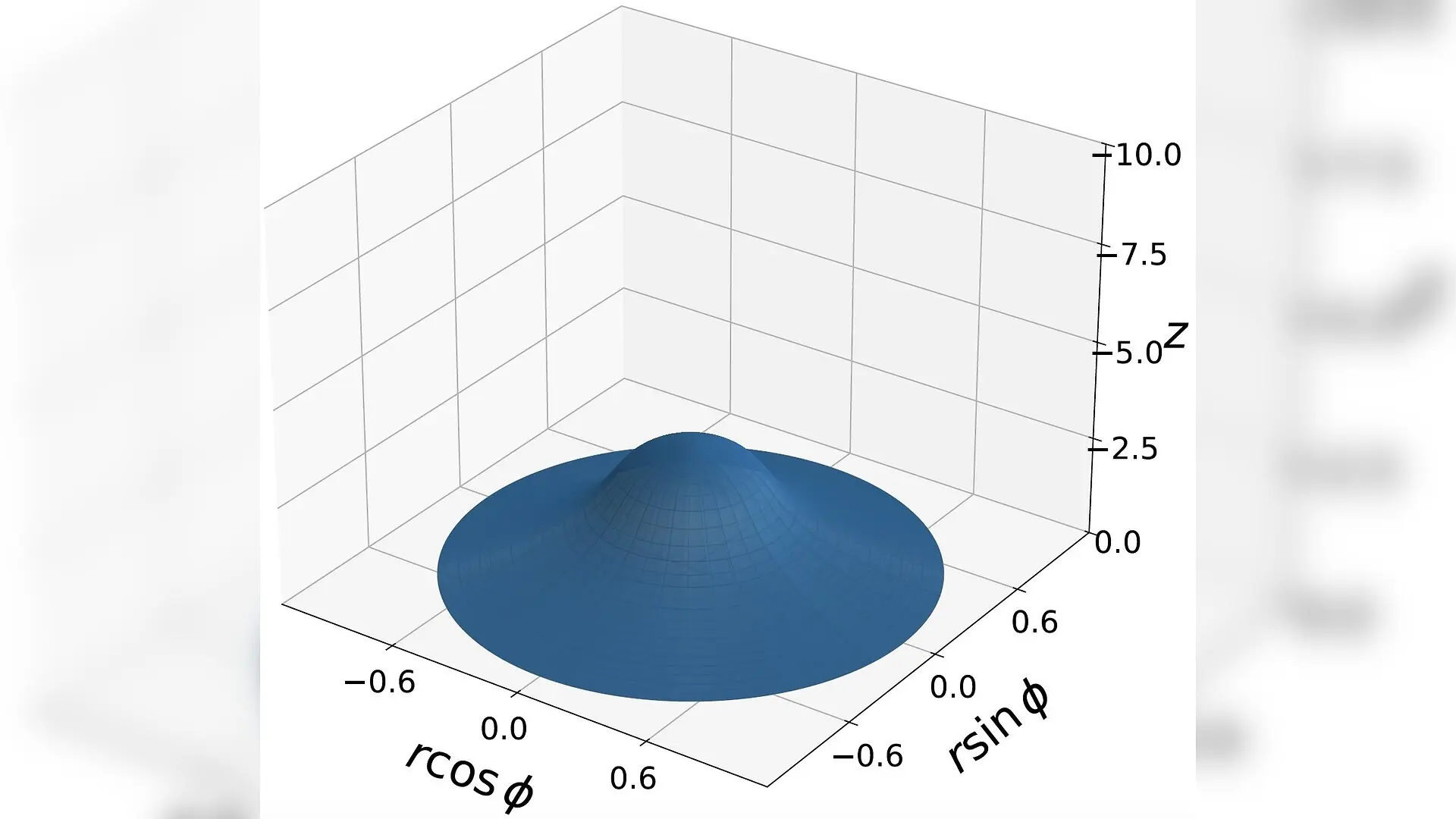
When ultra-dense objects push right up against a critical trapping threshold, they can develop deep internal cavities that trap and bounce gravitational waves back out as repeating echoes. In a theoretical study published on the arXiv preprint server, researcher Jahed Abedi investigated how gravitational waves behave inside these extreme, horizonless configurations, which serve as simplified models for exotic stellar objects.
While a standard black hole swallows everything that crosses its event horizon, these theoretical objects feature a dense core surrounded by a powerful angular-momentum barrier. When gravitational waves strike this barrier from the outside, a portion of the wave is immediately reflected, producing a standard initial ringing sound known as ringdown. However, the fraction of the wave that punches through the barrier falls into an internal pocket, bouncing back and forth before eventually leaking out as delayed gravitational echoes.
How Geometry and Stretching Create a Trap
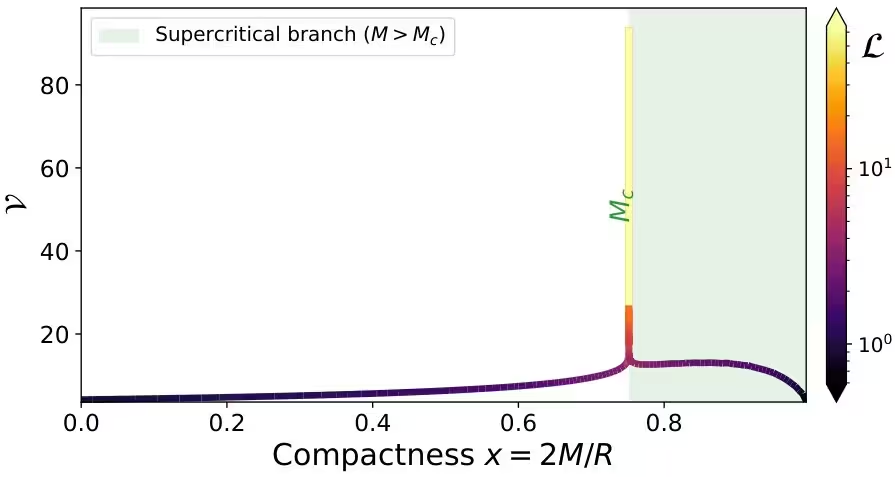
The research focuses on static, spherically symmetric systems where a specific geometric measurement—the minimum of a function governing the spacetime curvature—approaches zero. As this threshold is approached, the proper radial length and internal volume of the object stretch dramatically, growing in proportion to the natural logarithm of a small parameter representing the distance to the threshold.
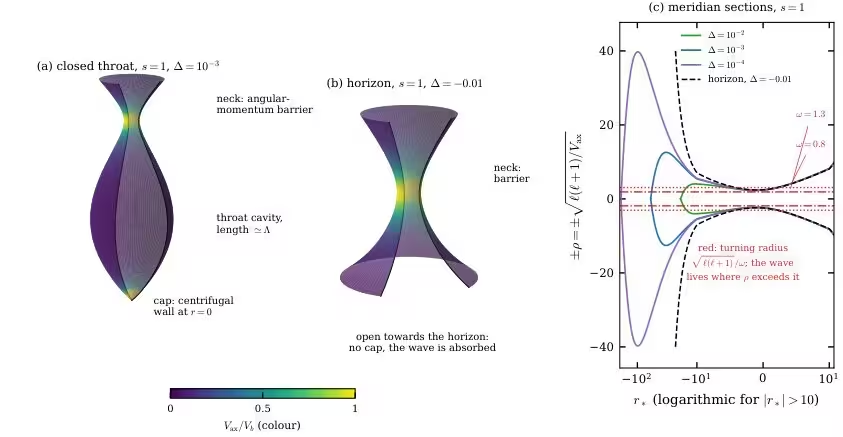
Despite this massive internal stretching, the local curvature of spacetime remains finite throughout the region. The author parametrized the lapse function, which dictates how proper time flows relative to coordinate time, using a specific scaling factor. Depending on this scaling parameter, the interior region forms a resonant cavity behind the barrier, allowing trapped waves to escape in regular intervals.
Why Echo Delays Scale Differently Than Wormholes
In previously studied models of thin-shell gravastars or wormholes, the delay between repeating echoes grows only logarithmically with the object’s proximity to its would-be horizon. By contrast, this new analysis reveals that for certain lapse parameters, the echo delay scales as a power-law, growing inversely with the lapse at the bottom of the throat. This geometric delay mechanism closely mirrors the capped throats predicted in string theory microstate geometries.
Through time-domain numerical evolutions and frequency-domain calculations, the author tracked these echo trains across multiple decades of the critical parameter. The findings indicate that successive echo amplitudes do not decay by a simple fixed factor. Instead, because each round trip filters the wave spectrum through the barrier, the echoes gradually shift toward lower frequencies, causing the overall echo train envelope to decay as a inverse power of the echo number.
The Catch Regarding Matter and Energy Conditions
A significant physical caveat highlighted in the study concerns the underlying matter required to sustain these configurations. An ordinary isotropic fluid cannot reach this critical trapping threshold because internal pressures would diverge before the throat could form. Instead, the model relies on an effective anisotropic fluid.
When evaluating standard energy conditions, the calculations show that only one specific value of the lapse parameter satisfies the null, weak, and dominant energy conditions everywhere outside the core. Other choices within the family require effective matter that violates the null energy condition on at least one side of the throat. Furthermore, the present work is restricted strictly to linear axial perturbations, meaning polar perturbations and the full dynamical formation process remain open questions for future research.
The study was posted to the arXiv preprint server on October 29, 2026.
This article has been fact checked for accuracy, with information verified against reputable sources. Learn more about us and our editorial process.
Last reviewed on .
Article history
- Latest version
Reference(s)
- Abedi, Jahed. “Gravitational-Wave Echoes and Greybody Cutoff from Logarithmic Throats at a Marginal-Trapping Threshold.” arXiv.org <http://arxiv.org/abs/2610.40631v1>.
Cite this page:
- Posted by John Williams