Do Ultramassive Black Holes Break Physics as We Know It?
A fresh analysis of galactic archives suggests that decades of evidence for a high-mass radio excess may be an observational illusion.
A fundamental law linking black hole mass to radio and X-ray emissions breaks down or holds firm at the extreme mass frontier above ten billion solar masses, according to a reassessment of galactic archives. Astronomers have long used this scaling relationship, known as the Fundamental Plane, to estimate masses and study particle jets, but whether the rule applies unchanged to the universe’s most colossal black holes has remained a persistent mystery.
The study, available as a preprint on arXiv by researchers Ramananda Santra, Samik Mitra, and Shahram Abbassi, demonstrates that earlier claims of enhanced radio emissions in ultramassive black holes were likely statistical artifacts. Previous investigations often relied on heterogeneous data and indirect mass proxies, which confused systematic measurement errors with genuine astrophysical departures.
Reassessing the Mass Scaling Law with Direct Data
To test the validity of the scaling relation at the high-mass end, the authors analyzed three distinct datasets rather than combining incompatible metrics. First, they evaluated a calibration sample of 29 galaxies featuring direct dynamical mass measurements derived from stellar, gas, or maser tracking. This step established the predictive width of the forward relationship between radio luminosity, X-ray output, and central mass.
When the team fitted this calibration sample, they found a total forward predictive dispersion of approximately 1.07 dex. This means that predictions of radio luminosity across five decades span about an order of magnitude in scatter. The authors note that this spread is substantially wider than previously reported conditional scatter metrics because it accounts for real-world observational heterogeneities, including differing beam sizes, observing frequencies, and multi-year time gaps between radio and X-ray snapshots.
The Trap of Indirect Mass Proxies
Next, the researchers examined an archive of 72 brightest cluster galaxies, which host the most massive black holes known, sitting at the centers of deep cosmic gravitational potentials. Past studies pointed to these systems as evidence of a high-mass radio excess, arguing that black holes exceeding ten billion solar masses produce disproportionately strong radio jets.
However, the new analysis reveals an observational degeneracy between actual radio enhancements and errors in the K-band luminosity proxies used to estimate black hole masses in those older studies. If the mass proxies are systematically underestimated, the predicted radio luminosity shifts in tandem, creating the illusion of a population-wide excess. Furthermore, mock catalog simulations showed that unknown selection effects and flux limits in archival data can easily mimic or erase a true physical offset, meaning archival datasets alone cannot prove the existence of a high-mass break.
Testing Future Survey Strategies and Precision Limits
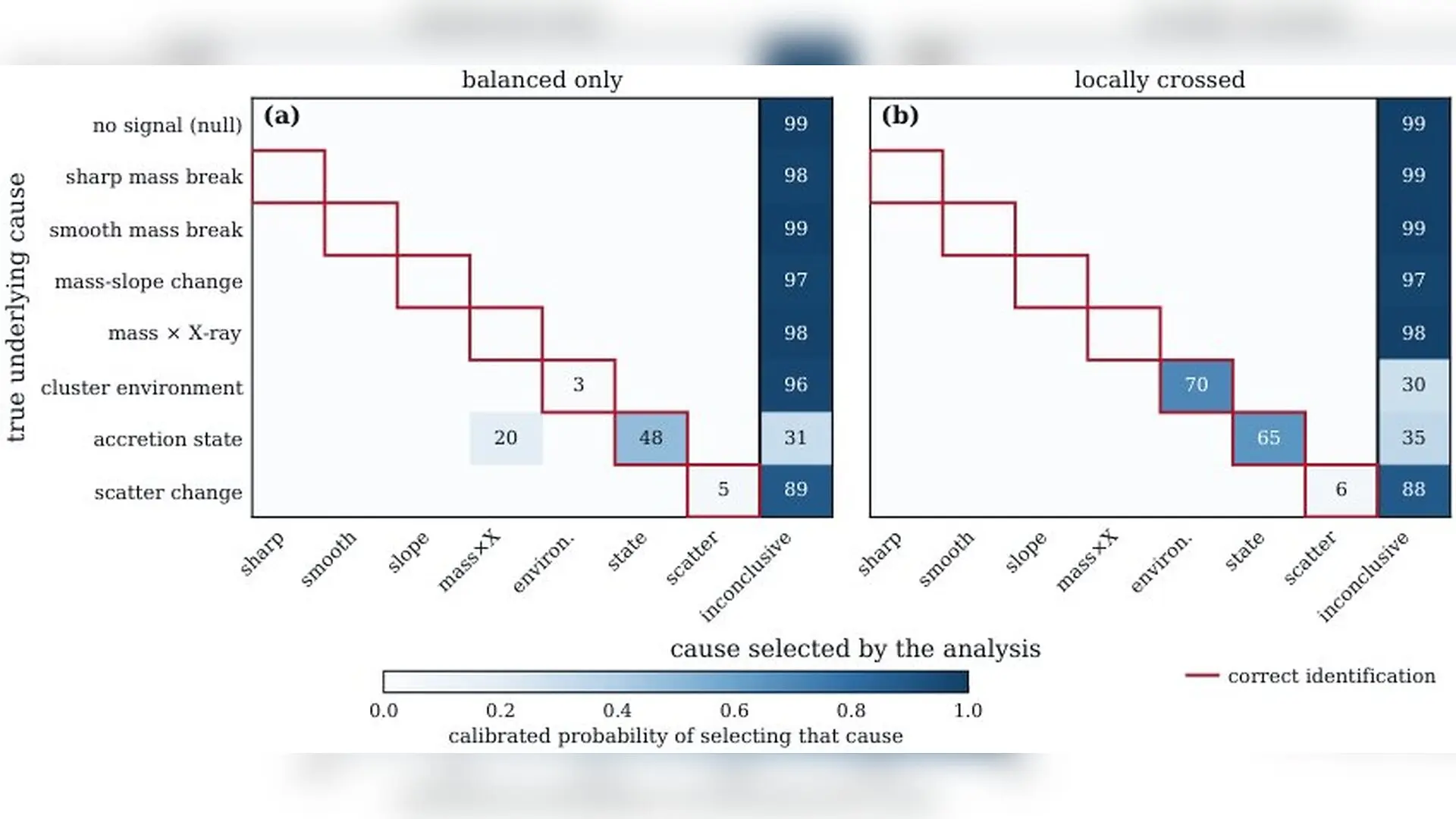
To determine what it would take to definitively confirm or rule out an ultramassive departure, the team simulated future observing programs using 16 direct-mass brightest cluster galaxies and proposed expanded samples of 64 systems. Their models show that at the currently demonstrated measurement width of 1.11 dex, joint detection and precise localization of a sharp mass transition are nearly impossible with current instruments, yielding success rates of only one to two percent.
The authors suggest that resolving the question requires a strict, two-stage observational strategy. A dedicated pilot program targeting 32 to 48 direct-mass nuclei must first demonstrate a narrower nuclear dispersion of roughly 0.40 dex using quasi-simultaneous radio and X-ray observations matched to a common physical scale of 100 parsecs. Only by isolating the compact jet core from surrounding diffuse cluster plasma and independently crossing mass with accretion states and environmental metrics can astronomers hope to pierce the observational fog surrounding the universe’s most massive black holes.
The study was posted to the arXiv preprint server on October 29, 2026.
This article has been fact checked for accuracy, with information verified against reputable sources. Learn more about us and our editorial process.
Last reviewed on .
Article history
- Latest version
Reference(s)
- Santra, Ramananda. “The unresolved high-mass frontier of the black hole Fundamental Plane.” arXiv.org <http://arxiv.org/abs/2610.40606v1>.
Cite this page:
- Posted by John Williams