Massive Cosmic Archive of 825 Galaxy Clusters Mapped Across Time
A deep infrared survey uncovers hundreds of ancient galaxy clusters and groups, providing a vital calibration tool for upcoming space telescopes.
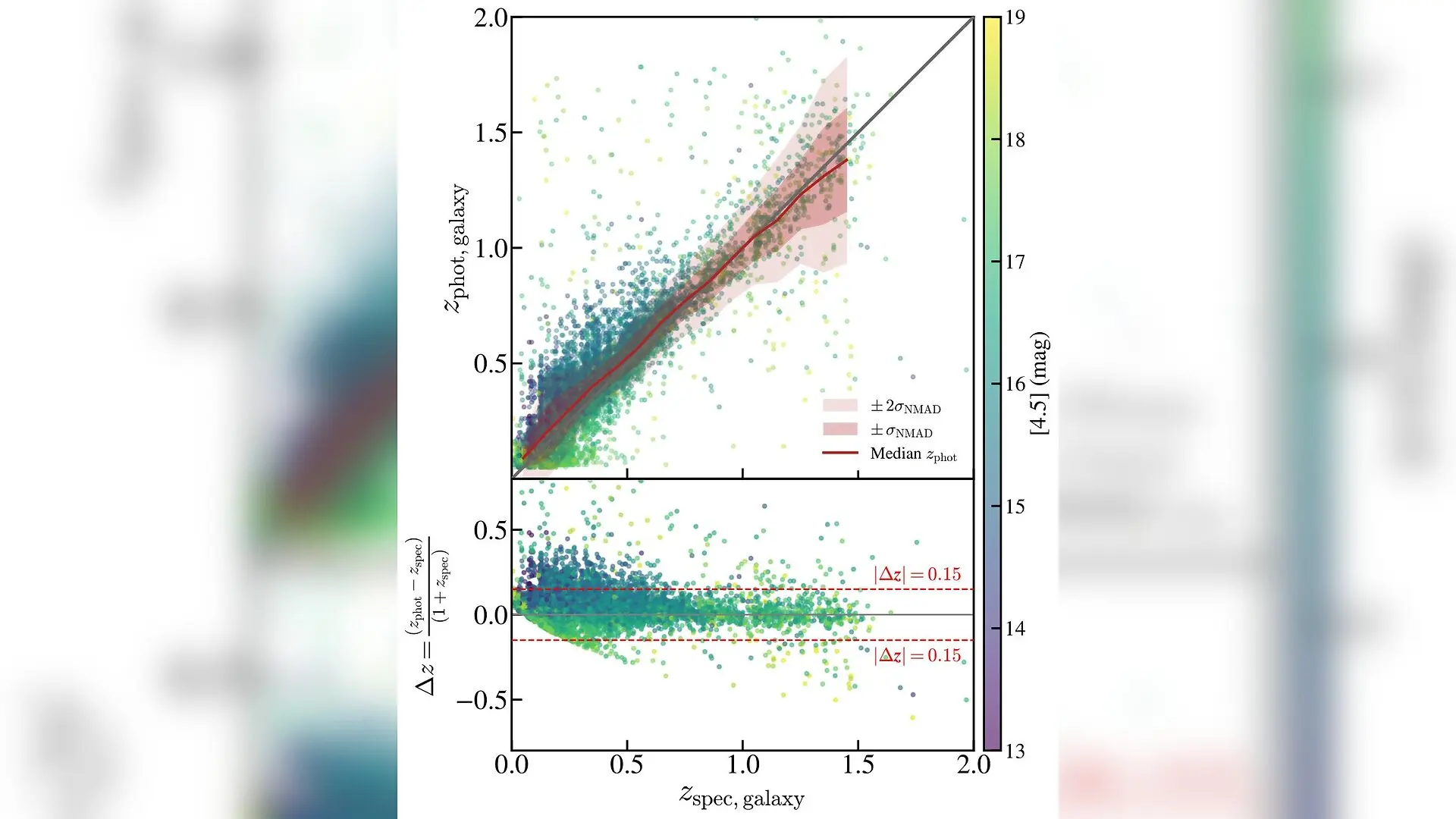
Astronomers have mapped a massive cosmic archive containing 825 galaxy cluster candidates spanning up to 11 billion light-years across space. The survey reveals how ancient megastructures formed in the early universe, offering a crucial testing ground for upcoming wide-field space telescopes.
How Infrared Vision Unlocked Deep Space Clusters
Galaxy clusters are the largest gravitationally bound structures in the universe, containing hundreds or thousands of galaxies alongside vast reservoirs of hot gas and dark matter. Finding these massive assemblies at great distances is notoriously difficult because their constituent stars grow old and faint over billions of years. To overcome this limitation, an international team of researchers utilized deep infrared data from the Spitzer Space Telescope combined with optical imaging of the Boötes field, a 9.3 square degree region near the North Galactic Pole.
By applying a modernized detection algorithm called PZWav, the study identifies overdensities of galaxies across twelve distinct wavelength bands. The resulting catalog, available on the arXiv preprint server, spans a redshift range from 0.08 to 2.0 with a median redshift of 0.93. Crucially, the survey detects 147 candidate systems at redshifts of 1.5 or greater, capturing galaxy clusters at a critical epoch when the universe was only a fraction of its current age.
Validating Ancient Structures With Modern Spectroscopic Surveys
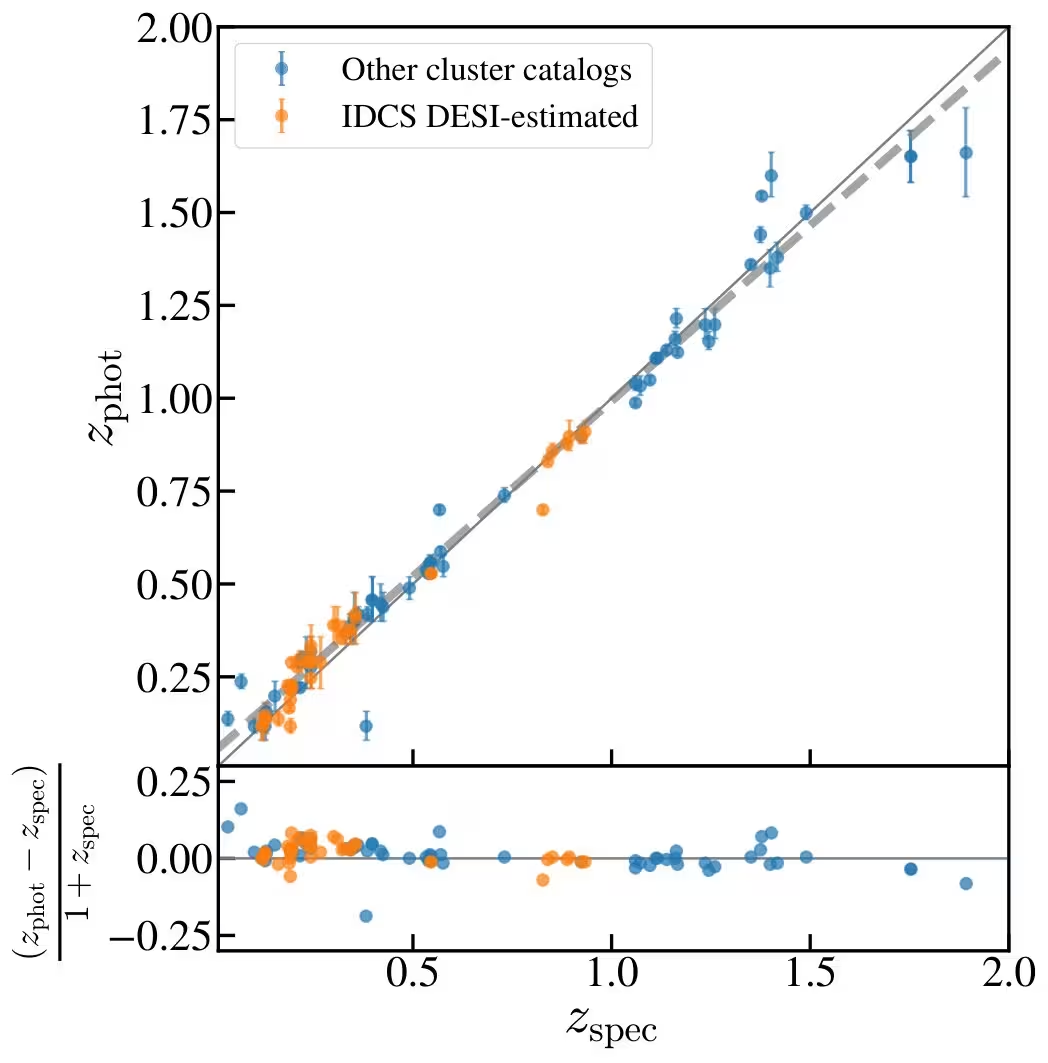
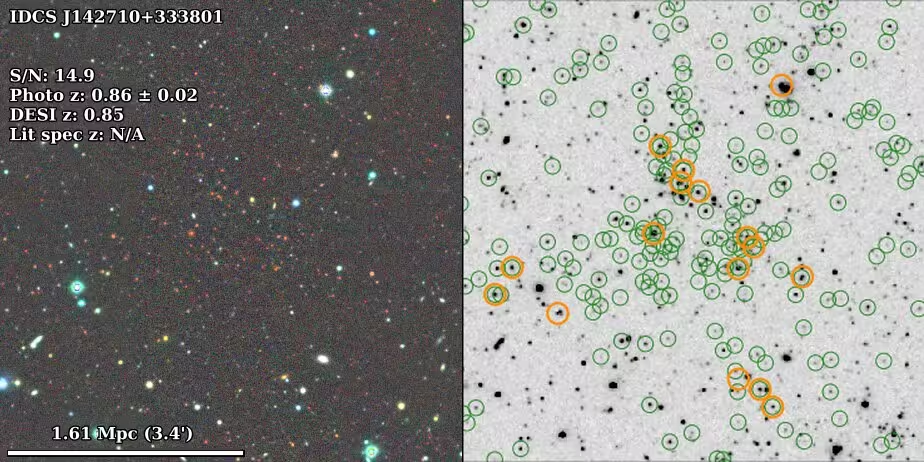
Confirming that these candidate overdensities represent genuine gravitational bound systems rather than random alignments requires rigorous verification. The team cross-referenced their candidates with spectroscopic data from the Dark Energy Spectroscopic Instrument, known as DESI. This follow-up allowed the researchers to measure reliable redshifts and velocity dispersions for 38 systems containing at least ten confirmed member galaxies each.
The velocity dispersions measured for these systems yield a median value of approximately 490 kilometers per second. Using established scaling relations, the authors calculated a median halo mass of 1.1 multiplied by 10 to the 14th power solar masses for these verified clusters. Out of the 38 DESI-confirmed systems, 23 represent first-time spectroscopic confirmations, significantly expanding our observational inventory of massive structures in the distant universe.
What These Hidden Megastructures Mean for Cosmology
Understanding the distribution and mass of ancient galaxy clusters allows cosmologists to test models of cosmic evolution and dark energy. The catalog demonstrates high purity, with simulations indicating a 93 percent purity rate at the adopted signal-to-noise threshold of 4 or higher. Furthermore, the survey achieves a 50 percent completeness limit at a mass corresponding to about 5.5 multiplied by 10 to the 13th power solar masses when adjusted for specific overdensity definitions.
While the findings provide an unprecedented window into the early assembly of cosmic structures, the authors note certain observational limits. At redshifts beyond 1.5, the galaxy catalog becomes observationally incomplete, meaning high-redshift completeness estimates should be treated as upper limits. As upcoming facilities like the Vera C. Rubin Observatory, the Nancy Grace Roman Space Telescope, and Euclid begin scanning the cosmos, this deep infrared catalog serves as a vital benchmark for calibrating next-generation cluster detection techniques.
The study was posted to the arXiv preprint server on October 29, 2026.
This article has been fact checked for accuracy, with information verified against reputable sources. Learn more about us and our editorial process.
Last reviewed on .
Article history
- Latest version
Reference(s)
- Garcia, Karolina. “The IRAC Distant Cluster Survey.” arXiv.org <http://arxiv.org/abs/2610.40534v1>.
Cite this page:
- Posted by John Williams