Ancient Carbon Glow Will Reveal Early Universe Structure
New empirical models indicate that future carbon intensity mapping surveys will successfully trace large-scale cosmic structure.
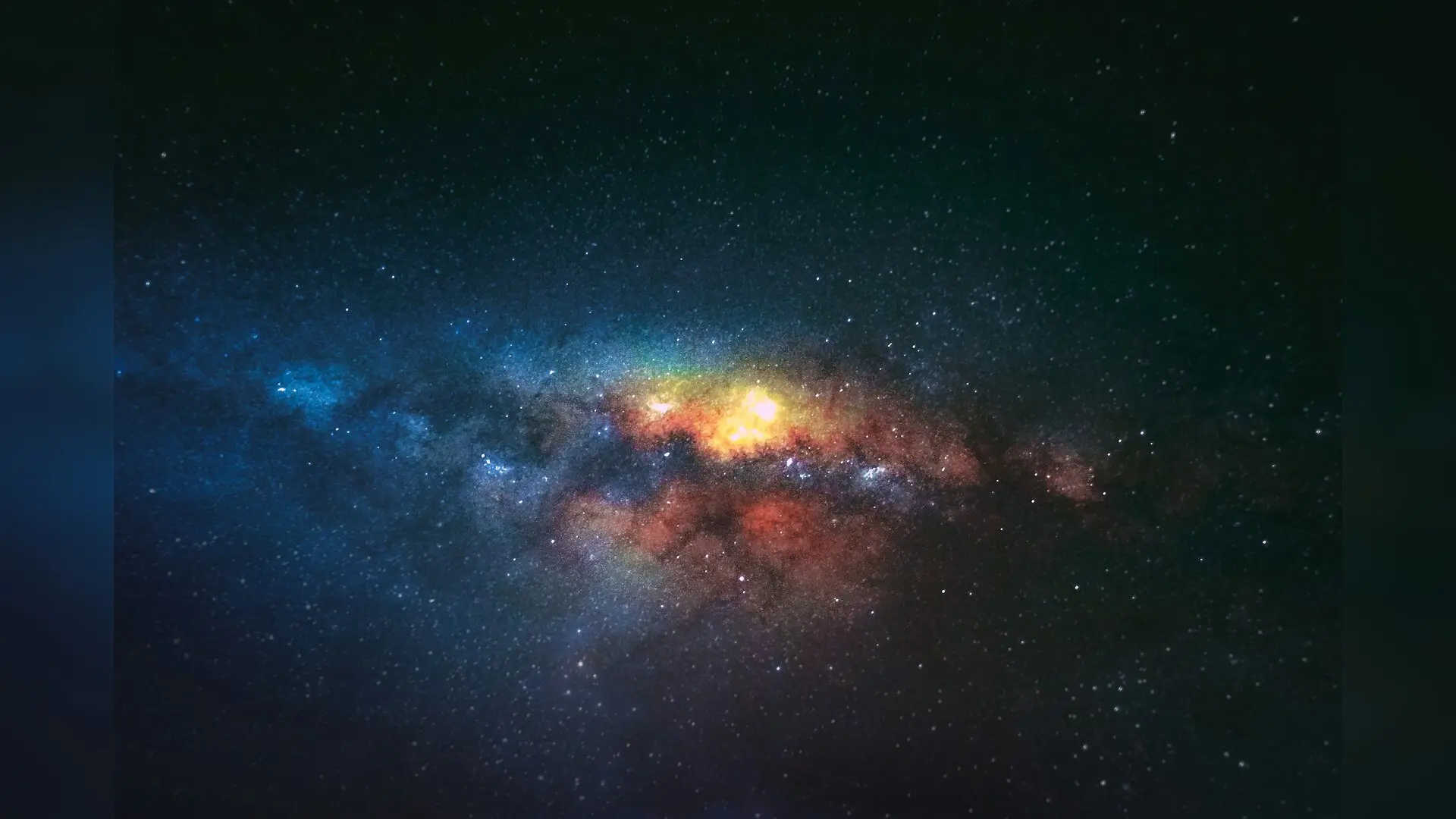
A new astronomical model suggests that upcoming surveys searching for ancient carbon emissions in the early universe will successfully map large-scale cosmic structures rather than getting lost in random background noise. By analyzing how ionized carbon traces the distribution of invisible dark matter halos, researchers have resolved long-standing uncertainties regarding how the distant cosmos glows in far-infrared light.
Millimeter-wave line intensity mapping is an observational technique designed to study the high-redshift universe, referring to objects billions of light-years away whose light is shifted deeply into the infrared and radio spectrum. The primary target for these cosmic surveys is the 158 micrometer fine-structure line of singly ionized carbon, known as [C II], which serves as the brightest cooling line emitted by star-forming galaxies. Detecting this faint collective glow allows astronomers to peer past individual, hard-to-see galaxies and map the large-scale architecture of space.
Whether future telescopes can extract useful cosmological data depends heavily on the power spectrum of the [C II] signal, which describes how intensity fluctuates across different spatial scales. On large scales, the signal traces the clustering of massive dark matter halos, while on small scales, it flattens into a random background known as shot noise. Previous theoretical forecasts relied on complex chains of scaling relations or numerical simulations that yielded widely varying predictions, differing by more than an order of magnitude.
To establish a reliable baseline, the study is available on the arXiv preprint server, detailing how researchers calibrated a double power-law relation connecting halo mass to [C II] luminosity using direct empirical data. Instead of chaining external models, the team constrained their parameters using recent measurements of mean intensity from cross-correlation techniques alongside local and high-redshift luminosity functions.
What the New Model Reveals About Cosmic Clustering Scales
The analysis demonstrates that the clustering signal stands significantly above the random shot-noise floor across the spatial scales relevant to upcoming instruments. Specifically, the two-halo clustering peak rises roughly 45 to 64 times higher than the shot-noise floor at redshifts $z = 4.5$ and $5.5$, exceeding ten times the floor in over 98 percent of the model posterior samples. This strong separation means that future line intensity mapping experiments will successfully measure large-scale structure and fundamental cosmology.
Furthermore, the team calculated that roughly 90 percent of the total mean carbon intensity originates from halos spanning a narrow mass range between $10^{10.6}$ and $10^{12.2}$ solar masses. These specific halos are the very same structures that host Lyman-break galaxies and Lyman-alpha emitters already cataloged by optical and infrared telescope surveys. Rather than probing entirely unreachable domains, [C II] mapping captures the total integrated emission of these known populations across massive volumes of space that traditional spectroscopic surveys cannot cover.
What Lies Ahead for Cosmic Mapping Experiments
The findings provide essential design guidelines for current and planned instrument arrays, such as the TIME and FYST projects, which aim to observe the distant universe. While the shape of the power spectrum is now firmly constrained by existing data, the absolute amplitude of the signal remains less precisely known. The authors note that achieving tighter constraints on the signal amplitude will require targeted follow-up measurements, such as carbon intensity stacking for galaxies with known spectroscopic redshifts or detailed cross-correlations with optical galaxy surveys.
The study was posted to the arXiv preprint server on October 29, 2026.
This article has been fact checked for accuracy, with information verified against reputable sources. Learn more about us and our editorial process.
Last reviewed on .
Article history
- Latest version
Reference(s)
- Jeong, Oliver. “An Empirically Calibrated [C II] Luminosity-Halo Mass Relation for Line Intensity Mapping.” arXiv.org <http://arxiv.org/abs/2610.40550v1>.
Cite this page:
- Posted by Aisha Ahmed