New Simulation Links Stellar Feedback and Gas Accreting Flows
An advanced numerical framework reveals how massive protostars continue growing for millions of years despite intense radiation and gas-clearing winds.
Massive stars can form over extended timescales of several million years even while enduring intense radiation and powerful particle winds from neighboring newborn stars. That surprising insight emerges from a comprehensive computational framework developed by astrophysicists William Lake, Paolo Padoan, Åke Nordlund, and Troels Haugbølle to model how star-forming gas clouds evolve under the combined influence of stellar feedback and gravity.
Understanding how giant molecular clouds convert gas into stars remains one of the most challenging problems in modern astrophysics. As massive protostars grow, they emit blistering ultraviolet radiation and launch high-speed gas jets that threaten to blow apart the very nurseries feeding them. While earlier theoretical models debated whether these feedback forces abruptly terminate star growth or whether external turbulent gas inflows can sustain accretion for millions of years, most simulations struggled to capture both the large-scale dynamics of turbulent clouds and the small-scale physics of individual star growth simultaneously.
Coupling Radiation to Turbulent Gas Flows
To bridge this vast scale gap, the authors extended the modular astrophysical framework DISPATCH, combining directional stellar radiation, diffuse infrared transport, nonequilibrium thermochemistry, and protostellar jets into a self-gravitating magnetohydrodynamics solver. As published in arXiv, the method utilizes adaptive mesh refinement and asynchronous local timestepping, allowing dense collapsing cores and shock fronts to evolve at much faster rates than their diffuse surroundings without wasting computational power.
The newly expanded framework separates radiation into two distinct components. Direct stellar radiation uses multiband short-characteristics ray tracing across eight spectral bands, tracking ionizing photons and preserving geometric shadows and source directions as light cuts through complex gas structures. Meanwhile, diffuse infrared radiation handles thermal energy re-emitted by dust grains. The research team implemented both an M1-closure-based moment method and a stationary angular ray method to transport this infrared radiation, ensuring that shielded material deep inside dense clumps receives warmth through realistic dust reprocessing.
Testing Thermal Evolution and Outflow Dynamics
The team subjected their numerical modules to a battery of rigorous validation tests, examining everything from fixed-temperature chemical ionization equilibria to radiation-driven shell expansion and the propagation of planar ionization fronts across adaptive grid boundaries. When simulating the gravitational collapse of a one-solar-mass prestellar core, the code successfully reproduced the transition from isothermal collapse to adiabatic heating as the gas density climbed, matching established benchmarks from independent studies.
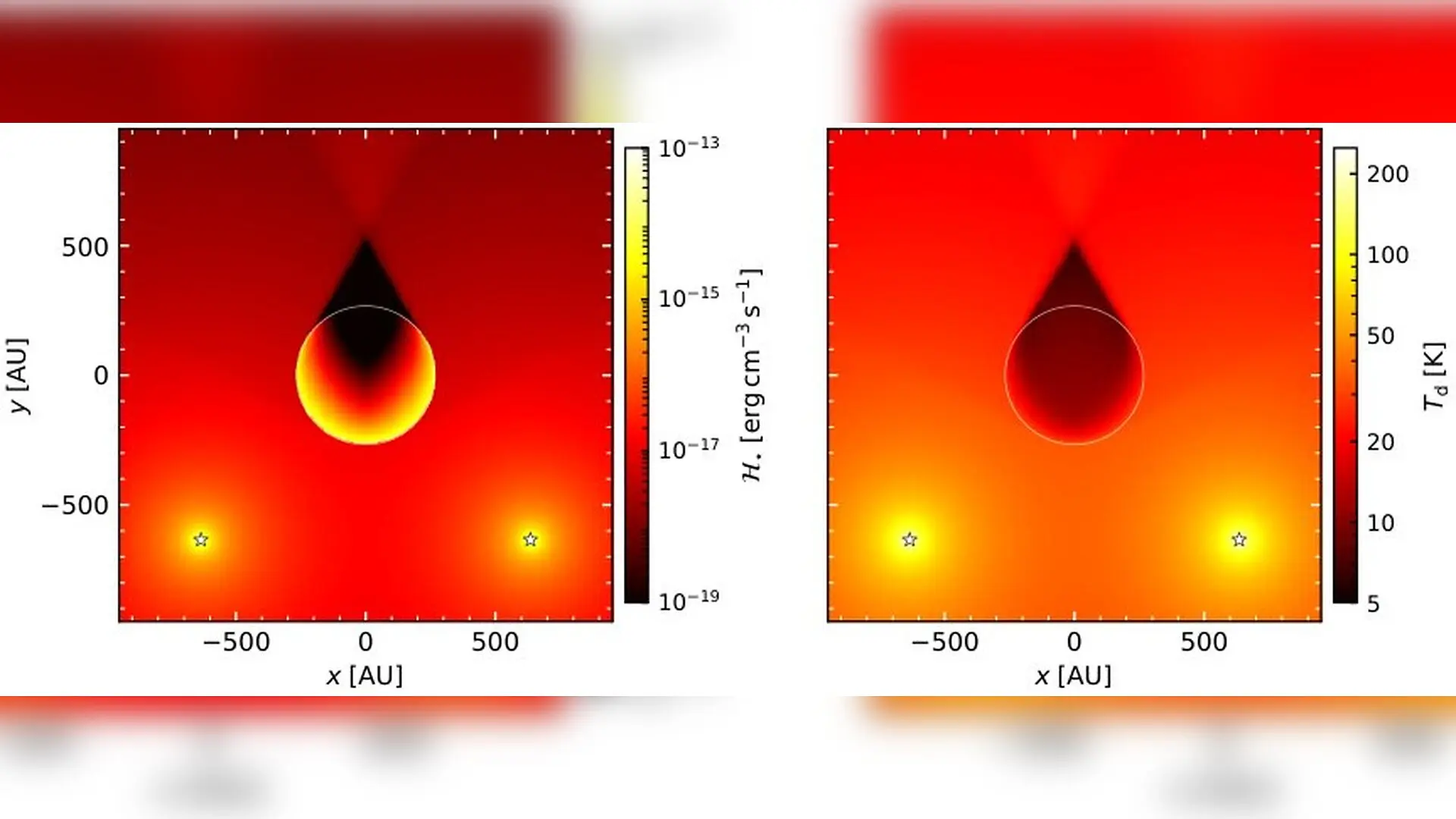
Additional tests focusing on protostellar jets demonstrated that subgrid outflows maintain consistent mass, linear momentum, and maximum speeds across different spatial resolutions. When multiple luminous sources illuminated a dense gas clump simultaneously, the hybrid transport approach successfully generated overlapping shadows in direct starlight while smooth infrared re-emission heated the shadowed regions. These tests confirmed that the numerical engine can accurately capture the complex interplay between radiation pressure, thermal cooling, and gas dynamics.
Implications for Star Cluster Assembly
These methodological advances provide researchers with a powerful tool to test how stellar feedback modifies gas accretion across environments ranging from local molecular clouds to the birth sites of the universe’s first stars. By allowing individual stellar masses to grow organically through gas accretion rather than relying on a predetermined initial mass function, the simulations can directly explore how radiative feedback erodes feeding flows and when accretion finally ceases.
The authors note several current limitations within their model, such as the use of a reduced speed of light for diffuse radiation transport and prescribed heavy-element abundances rather than fully evolved chemical species. Nevertheless, the framework opens up new pathways for zoom-in simulations of giant molecular clouds, offering a clearer picture of how massive stars manage to assemble their immense bulk before stellar feedback clears out their surrounding gas.
The study was posted to the arXiv preprint server on November 12, 2026.
This article has been fact checked for accuracy, with information verified against reputable sources. Learn more about us and our editorial process.
Last reviewed on .
Article history
- Latest version
Reference(s)
- Lake, William. “Radiation, Thermochemistry, and Stellar Feedback in DISPATCH.” arXiv.org <http://arxiv.org/abs/2611.17290v1>.
Cite this page:
- Posted by Aisha Ahmed