New Cubic Model Maps Distant Hydrogen Gas With Five Percent Accuracy
Advanced calculations map intergalactic gas fluctuations and reveal sub-percent shifts in cosmic distance standards.
A new mathematical model mapping the distribution of distant hydrogen gas has successfully predicted cosmic distortions with unprecedented accuracy, sharpening our view of the early Universe. Researchers found that adding cubic calculations to existing theoretical frameworks reduces errors down to five percent across vast intergalactic scales spanning billions of light-years.
The Lyman-alpha forest consists of absorption lines imprinted on the spectra of bright, distant quasars by neutral hydrogen clouds in the intergalactic medium. As light travels across redshifts between $z = 2$ and $z = 4$, which corresponds to a time when the Universe was roughly 1.5 to 3 billion years old, it records the imprint of large-scale cosmic structures. Because traditional galaxy surveys struggle to probe these remote epochs, cosmologists rely on this forest of absorption features to chart the growth of matter and measure the cosmic expansion history. However, accounting for non-linear physical interactions has remained a major challenge for modern instruments like the Dark Energy Spectroscopic Instrument.
How Advanced Perturbation Theory Solves Intergalactic Clues
To overcome these obstacles, physicists developed an analytical forward model based on effective field theory calculations, available on the arXiv preprint server, incorporating third-order mathematical corrections. By testing this cubic model against thousands of hydrodynamical simulations from the CAMELS project and the high-resolution Sherwood simulation suites, the authors demonstrated a substantial improvement over previous quadratic models. The enhanced framework successfully reproduces three-dimensional flux power spectra to within five percent down to spatial scales of $k \simeq 1$ to $1.5\,h\,{\rm Mpc}^{-1}$.
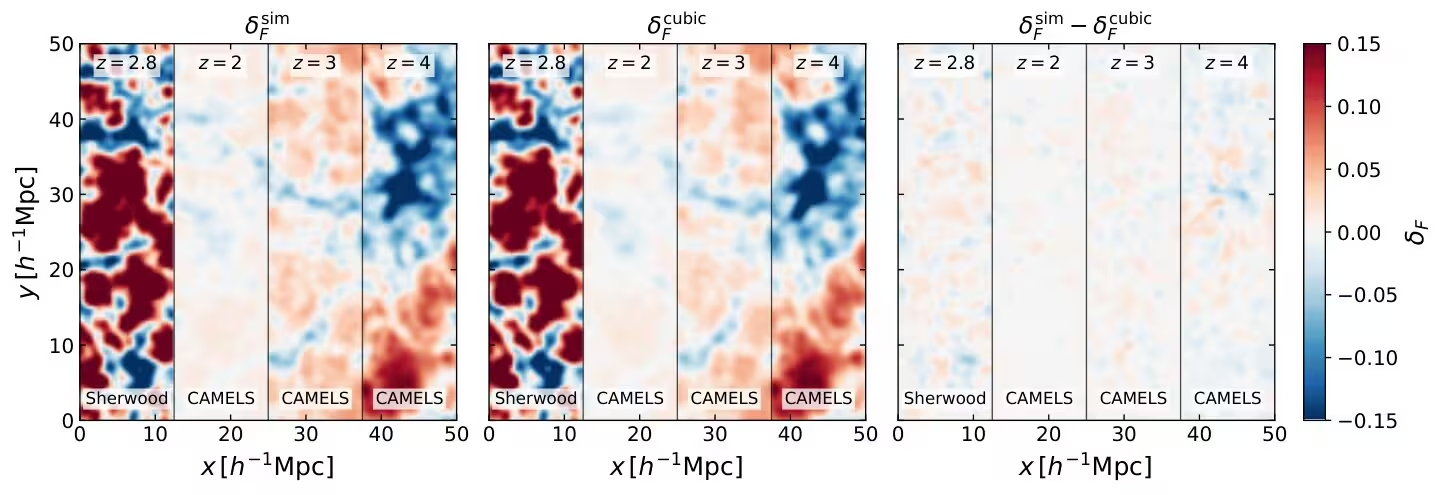
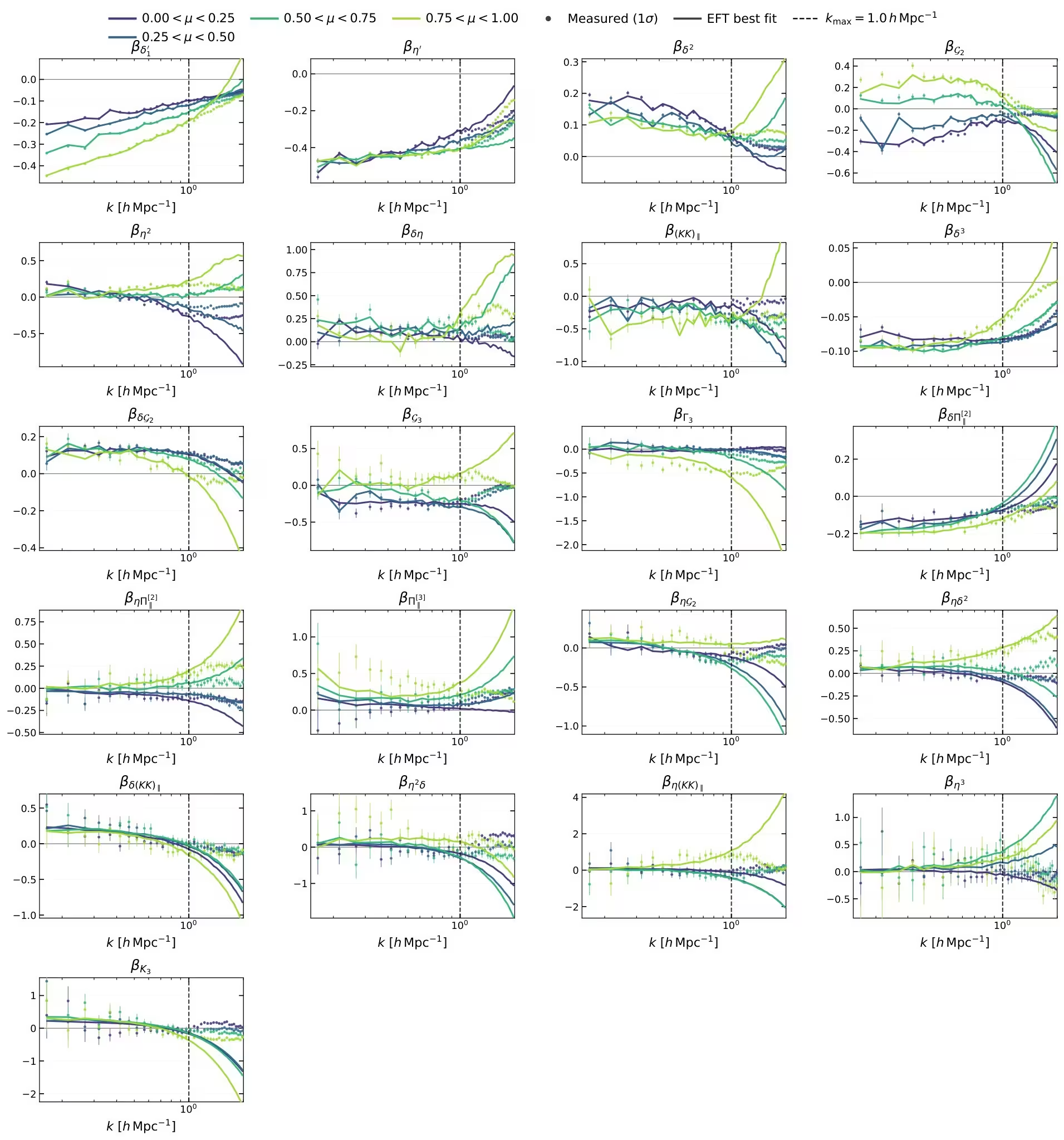
The research team utilized a field-level fitting approach that exploits shared initial conditions between simulations and analytical models to cancel cosmic variance. This technique allows for precise extraction of 22 independent bias parameters at the cubic level. These parameters quantify how neutral hydrogen traces underlying dark matter distributions, providing crucial calibration for cosmological observations across diverse astrophysical environments.
What These Corrections Mean for Baryon Acoustic Oscillations
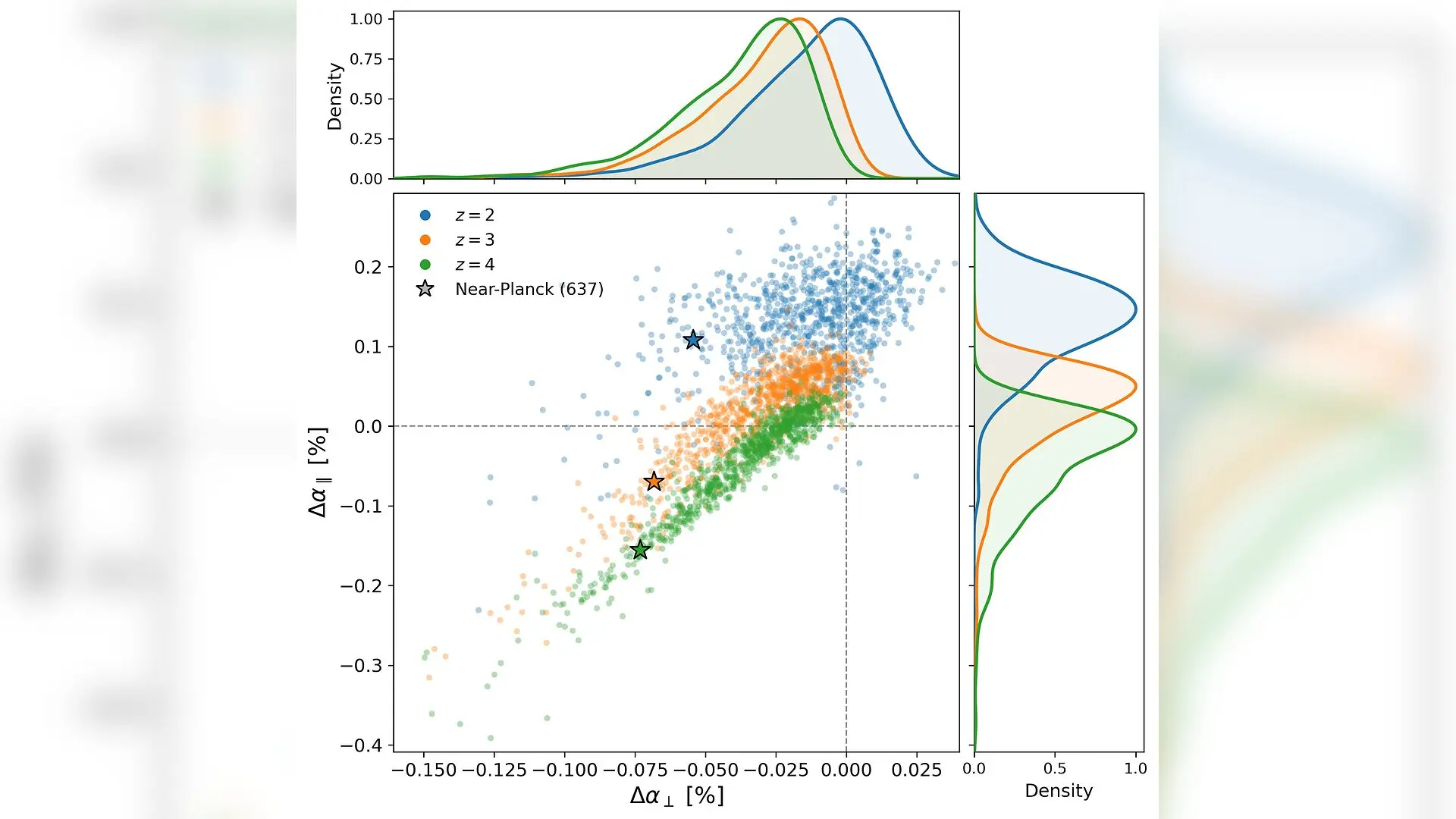
A primary driver for modern sky mapping surveys is the precise measurement of baryon acoustic oscillations, which are primordial sound waves frozen into the matter distribution that serve as a standard ruler for cosmic distances. Non-linear gravitational collapse shifts and damps these acoustic features, introducing potential biases into standard linear analysis models. Using their newly extracted cubic bias coefficients, the authors calculated the resulting shifts in radial and transverse dilation parameters.
The analysis revealed sub-percent shifts in both directions, accompanied by a clear redshift evolution. At a redshift of $z = 2$, the median transverse shift is $-0.0095\%$ and the radial shift is $+0.137\%$, whereas both values trend toward more negative outcomes at higher redshifts. Furthermore, the joint distribution of these shifts displays strong positive correlations across different cosmological parameters, offering vital statistical pathways for constructing simulation-based priors.
Limitations and Future Survey Applications
While the forward model achieves remarkable agreement across simulated environments, the authors note certain limitations regarding simulation resolution and finite-grid effects. Specifically, smaller simulation boxes like those in the CAMELS suite introduce truncation discrepancies in high-momentum Fourier modes that do not affect continuous theoretical calculations. Additionally, these predicted baryon acoustic oscillation shifts should be interpreted as indicative due to the restricted volumes of the underlying training boxes.
Despite these minor constraints, the framework opens up significant opportunities for upcoming cosmological data releases. By capturing the connected four-point function, known as the trispectrum, the cubic model provides a direct route toward accurate covariance matrix estimation for future spectroscopic surveys like DESI-II. Integrating these physics-informed priors will ultimately help researchers break parameter degeneracies and extract fundamental properties such as neutrino masses and non-standard dark matter scenarios from future observations.
The study was posted to the arXiv preprint server on November 12, 2026.
This article has been fact checked for accuracy, with information verified against reputable sources. Learn more about us and our editorial process.
Last reviewed on .
Article history
- Latest version
Reference(s)
- Sharma, Divij. “Simulation-Based Priors and BAO Shifts from the Lyman-$α$ Forest at the Field Level.” arXiv.org <http://arxiv.org/abs/2611.17299v1>.
Cite this page:
- Posted by John Williams