Lunar Dust Threatens Ancient Life Clues: How Future Missions May Erase Billions‑Year Records
Study warns upcoming lunar missions may damage rare clues about life’s origins, urging careful protection of fragile moon evidence.
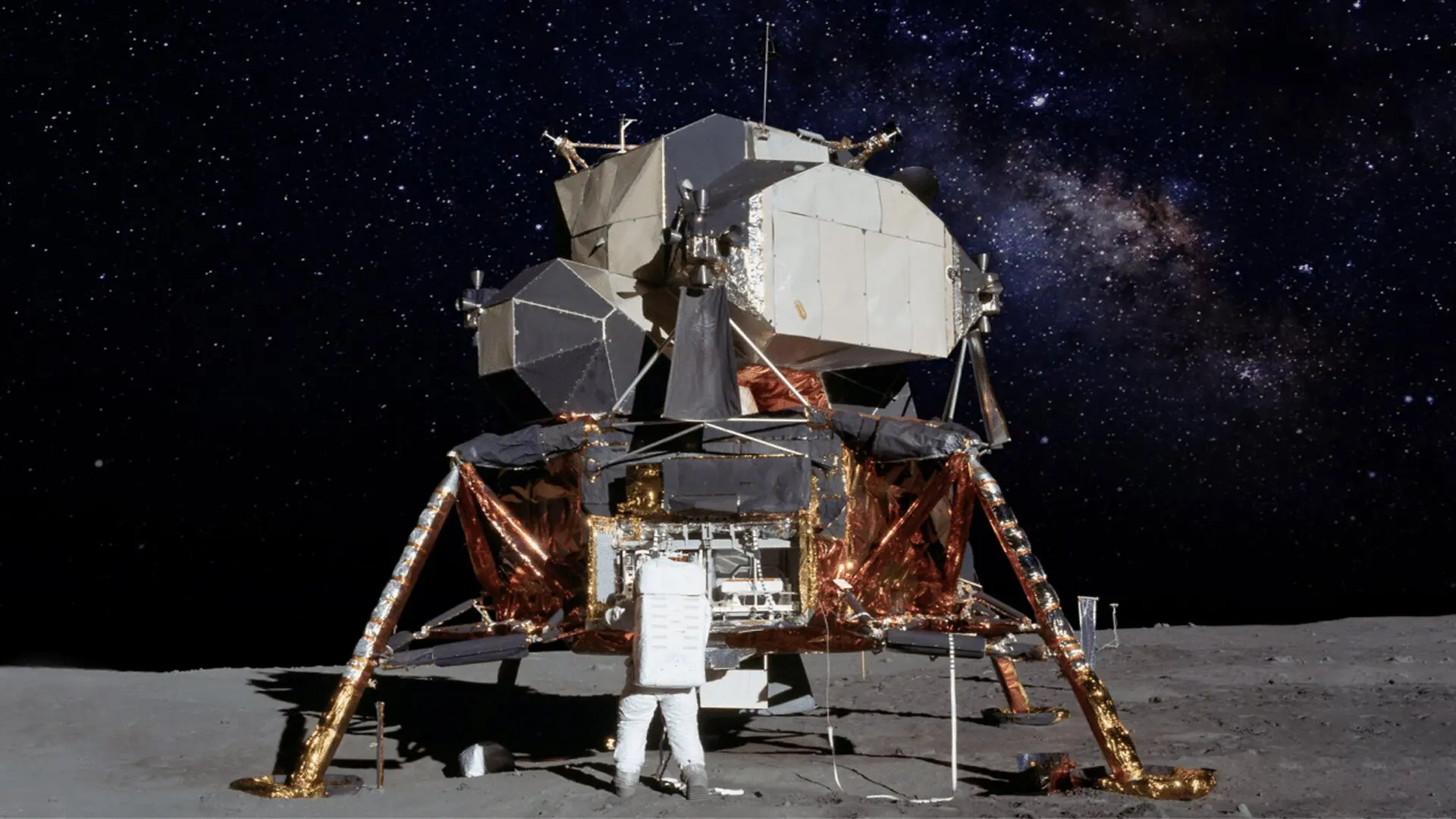
A new analysis published in the Journal of Geophysical Research: Planets warns that upcoming human and robotic trips to the Moon could compromise ancient scientific clues about the origin of life. Researchers highlight that the fine lunar regolith and activities of landers may disturb layers that have remained untouched for billions of years, potentially obscuring future studies of early solar‑system chemistry.
Lunar Missions May Disrupt a Billions‑Year‑Old Archive
The Moon serves as a natural time capsule because its surface lacks wind, rain, oceans and active tectonics that constantly reshape Earth. This stability allows it to retain deposits of extraterrestrial material that have accumulated over eons.
The recent study focuses on how the movement of lunar dust generated during landings and surface operations could spread anthropogenic particles across the regolith. Scientists caution that such redistribution might mask or alter sites that could hold vital information about the chemical environment in which life first emerged.
Published in the Journal of Geophysical Research: Planets, the research models the trajectories of dust and other debris displaced by landers, rovers and future exploration hardware.
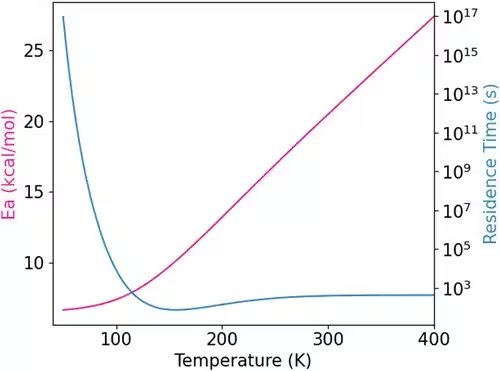
Senior author Silvio Sinibaldi, planetary‑protection officer at the European Space Agency, stresses that protecting lunar sites is essential for safeguarding scientific returns. “We are trying to protect science and our investment in space,” he said. “Our activity can actually hinder scientific exploration.”
The risk is not a single mission erasing all evidence, but the cumulative effect of repeated operations in the same regions, which could make it increasingly difficult to separate natural lunar material from contamination linked to human presence.
Unpredictable Dust Trajectories Challenge Preservation Efforts
Unlike Earth, where atmospheric processes quickly re‑mix surface particles, the Moon’s airless environment allows disturbed material to follow ballistic paths that can carry it far from the original disturbance site.
Lead author Francisca Paiva, a physicist at Instituto Superior Técnico in Portugal, describes the movement as governed by simple physical laws rather than weather‑driven transport.
“Their trajectories are basically ballistic,” Paiva said in the statement. “They just hop around from one point to another.”
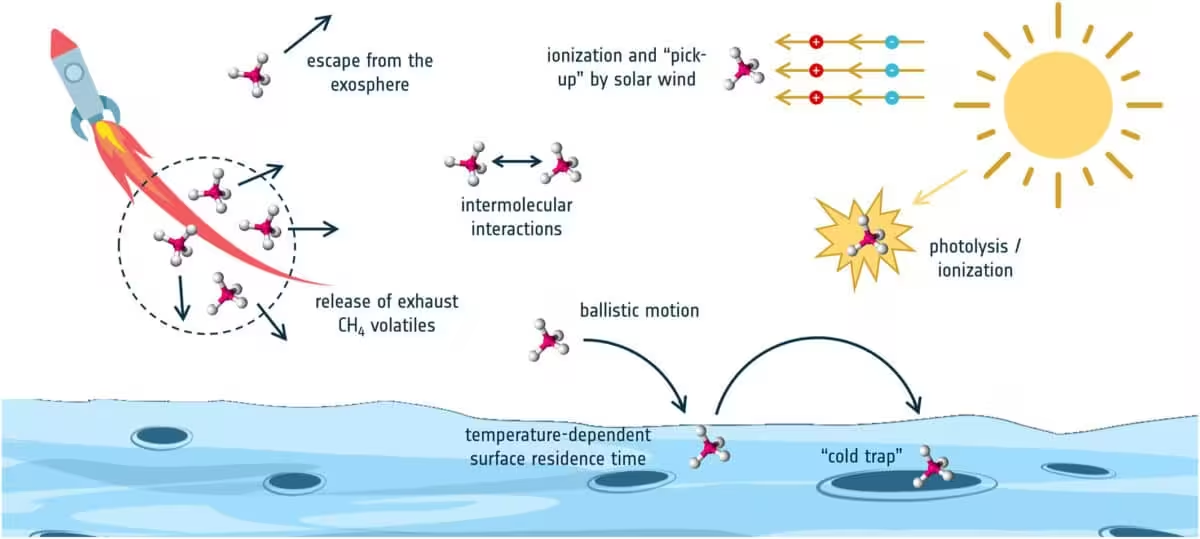
Consequently, dust lofted by a landing could migrate beyond the immediate landing zone, gradually extending human influence into areas that future scientists may wish to examine in their pristine state.
Researchers are especially interested in sites that retain ancient solar‑system deposits, such as asteroid‑derived material that may house organic compounds offering clues about pre‑biotic chemistry.
“We know we have organic molecules in the solar system — in asteroids, for example,” Sinibaldi noted. “But how they came to perform specific functions like they do in biological matter is a gap we need to fill.”
Increasing Emphasis on Lunar Heritage Protection
As nations and private firms gear up for new ventures under initiatives like NASA’s Artemis program, the conversation around safeguarding lunar science grows louder. Planned activities include research outposts, commercial operations and expanded crewed presence.
Scientists argue that exploration and conservation must proceed hand‑in‑hand; the Moon’s record cannot be recreated once altered.
Paiva draws parallels with Earth‑based regulations that limit contamination of fragile environments such as Antarctica and national parks. “We have laws regulating contamination of Earth environments like Antarctica and national parks,” she said. “I think the moon is an environment as valuable as those.”
The team proposes targeted landing zones, strict contamination protocols and designated scientific preserves as ways to reconcile mission goals with the need to keep lunar archives intact.
These safeguards will become more critical as the cadence of lunar missions accelerates, offering fresh discovery opportunities while also presenting new hurdles for researchers aiming to study untouched terrain.
Balancing Discovery with Conservation on Future Moon Missions
The lunar preservation debate echoes a broader dilemma in planetary science: how to explore new worlds without erasing the evidence they contain.
Because the Moon uniquely records planetary formation, impact history and chemical evolution, it may also help resolve how life’s building blocks emerged before Earth became habitable.
Although upcoming missions will inevitably modify the surface, careful planning could limit those changes. Preserving select regions for later study would enable future generations to investigate lunar material with confidence.
As humanity embarks on a new era of off‑Earth activity, striking a balance between curiosity and stewardship will determine whether the Moon continues to serve as a window into the origins of life.
This article has been fact checked for accuracy, with information verified against reputable sources. Learn more about us and our editorial process.
Last reviewed on .
Article history
- Latest version
Reference(s)
- Paiva, Francisca S.., et al. “Can Spacecraft‐Borne Contamination Compromise Our Understanding of Lunar Ice Chemistry?.” Journal of Geophysical Research: Planets, vol. 130, no. 11, November 13, 2025 American Geophysical Union (AGU), doi: 10.1029/2025JE009132. <http://dx.doi.org/10.1029/2025JE009132>.
Cite this page:
- Posted by Aisha Ahmed