Scientists Discover a Space Shortcut That Could Reach Mars in Just 56 Days
Scientists discover an old asteroid trajectory that offers a faster route to Mars, but it demands a massive boost in propulsion power.
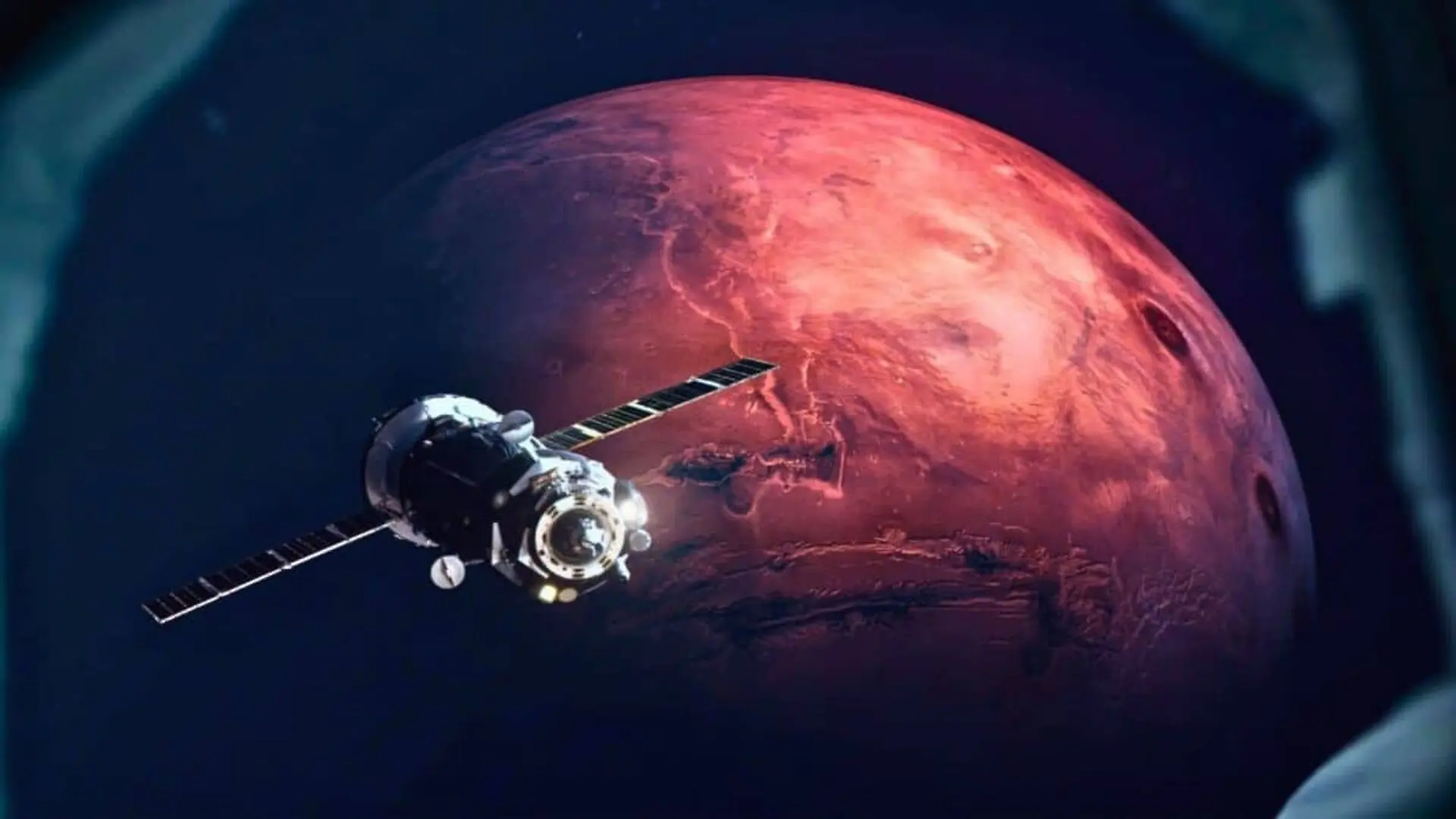
A crewed mission could lift off from Earth on 20 April 2031, coast to Mars in 56 days, spend five weeks exploring the Red Planet, and then fire its engines for a 135‑day return, completing the round trip in just 226 days, according to a study published in Acta Astronautica. This timeline is roughly one‑third of the travel time required by conventional chemical‑propulsion concepts, which typically need seven to nine months for the outbound leg alone.
The 226‑day itinerary – and an even more aggressive 153‑day variant also described in the paper – do not rely on speculative physics or a brand‑new engine. Instead, they exploit a geometric shortcut hidden in legacy orbital data, a shortcut that becomes viable only with propulsion capabilities far beyond today’s chemical rockets.
Legacy Asteroid Orbit Provides a Fast‑Transit Blueprint
Astrophysicist Marcelo de Oliveira Souza of Brazil’s State University of Northern Fluminense built his analysis on the preliminary 2015 orbit of asteroid 2001 CA21. That object follows a low‑inclination ellipse intersecting both Earth’s and Mars’ paths, offering a convenient reference plane for testing extreme transfer trajectories.
Although later observations refined the asteroid’s trajectory, the early orbital solution still serves as a fixed geometric baseline. Souza imposed a strict rule: any Earth‑Mars transfer must remain within five degrees of the asteroid’s orbital plane. He then evaluated the three upcoming Mars‑opposition windows (2027, 2029, and 2031) using a Lambert solver, a standard tool that computes feasible flight paths between two points in space.
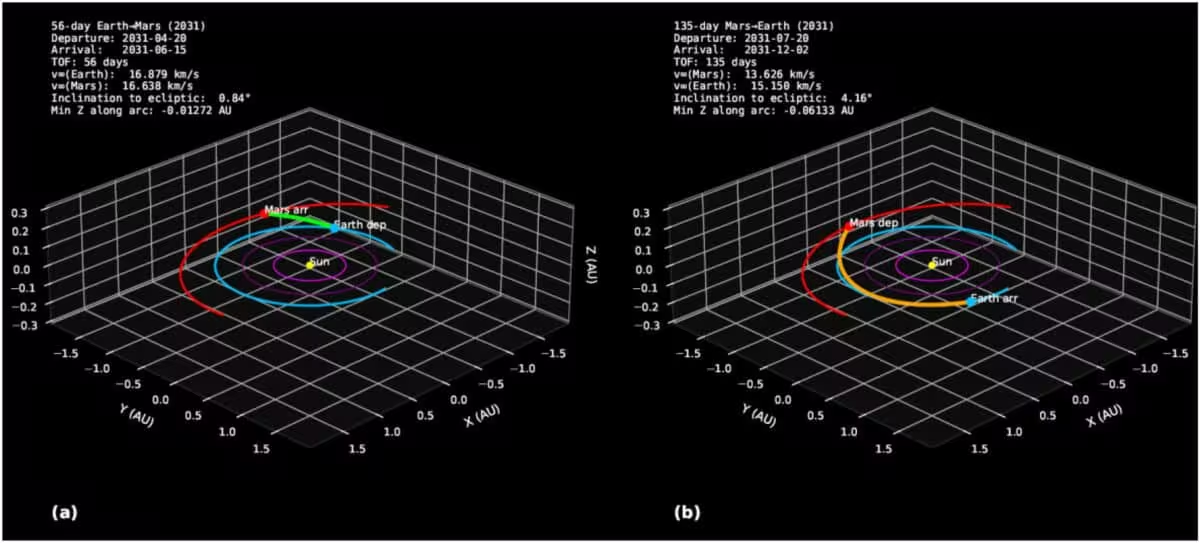
The 2027 and 2029 windows proved impractical – either the required energy was prohibitive or the geometry could not close into a viable return leg. By contrast, the 2031 window yielded two full round‑trip designs, both launching on the same April date.
The first, labeled the “extreme” case, envisions a 33‑day outbound leg, a 30‑day surface stay, and a 90‑day return, totaling 153 days. The second, termed the “feasible rapid” scenario, combines a 56‑day outbound leg, a 35‑day stay, and a 135‑day return for a 226‑day mission. Both designs respect the five‑degree constraint relative to the asteroid’s orbital plane and remain robust even when the underlying asteroid orbit is treated with realistic observational uncertainties.
Propulsion Demands Far Exceed Chemical Rocket Limits
Key to these trajectories is the hyperbolic excess velocity – the speed a spacecraft retains after escaping Earth’s gravity. The 56‑day outbound profile requires roughly 16.9 km s⁻¹ of excess velocity.
Achieving that figure would consume about fifteen times the energy of a typical Mars mission and roughly 1.5 times the launch energy NASA expended for the New Horizons probe, which had a mass of only about half a tonne.
A crewed vehicle would be orders of magnitude heavier, needing life‑support systems, a habitat, and an ascent module for the return, all of which increase the energy budget dramatically.
The 33‑day extreme case pushes the envelope even further, demanding a departure velocity of about 27.5 km s⁻¹ – a value beyond the theoretical limits of any chemical rocket stage ever conceived.
Arrival conditions are equally challenging. The 56‑day outbound leg would strike Mars at roughly 16.6 km s⁻¹, and the return trajectory would re‑enter Earth’s atmosphere at about 15.1 km s⁻¹, imposing heating loads that exceed those encountered by lunar return vehicles and testing the limits of upcoming heat‑shield materials.
Nuclear Thermal Engines Emerge as the Viable Path Forward
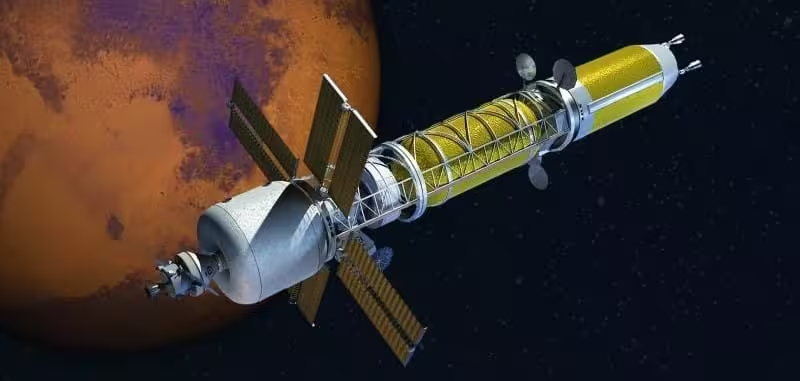
The analysis makes it clear that chemical propulsion cannot meet the energy demands of these fast‑track missions. Instead, it points to nuclear thermal propulsion (NTP), which heats liquid hydrogen in a reactor core and ejects the resulting exhaust at two to three times the specific impulse of conventional chemical engines.
Europe is already advancing this technology. In 2023, France’s research agency CEA launched the “Alumni” feasibility study – a nuclear‑thermal engine concept developed with ArianeGroup, Framatome, and the European Space Agency – explicitly aimed at shortening Mars transit times and reducing astronaut radiation exposure.

A parallel CEA effort called “RocketRoll” explores nuclear electric propulsion, an approach better suited to missions operating far from the Sun where solar power is insufficient. Program manager Xavier Averty notes that CEA has been involved in space‑nuclear systems since the 1980s and is currently the only European organization pursuing both thermal and electric nuclear concepts simultaneously.
Both initiatives target a technology demonstrator around 2035, aligning closely enough with the 2031 launch window identified in the trajectory study to make the fast‑track designs practically relevant, provided the schedule holds.
The Acta Astronautica paper does not present a spacecraft design, mass budget, or detailed entry‑phase analysis. Instead, it demonstrates that a rapid, closed‑loop Earth‑Mars‑Earth trajectory exists within real orbital data and remains viable even when the underlying asteroid orbit is treated with realistic uncertainty.
This article has been fact checked for accuracy, with information verified against reputable sources. Learn more about us and our editorial process.
Last reviewed on .
Article history
- Latest version
Reference(s)
- Souza, Marcelo de Oliveira. “Using asteroid early orbital data for rapid mars missions.” Acta Astronautica, vol. 246, September 1, 2026, pp. 354-366. Elsevier BV, doi: 10.1016/j.actaastro.2026.04.018. <https://www.sciencedirect.com/science/article/pii/S0094576526002456>.
Cite this page:
- Posted by Farah Siddiqui