Scientists Use Ghost Ink to Reveal 42 Lost Pages of 6th‑Century New Testament
Ghostly ink reveals hidden pages of a lost biblical manuscript thought unreadable for centuries.
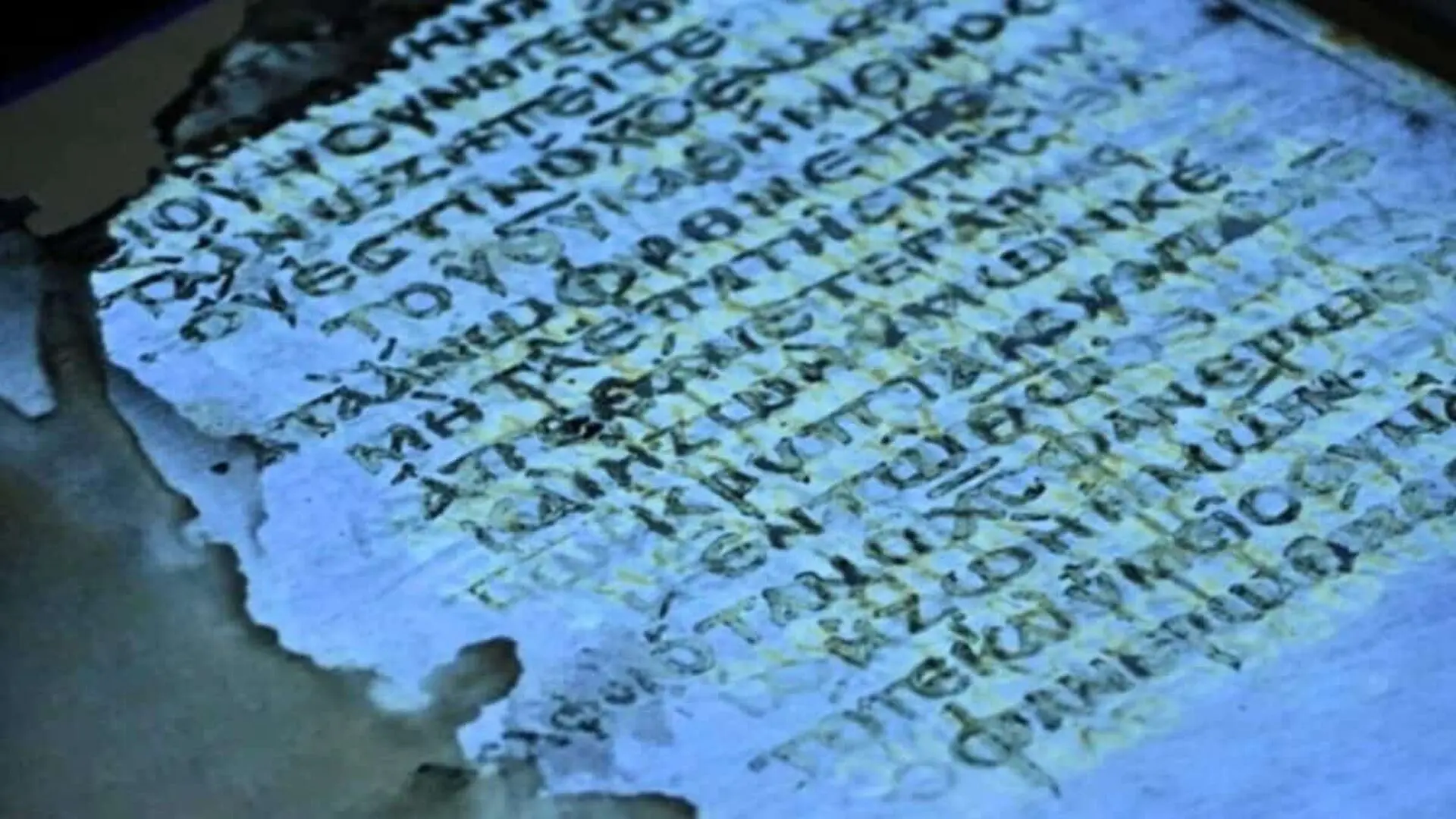
Scholars from the University of Glasgow reported on 24 April 2026 that they have identified and restored 42 previously lost leaves of a 6th‑century Pauline codex, dubbed Codex H, by detecting faint ink transfer that survived a 13th‑century disassembly at a Greek monastery where the vellum was repurposed for bookbinding.
The investigation, led by Professor Garrick Allen, did not rely on newly uncovered fragments. Instead, the team extracted text that no longer appears on any extant page, reconstructing it from subtle chemical residues left when the manuscript was altered. As one of the earliest surviving witnesses to the New Testament, Codex H now offers researchers a rare glimpse into how fledgling Christian communities managed and organized their sacred writings.
Monastic Recycling and the Scattering of Codex H
Produced in the 6th century, the codex was housed for centuries at the Great Lavra Monastery on Mount Athos, Greece. Its eventual fragmentation represented a considerable loss for those tracing the early transmission of Paul’s letters.
When the volume became unusable, the monks did not discard the valuable parchment. Reusing vellum was a common practice once a manuscript could no longer be read, given the material’s durability and expense.
The monks applied fresh ink to the old leaves and repurposed them as flyleaves or binding reinforcement for other texts. This practice dispersed the original material across unrelated volumes, preserving the parchment but rendering the original text inaccessible in its initial format.
Over subsequent centuries the host books travelled far from Athos. Today, surviving fragments of Codex H reside in libraries across Italy, Greece, Russia, Ukraine and France, each preserving only a tiny portion of what was once a single volume.
In the 18th century, the French Benedictine Bernard de Montfaucon first noticed evidence of the lost codex while cataloguing a Paris collection, extracting fourteen leaves of Paul’s epistles from other bindings. Yet the precise wording and layout of most of Codex H remained concealed, obscured by the re‑inking that had originally contributed to its disappearance.
Chemical Traces Reveal Hidden Script
The recovery hinged on a side effect of the medieval re‑inking. When monks introduced new ink, chemicals in the mixture caused what researchers term offset damage.
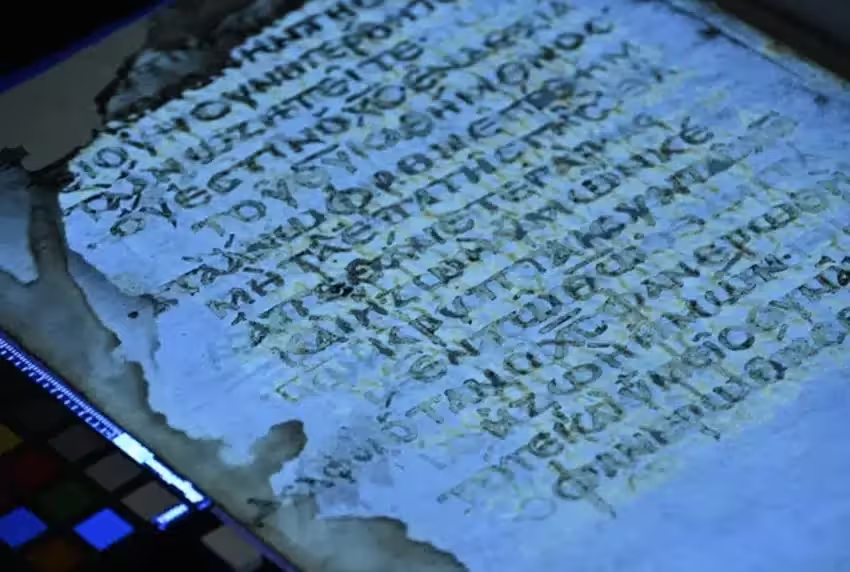
This phenomenon produced a mirror imprint of the original script on the opposite page, sometimes extending several leaves deep. Allen described the effect as “barely visible to the naked eye but very clear with latest imaging techniques.”
These ghostly impressions escaped detection for centuries because they leave no visible mark under normal lighting. The offset text lay hidden on pages that scholars had examined repeatedly without realizing a second layer of writing existed.
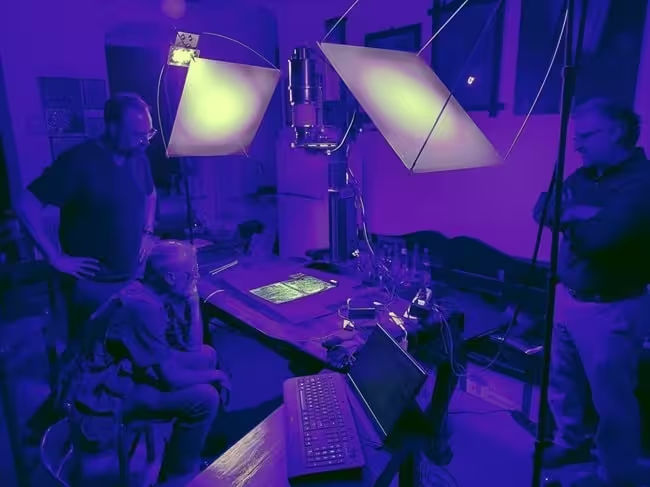
To expose the hidden script, Allen’s team collaborated with the Early Manuscripts Electronic Library and employed multispectral imaging, a method that photographs a page across ultraviolet, visible and infrared bands to reveal features invisible to the eye.
Processing the multispectral data allowed researchers to extract the faint ghost text and effectively recover multiple writing layers from each surviving leaf. Specialists in Paris then performed radiocarbon dating on the parchment, confirming a 6th‑century origin and anchoring the discovery within early manuscript production.
Early Chapter Lists and Scribal Annotations Illuminate Reading Practices
While the recovered leaves do not alter the wording of Paul’s letters, they shed light on how those texts were organized and accessed by early readers.
Among the most significant findings are some of the earliest known chapter lists for Paul’s epistles, part of a navigational system that pre‑dated modern page numbers. According to the Daily Galaxy, this system—known as the Euthalian apparatus—also included prologues and quotation markers.
The division scheme employed in this early apparatus differs markedly from the chapter numbers familiar to modern readers, offering scholars a clearer view of how the text was segmented and referenced long before standardized chapter numbering emerged.
The fragments also contain corrections and marginal notes added by 6th‑century scribes, indicating active engagement with the text rather than mere mechanical copying. These annotations demonstrate individual readers interacting with and refining the manuscript over time.
Combined with the codex’s physical journey, the newly revealed pages illustrate a broader medieval practice: when a manuscript wore out, monastic communities often salvaged its parchment for practical reuse. Allen characterised the scale of the recovery as “nothing short of monumental,” given Codex H’s established importance for understanding early Christian scripture.
Digital Edition Opens Access to Restored Leaves
Funding for the project came from the Templeton Religion Trust and the UK Arts and Humanities Research Council, with cooperation from the Great Lavra Monastery, which still retains portions of the codex.
A printed edition of Codex H is in preparation, and a digital edition is already freely accessible. This platform allows scholars and the public to examine the recovered material for the first time in centuries without travelling to the various libraries that house the remaining fragments.
The Christian Post noted that the manuscript’s condition provides insight into how damaged sacred texts were repaired and repurposed in the medieval period, rather than being discarded once they became unusable.
This article has been fact checked for accuracy, with information verified against reputable sources. Learn more about us and our editorial process.
Last reviewed on .
Article history
- Latest version
Reference(s)
- “42 lost pages of the new testament manuscript discovered.” <https://www.gla.ac.uk/news/headline_1263245_en.html>.
- “Annotating the New Testament.” <https://codexh.arts.gla.ac.uk/>.
Cite this page:
- Posted by Zara Tariq