Super‑Kamiokande Finds Strongest Hint of Cosmic Neutrino Background From Ancient Supernovae
A faint signal in 5,000 days of data may provide the strongest hint yet of a cosmic neutrino background from countless supernova explosions.
After almost 14 years of continuous monitoring, the Super‑Kamiokande detector in Japan has reported the most compelling hint yet of a faint neutrino glow that pervades the universe. The signal, emerging from an analysis of nearly 5,000 days of data, may represent the first glimpse of the Diffuse Supernova Neutrino Background (DSNB), a relic of countless stellar explosions that could reshape our picture of star formation, black‑hole birth, and cosmic chemistry.
A Universe‑Wide Neutrino Whisper
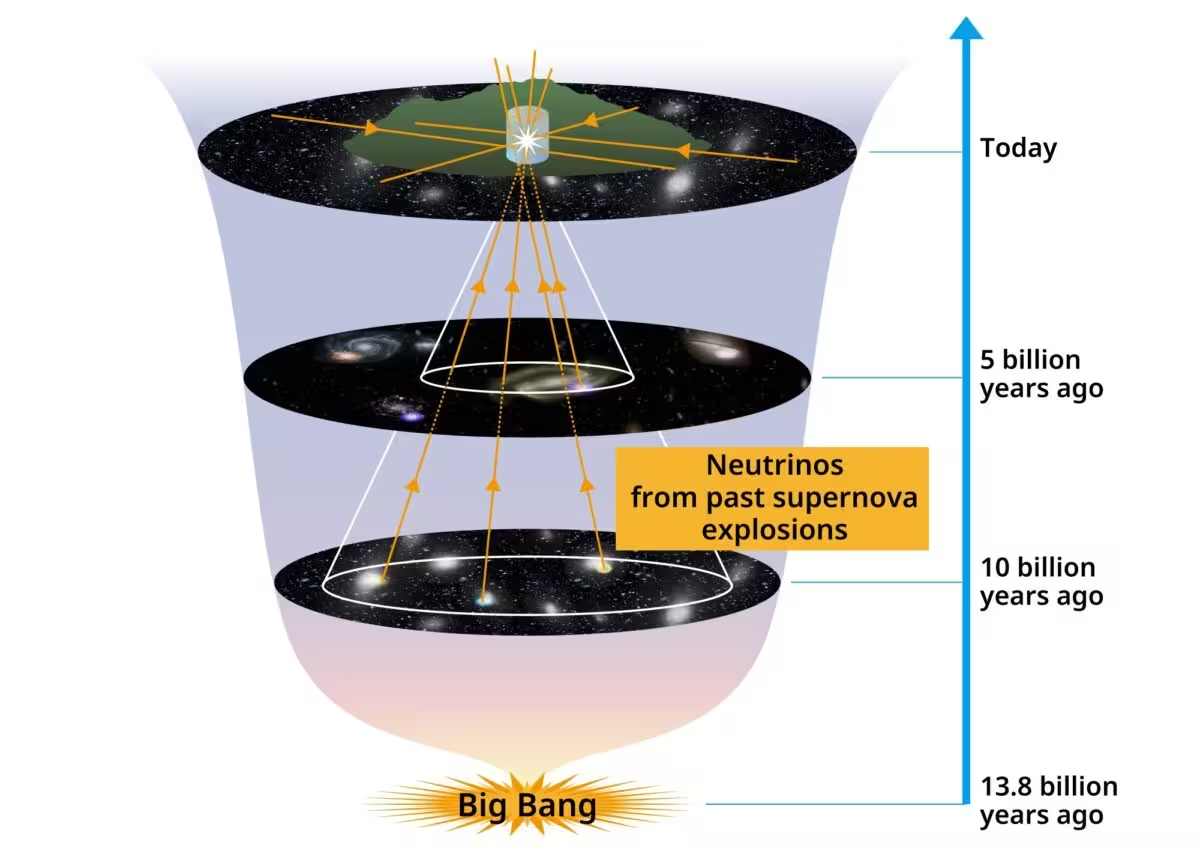
Every few seconds, massive stars end their lives in core‑collapse supernovae, releasing bursts of light and a torrent of neutrinos. While photons are absorbed or scattered by interstellar matter, neutrinos sail through galaxies and planets virtually unimpeded, preserving a record of the explosions that generated them. Over billions of years these particles have accumulated into a diffuse background that is incredibly difficult to detect, yet its observation would provide a direct tally of stellar deaths across cosmic time and a test of models that link star formation to element synthesis.
Because neutrinos interact so weakly, even the largest underground detectors expect only a few genuine events after many years of observation. This scarcity makes the DSNB one of the most demanding targets in particle astrophysics, but also one of the most informative if finally captured.
How Super‑Kamiokande Captures Elusive Particles
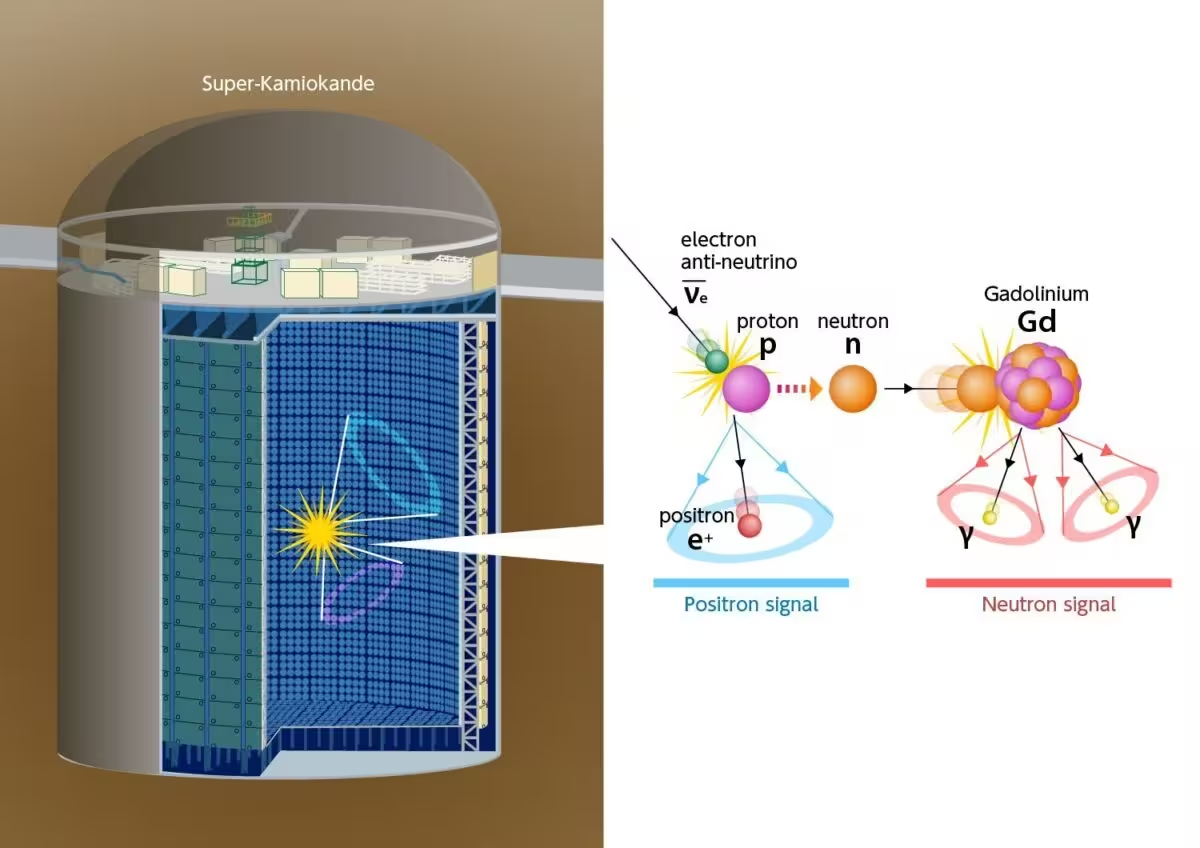
Buried about a kilometre beneath Gifu Prefecture, Japan, Super‑Kamiokande houses a 50‑kiloton tank of ultrapure water surrounded by roughly 13,000 photomultiplier tubes. When a neutrino collides with a water molecule, the resulting charged particle emits a brief flash of Cherenkov light that the tubes record. The latest analysis combines data from two operational phases, one of which includes a modest amount of gadolinium dissolved in the water. Gadolinium enhances the detector’s ability to spot electron antineutrinos by making neutron captures more conspicuous, thereby suppressing background events that can masquerade as genuine signals.
The collaboration’s findings were unveiled at Neutrino 2026: XXXII International Conference on Neutrino Physics and Astrophysics in Irvine, California, and are documented in a presentation hosted on the conference portal. The effort involves roughly 250 scientists from about 60 institutions worldwide.
A 2.6‑Sigma Hint, Not Yet a Discovery
The analysis reveals an excess of events in the energy window from 13.3 to 81.3 MeV that reaches a statistical significance of 2.6 sigma, equivalent to a 99.5 % confidence level. While this level of significance makes a pure statistical fluctuation unlikely, it falls short of the 5‑sigma standard typically required to claim a discovery in particle physics. Consequently, the team presents the result as an indication of the DSNB rather than a definitive detection.
If subsequent data strengthen the signal, astronomers could employ neutrinos as a novel probe of the universe’s star‑formation history, the birth rate of neutron stars and black holes, and the distribution of heavy elements across galaxies. Unlike electromagnetic observations, neutrinos would offer a view of stellar death that is largely untouched by intervening matter.
Looking Ahead to Hyper‑Kamiokande
The collaboration is already planning to augment Super‑Kamiokande’s dataset with measurements from its forthcoming successor, Hyper‑Kamiokande, whose larger volume promises markedly improved sensitivity to rare neutrino events. “We are already planning on incorporating ongoing observations at Super‑Kamiokande together with its successor detector, Hyper‑Kamiokande, to further improve sensitivity in future collaborative studies,” says Yosuke Ashida, assistant professor at Tohoku University.
As the combined exposure grows and detector technologies evolve, researchers anticipate separating true cosmic neutrinos from residual backgrounds with greater confidence. A confirmed observation of the DSNB would mark the first direct measurement of the cumulative neutrino output of all core‑collapse supernovae, delivering unprecedented insight into the life cycles of massive stars, the genesis of compact objects, and the long‑term chemical evolution of the observable universe.
This article has been fact checked for accuracy, with information verified against reputable sources. Learn more about us and our editorial process.
Last reviewed on .
Article history
- Latest version
Reference(s)
- “Neutrino 2026: XXXII International Conference on Neutrino Physics and Astrophysics.” Indico Global (Indico) <https://indico.global/event/15740/contributions/155621/>.
Cite this page:
- Posted by Farah Siddiqui