High School Student Uses AI to Uncover 1.5 Million Potential Cosmic Objects in NASA Data
A Pasadena teen used AI to scan 200 billion NEOWISE detections, turning a summer project into a significant astronomical discovery.
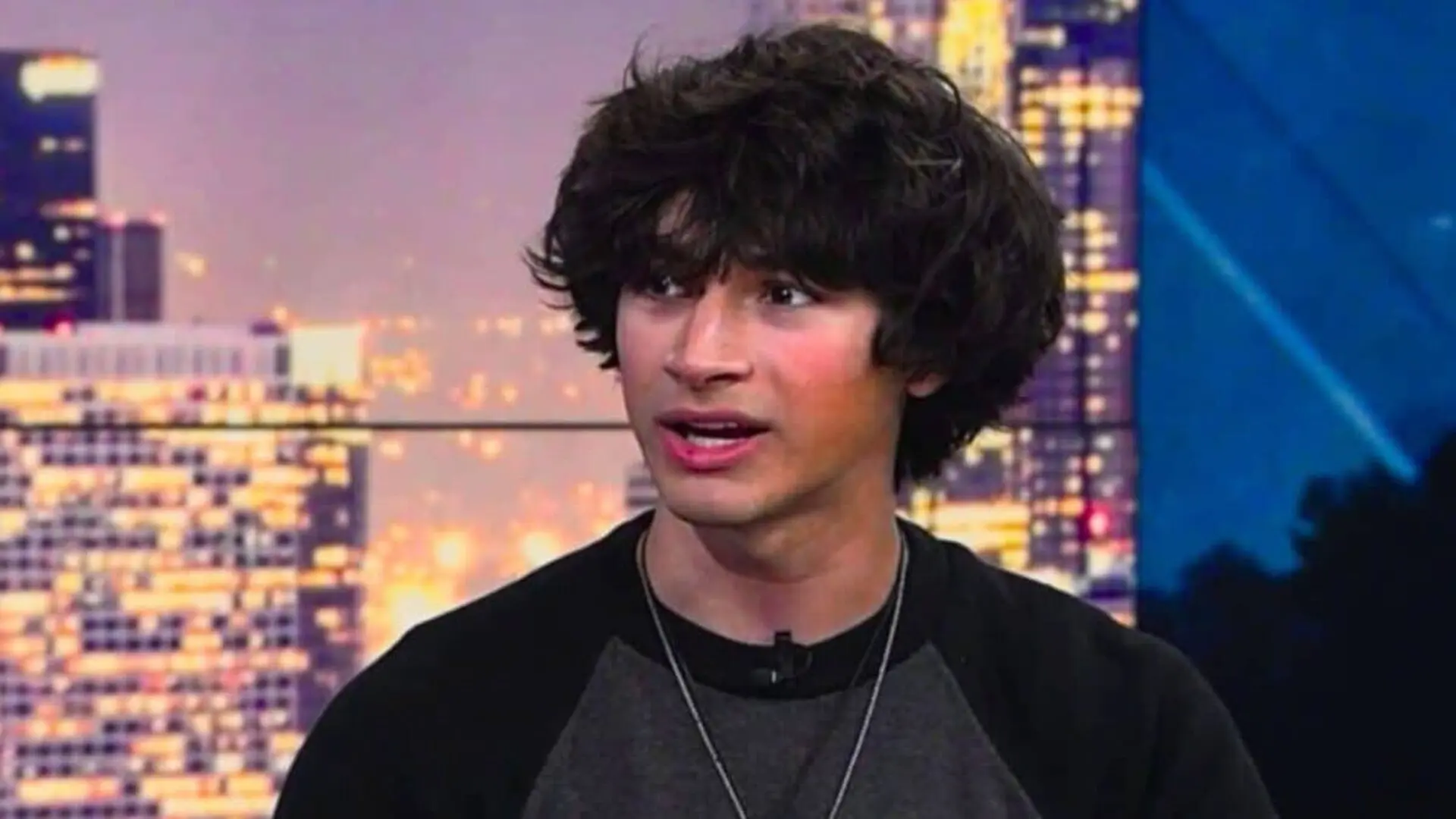
A high school student from Pasadena has utilized artificial intelligence to sift through one of the most massive archives in modern astronomy, identifying 1.5 million potential variable celestial objects within data captured by NASA’s decommissioned NEOWISE telescope.
Matteo Paz, who was a student at Pasadena High School at the time, developed the sophisticated machine learning model while participating in research at Caltech. The project, which originated as a brief summer internship, evolved into a single-author, peer-reviewed study published in The Astronomical Journal. This achievement earned Paz the top prize of $250,000 at the 2025 Regeneron Science Talent Search.
It is important to note that the 1.5 million figure represents candidate objects identified by the algorithm rather than confirmed astronomical breakthroughs. As indicated in a February 2026 report on the research, these candidates require rigorous follow-up observations, as some may represent previously cataloged sources or technical false positives.
Scaling a Targeted Research Task into a Sky-Wide Hunt
Paz’s journey into astronomical data science began during the 2023 Caltech Summer Research Connection program. He was paired with Davy Kirkpatrick, an IPAC staff scientist with a focus on low-mass stars, brown dwarfs, and the solar neighborhood. Kirkpatrick had long been interested in the vast, untapped potential of the NEOWISE infrared archive.
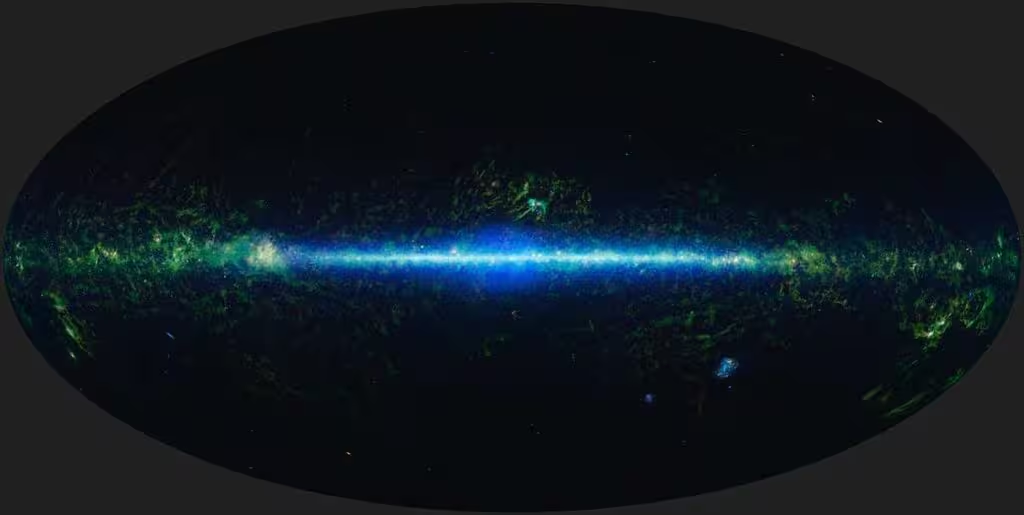
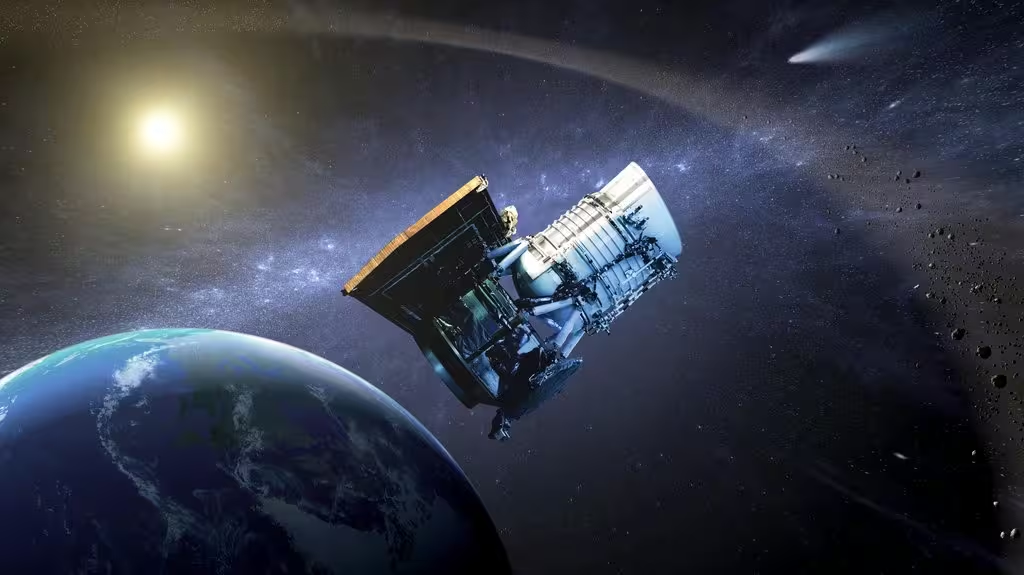
Over its decade-long mission, the NEOWISE telescope performed a systematic survey of the entire sky to track asteroids and near-Earth objects. However, its infrared sensors also captured the fluctuating light of distant quasars, supernovae, and eclipsing binary star systems. The challenge, according to Kirkpatrick, was the sheer volume of data, which had ballooned to nearly 200 billion individual measurements. While the original plan was for Paz to analyze a small, manageable portion of the sky, the student proposed a more ambitious approach: developing an automated system to scan the entire dataset.
Paz, who had been studying advanced undergraduate mathematics through the Pasadena Unified School District’s Math Academy, combined his background in coding and theoretical computer science to build the model. Throughout the process, he worked alongside Caltech researchers Shoubaneh Hemmati, Daniel Masters, Ashish Mahabal, and Matthew Graham to refine his understanding of variable astronomical phenomena.
Engineered for Speed: The VARnet Architecture
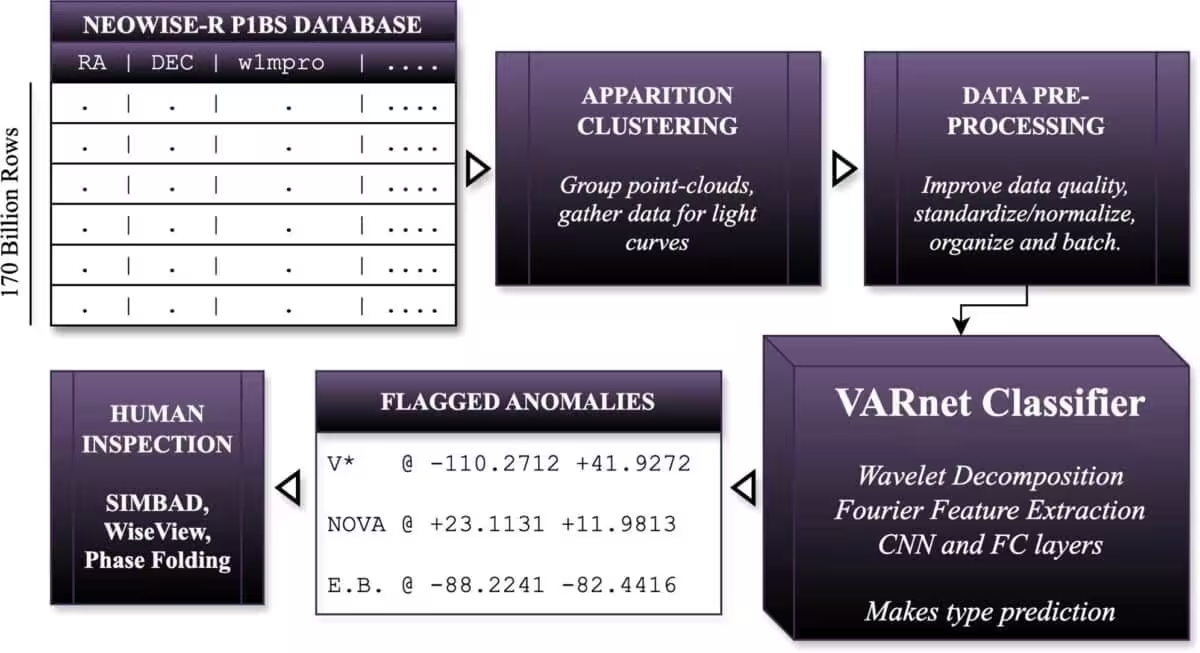
The resulting tool, dubbed VARnet, is designed to analyze time-series data with extreme efficiency. By integrating Fourier-based signal processing, wavelet decomposition, and neural networks, the system can extract potential variable candidates from the NEOWISE archive at record speed.
The research, published in The Astronomical Journal, highlights that the model operates in less than 53 microseconds per source when running on a dedicated GPU. With an F1 score of 0.91 on known validation sets, the tool proved robust enough to scale up from a single field of view to the entire archive.
While the model is highly effective, it remains constrained by the inherent limitations of the NEOWISE mission. Because the telescope surveyed the sky at a fixed cadence, transient events that occurred too rapidly or phenomena that changed too slowly were difficult to classify. If the telescope did not capture enough data points to establish a clear pattern, the model could not definitively categorize the source.
From Classroom to Career
Paz’s involvement with Caltech predates his high school research, having participated in the institute’s Planet Finder Academy in 2022. Following his successful summer project, he continued to collaborate with the team at IPAC, eventually joining them as a professional employee. This transition from a high school student participating in a summer workshop to a paid researcher at the institution that manages NASA’s infrared data archives highlights the impact of his work.

The successful deployment of VARnet underscores the growing importance of AI-driven tools in managing the “big data” problem currently facing modern astronomy. By automating the identification of variable sources, researchers can now dedicate their time to analyzing significant discoveries rather than manually reviewing trillions of data points.
This article has been fact checked for accuracy, with information verified against reputable sources. Learn more about us and our editorial process.
Last reviewed on .
Article history
- Latest version
Reference(s)
- “Exploring Space with AI.”, April 11, 2025 California Institute of Technology <https://www.caltech.edu/about/news/exploring-space-with-AI>.
- Paz, Matthew. “A Submillisecond Fourier and Wavelet-based Model to Extract Variable Candidates from the NEOWISE Single-exposure Database.” The Astronomical Journal, vol. 168, no. 6, November 7, 2024, pp. 241 American Astronomical Society, doi: 10.3847/1538-3881/ad7fe6. <https://iopscience.iop.org/article/10.3847/1538-3881/ad7fe6>.
Cite this page:
- Posted by Aisha Ahmed