Astronomers Calculate There Are 40 Quintillion Black Holes in the Observable Universe
A new cosmic census estimates that 40 quintillion stellar black holes exist throughout the universe, with many forming within dense star clusters.
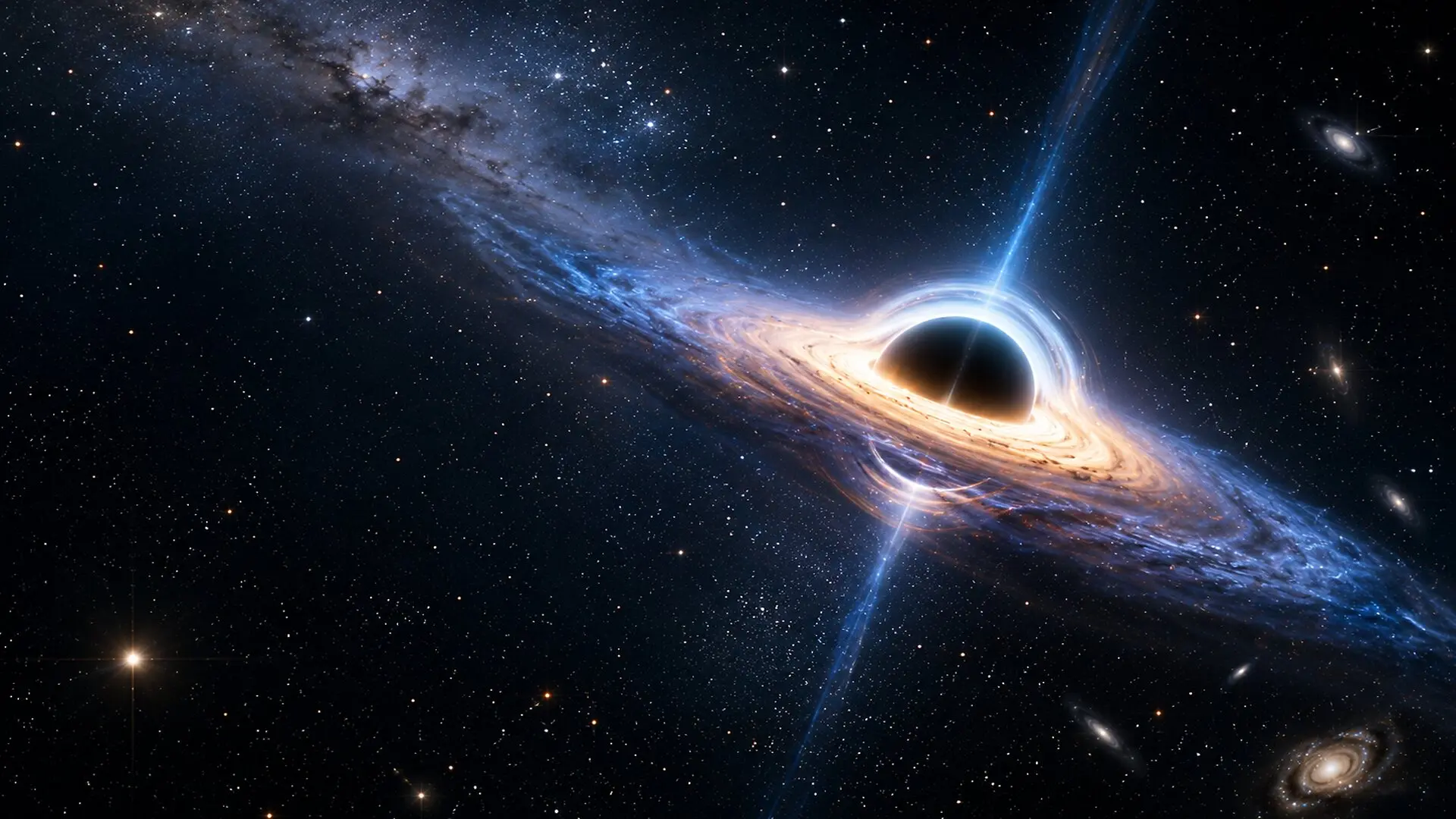
Astronomers have unveiled a staggering new census of the cosmos, estimating that approximately 40 quintillion stellar-mass black holes reside within the observable universe. This massive population, represented by the number 4 followed by 19 zeros, suggests that these elusive gravitational powerhouses account for nearly 1% of all ordinary baryonic matter in existence.
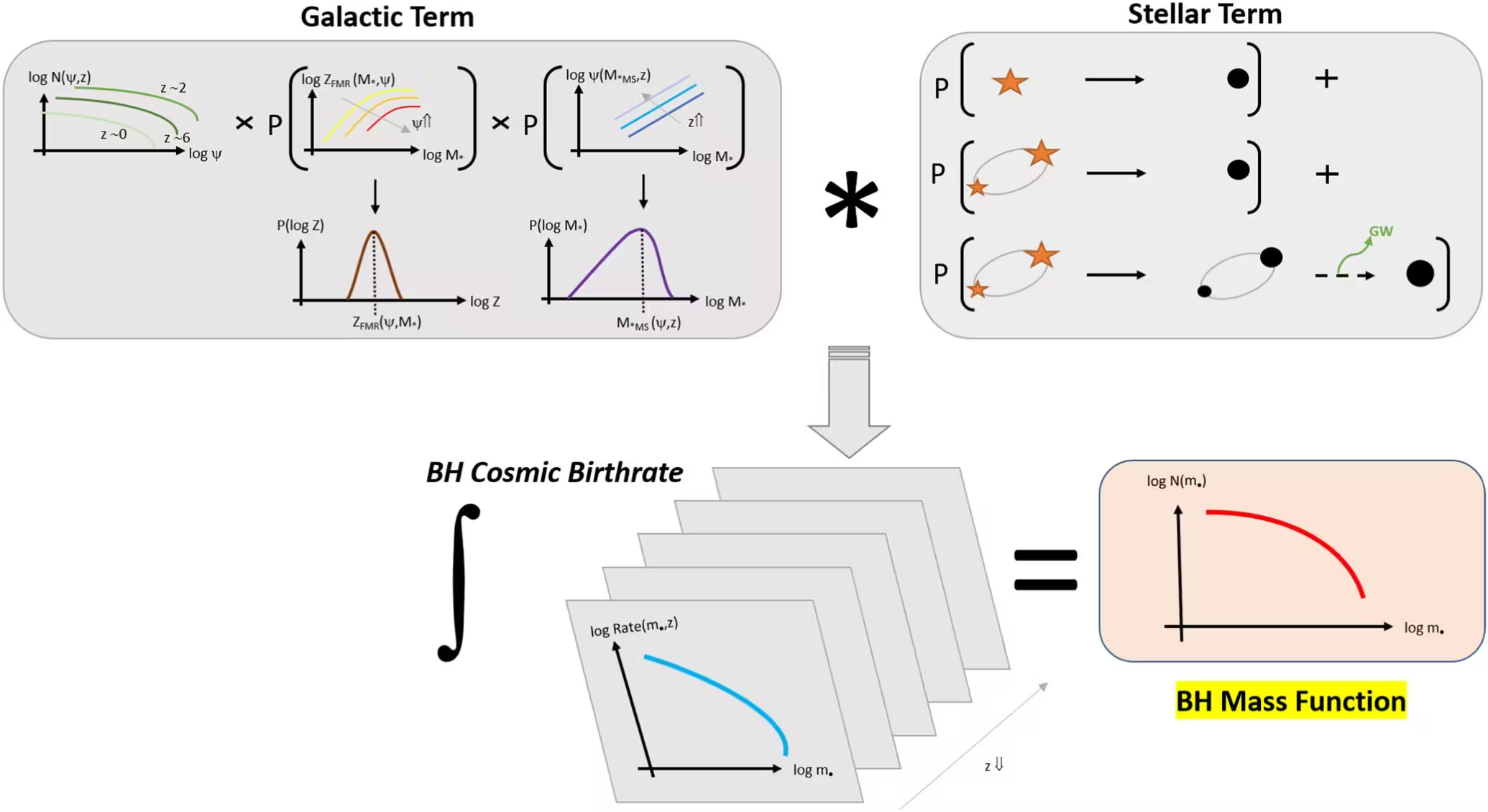
The findings, detailed in The Astrophysical Journal, represent a departure from traditional observational methods. Because black holes do not emit light, counting them directly is impossible. Instead, a research team led by Alex Sicilia at the International School for Advanced Studies (SISSA) in Italy reconstructed the life cycles of stars and galaxies throughout cosmic time to determine how many black hole “relics” should theoretically exist.
Mapping the Cosmic Population
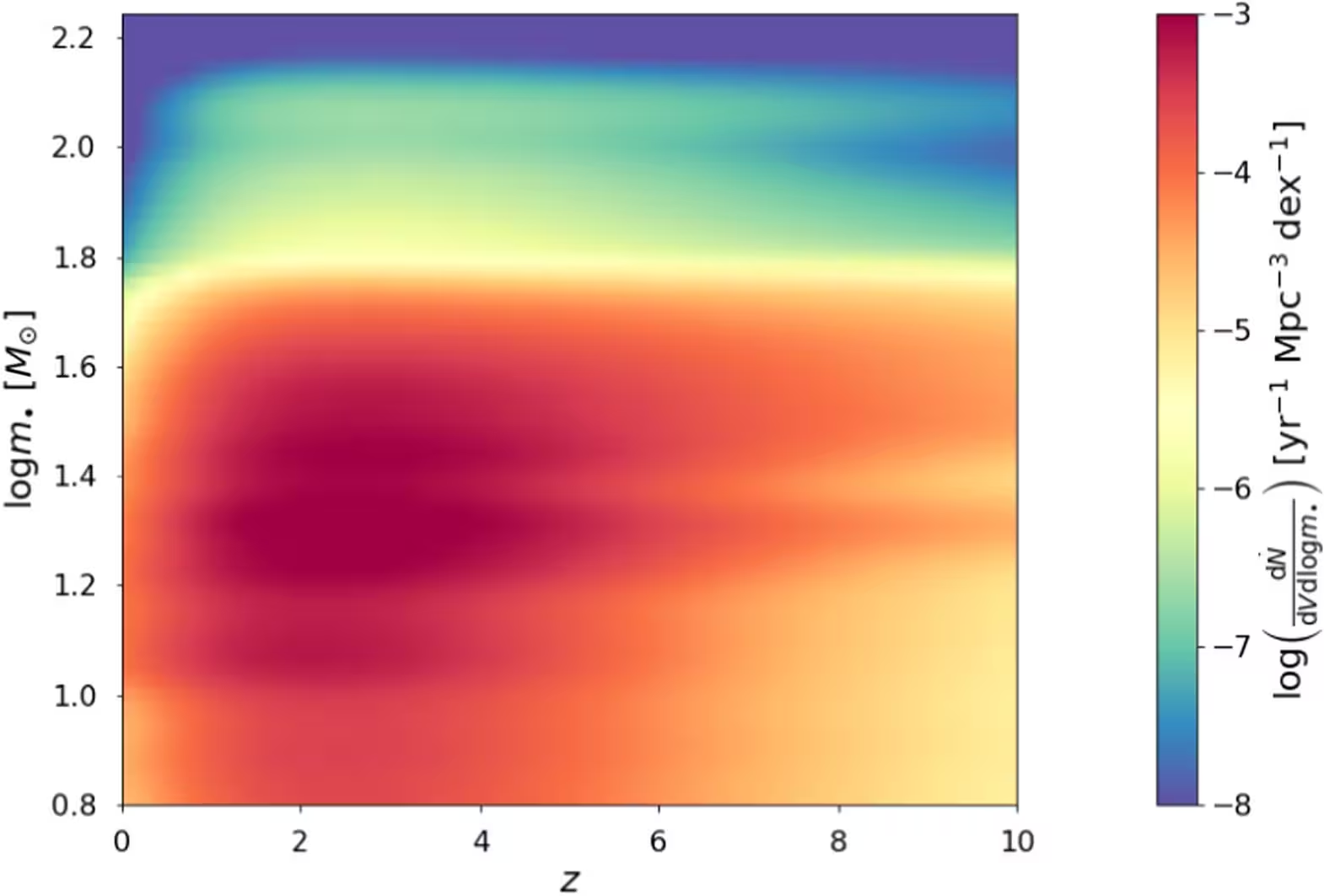
The study specifically focused on stellar-mass black holes—remnants of massive stars ranging from 5 to 150 times the mass of the Sun. To build their model, the researchers integrated the SEVN stellar and binary evolution code with data on star formation rates, galactic metallicities, and stellar masses across different cosmic epochs.
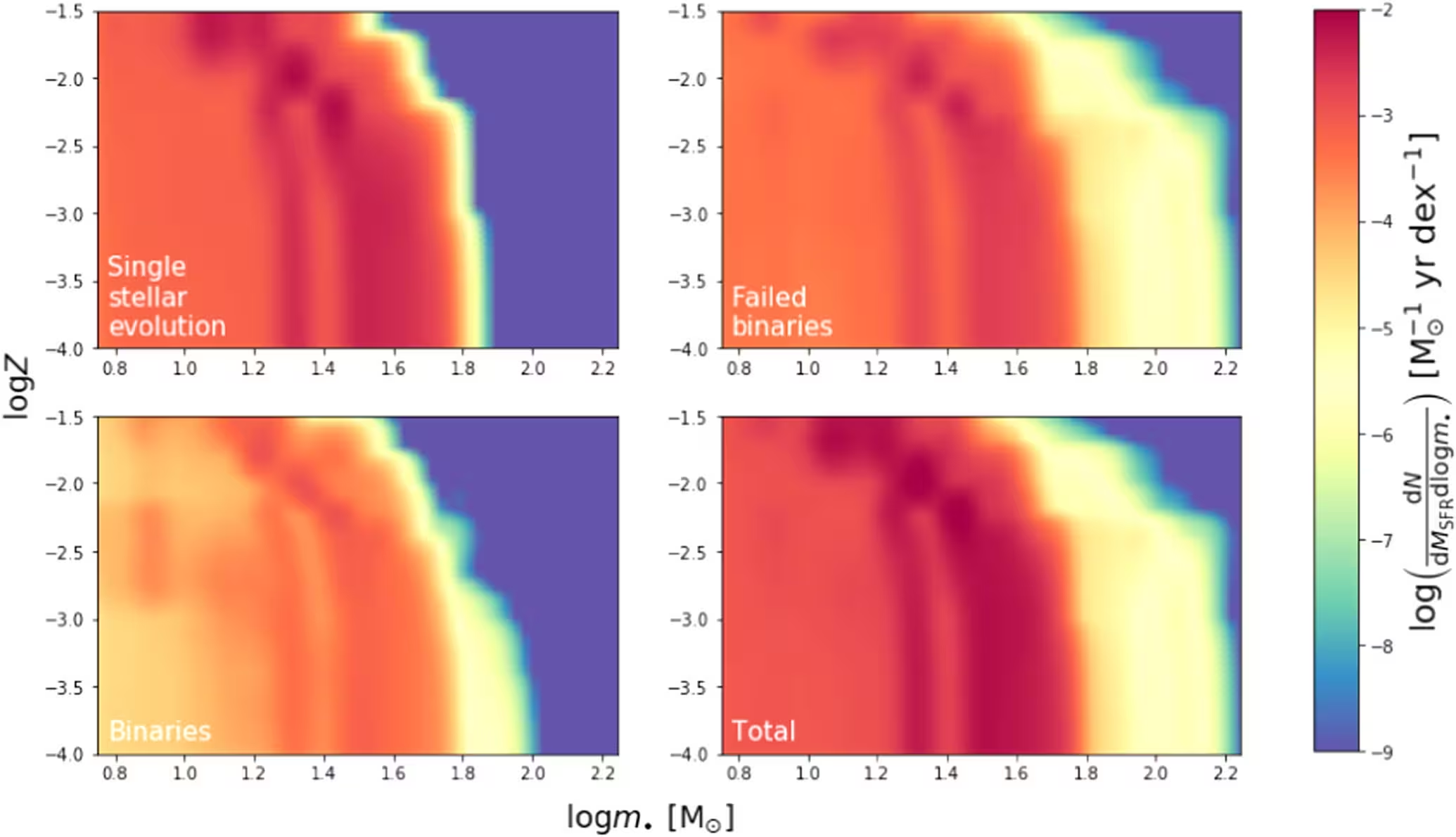
“The innovative character of this work is in the coupling of a detailed model of stellar and binary evolution with advanced recipes for star formation and metal enrichment in individual galaxies,” Sicilia explained. The resulting model accounts for black holes born from isolated stars as well as those originating from complex binary systems where one companion may be consumed or ejected.
Insights from Galactic Evolution
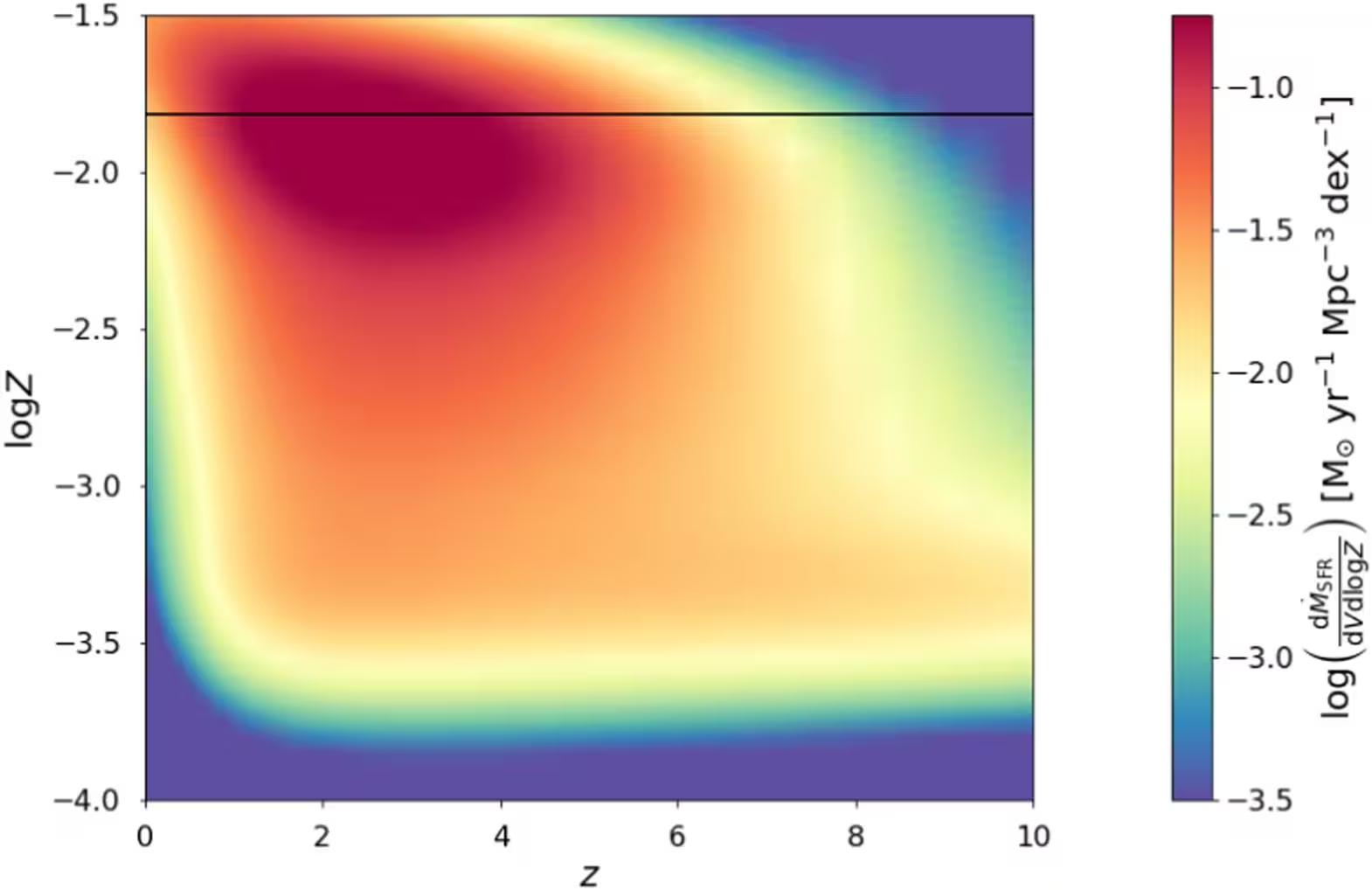
The distribution of these black holes is heavily influenced by metallicity, which dictates how stars lose mass via winds and how they eventually collapse. The researchers found that most stellar-mass black holes fall within a range of 20 to 50 solar masses. However, in the early universe, where metallicities were typically lower, larger black holes were more prevalent.
The team’s analysis also highlights the critical role of dense star clusters. While models of isolated binary evolution match gravitational-wave observations up to about 40 solar masses, they fail to explain the heavier remnants detected by the LIGO and Virgo collaborations. The researchers argue that dynamic interactions in crowded star clusters—where black holes can swap partners or merge repeatedly—are likely responsible for these heavier objects.
Seeds of Supermassive Giants
Beyond providing a headcount, this research offers a potential explanation for how supermassive black holes achieved such enormous sizes in the early universe. The study identifies a population of stellar-mass black holes forming at high redshifts that could act as “light seeds,” providing the foundational mass required for the rapid growth of the gargantuan black holes observed by telescopes like the James Webb Space Telescope.
Essential Research References
- GWTC-5.0: Population Properties of Merging Compact Binaries (LIGO-Virgo-KAGRA, 2026)
- Evidence of the pair-instability gap from black-hole masses (Nature, 2026)
- Gravitational-wave constraints on the pair-instability mass gap (Nature Astronomy, 2026)
- GW231123: A Binary Black Hole Merger with Total Mass 190–265 M⊙ (The Astrophysical Journal Letters, 2025)
- Stellar-Mass Black Holes (Symmetry, 2025)
This article has been fact checked for accuracy, with information verified against reputable sources. Learn more about us and our editorial process.
Last reviewed on .
Article history
- Latest version
Reference(s)
- Sicilia, Alex., et al. “The Black Hole Mass Function Across Cosmic Times. I. Stellar Black Holes and Light Seed Distribution.” The Astrophysical Journal, vol. 924, no. 2, January 12, 2022, pp. 56 American Astronomical Society, doi: 10.3847/1538-4357/ac34fb. <https://iopscience.iop.org/article/10.3847/1538-4357/ac34fb>.
- Collaboration, The. “GWTC-5.0: Population Properties of Merging Compact Binaries.” arXiv.org <https://arxiv.org/abs/2605.27226>.
- Tong, Hui. “Evidence of the pair-instability gap from black-hole masses - Nature.”, vol. 652, no. 8111, pp. 874-877. Nature, doi: 10.1038/s41586-026-10359-0. <https://www.nature.com/articles/s41586-026-10359-0>.
- Antonini, Fabio. “Gravitational-wave constraints on the pair-instability mass gap and nuclear burning in massive stars - Nature Astronomy.”, vol. 10, no. 7, pp. 1049-1056. Nature, doi: 10.1038/s41550-026-02847-0. <https://www.nature.com/articles/s41550-026-02847-0>.
- Abac, A. G.., et al. “GW231123: A Binary Black Hole Merger with Total Mass 190–265 M ⊙.” The Astrophysical Journal Letters, vol. 993, no. 1, October 27, 2025, pp. L25 American Astronomical Society, doi: 10.3847/2041-8213/ae0c9c. <https://doi.org/10.3847/2041-8213/ae0c9c>.
- Bambi, Cosimo. “Stellar-Mass Black Holes.” Symmetry, vol. 17, no. 9, August 26, 2025, pp. 1393 MDPI AG, doi: 10.3390/sym17091393. <https://doi.org/10.3390/sym17091393>.
Cite this page:
- Posted by Aisha Ahmed