Pulsar Signals May Reveal Secrets of the Universe’s First Dark Stars
Astronomers are investigating a faint gravitational-wave signal that may hold the key to uncovering how the universe’s first giant black holes formed.
New research suggests that the low-frequency hum of gravitational waves detected by pulsar timing arrays may hold vital clues about the genesis of the Universe’s most massive black holes. By analyzing the data, scientists are investigating whether primordial “dark stars”—hypothetical objects powered by dark matter—could have served as the original seeds for the supermassive black holes observed today.
The study, published in Physical Review D by researchers at Colgate University, links cosmic events from more than 13 billion years ago to the stochastic gravitational-wave background currently being mapped by international pulsar timing collaborations. The existence of exceptionally large black holes during the early stages of the Universe, recently highlighted by the James Webb Space Telescope and the Chandra X-ray Observatory, remains a significant astrophysical mystery, as it challenges standard models of how quickly these objects can grow.
Pulsars as Cosmic Detectors
Pulsar timing arrays function as galactic-scale sensors by monitoring the steady, rapid rotation of neutron stars. Because these stars pulse with extreme precision, astronomers can detect the subtle, passing ripples in spacetime known as gravitational waves by measuring infinitesimal deviations in the arrival times of their radio signals.
Current evidence points to a background of these waves at nanohertz frequencies, likely generated by the slow, inexorable inspiral of binary supermassive black hole systems. However, the emergence of these massive structures requires a starting point—the primordial seeds that eventually matured into giants weighing over a billion times the mass of the Sun. Researchers Sohan Ghodla and Cosmin Ilie suggest that the gravitational waves we record today might encode the history of these ancient ancestors.
“What our work shows is that the signal may also contain information about how the ancestors of those black holes formed at cosmic dawn,” said Ilie. “In that sense, gravitational waves observed today could provide a new window onto the birth of the first supermassive black holes.”
The Role of Primordial Dark Stars
The study evaluates two primary formation theories: direct-collapse black holes and those derived from the death of supermassive dark stars. In the latter scenario, these primordial objects would have been sustained by WIMP (Weakly Interacting Massive Particle) dark matter interactions rather than nuclear fusion, allowing them to balloon to sizes exceeding a million solar masses before collapsing.
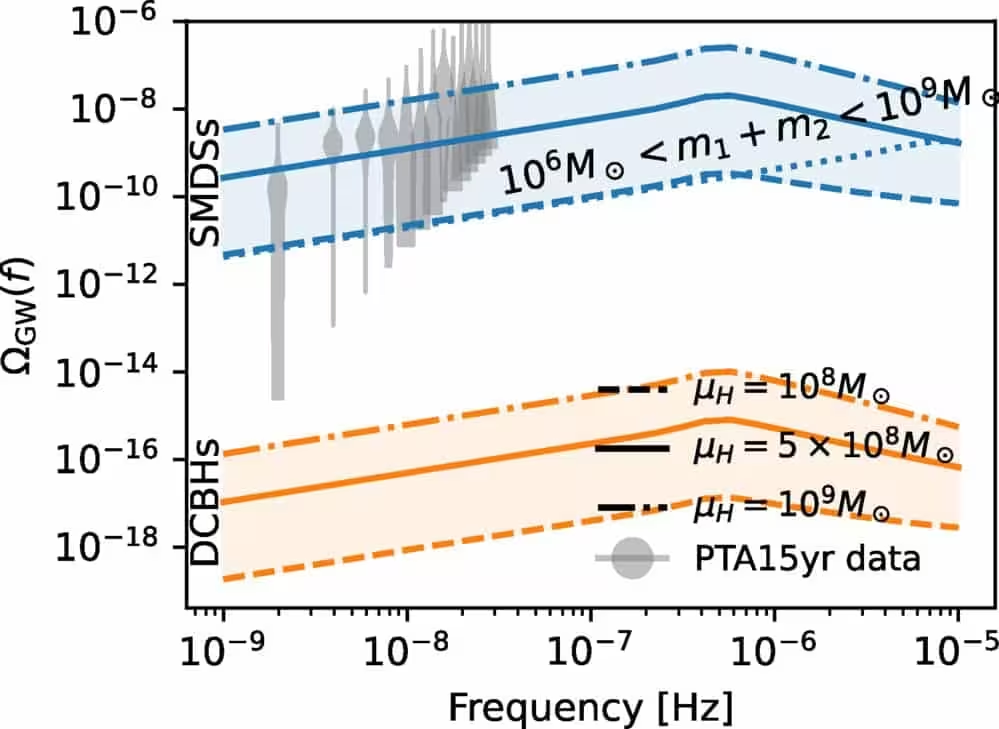
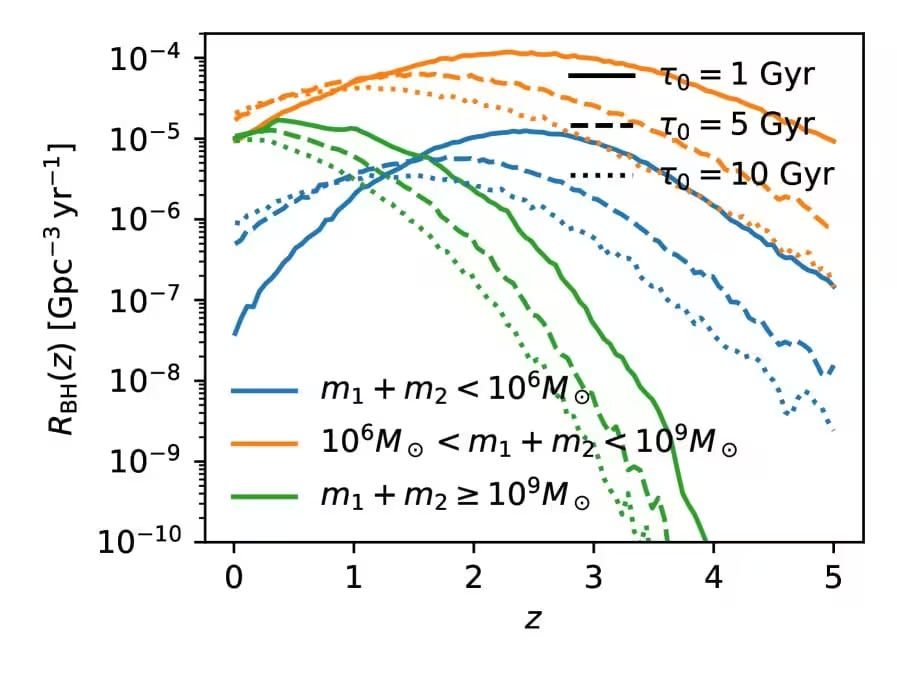
By modeling the evolution and merger rates of these black hole populations, Ghodla and Ilie found that if dark stars were present at a density of approximately 10⁻³ Mpc⁻³, they would leave a distinct imprint on the current gravitational-wave background. In contrast, standard direct-collapse models, which assume lower seed densities, produce a significantly quieter signal.
Constraints on Cosmic History
These findings provide a powerful new tool for constraining the abundance of early black hole seeds. The data suggest that if these objects were too numerous, the resulting gravitational-wave background would far exceed what is currently observed by pulsar timing arrays.
“Produce too many of these massive seeds and you end up over-producing the PTA-detected signal. Produce too few, and you need other sources to efficiently assemble these supermassive black holes later in the life of the universe to match PTA observations,” Ghodla explained.
As measurements from pulsar timing arrays become more precise, researchers hope to narrow the window on these density estimates. Such advancements could eventually confirm whether dark stars truly were the catalysts for the gargantuan black holes that reside in the centers of galaxies today.
This article has been fact checked for accuracy, with information verified against reputable sources. Learn more about us and our editorial process.
Last reviewed on .
Article history
- Latest version
Cite this page:
- Posted by Aisha Ahmed