New Evidence Reveals Mercury Formed From a Much Deeper and Hotter Interior Than Once Thought
New research reveals that Mercury’s ancient volcanoes were fueled by a significantly deeper and hotter interior than scientists previously thought possible.
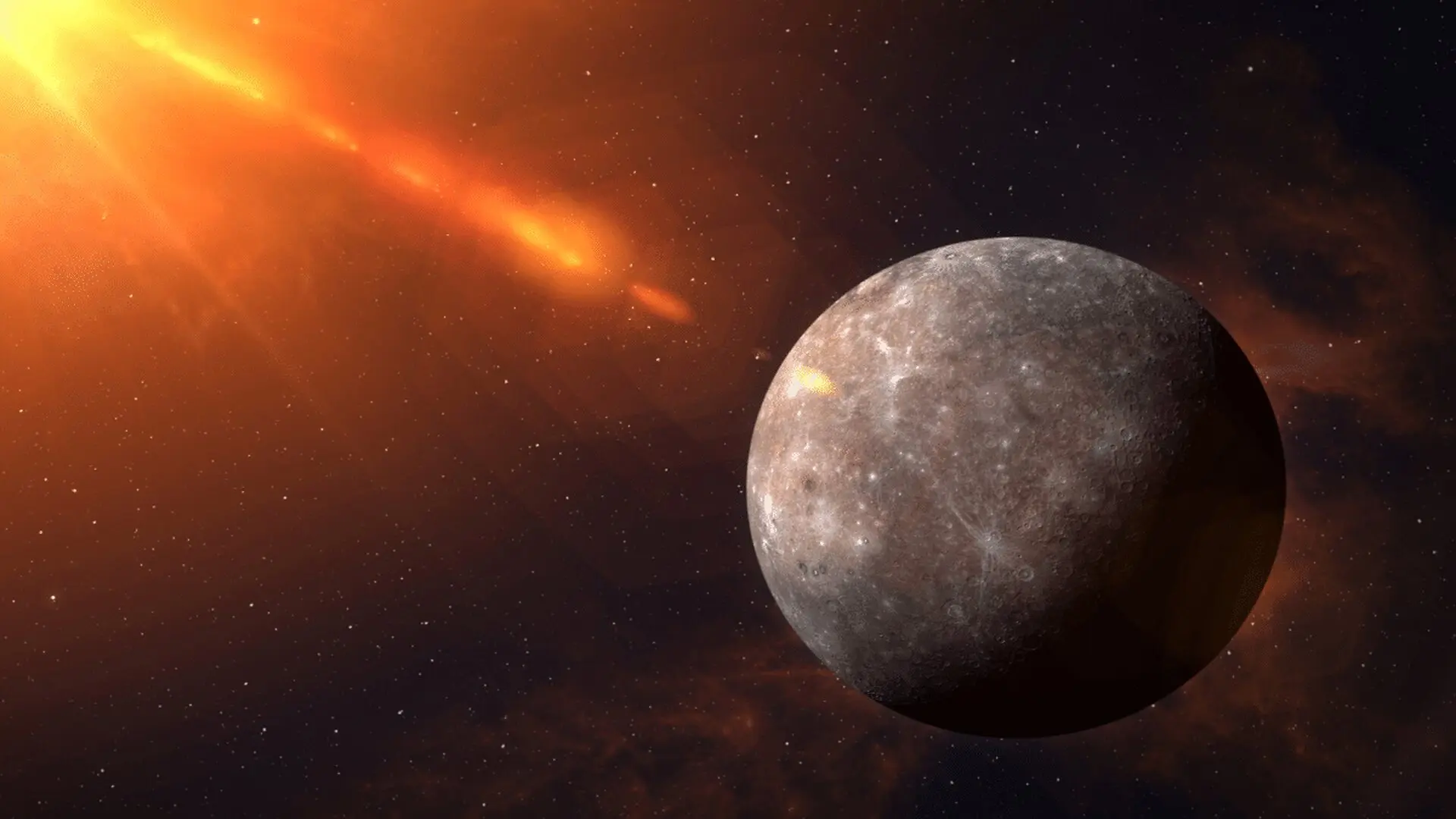
New evidence regarding the geological makeup of Mercury indicates that the planet’s surface is significantly poorer in silicon dioxide than scientists previously suspected. This finding, brought to light by an international team of researchers from the Max Planck Institute for Solar System Research, the University of Münster, and the University of Göttingen, provides a transformative look at the extreme thermal conditions that defined the solar system’s smallest planet during its formative years.
Rewriting the Geologic Narrative of a Swiftly Cooling World
While Earth has remained a geologically dynamic environment shaped by active plate tectonics and ongoing volcanic cycles, Mercury followed a starkly different trajectory. It underwent a rapid transition, shifting into a largely dormant state within its first billion years. Detailed in the journal Planetary Research, the new data suggest that Mercury’s ancient volcanic crust originated from mantle material subjected to much higher temperatures and deeper melting points than earlier models accounted for.
Current estimates place the silicon dioxide content of Mercury’s crust at approximately 37 percent. This represents a notably low concentration compared to Earth, where geological recycling frequently redistributes silica into common volcanic materials like basalt, andesite, and granite. On Mercury, the scarcity of this compound points to an environment where volcanic activity was driven by deep-seated, high-temperature processes occurring far beneath the crust.
“Our findings suggest that the volcanic rocks on Mercury formed from mantle material that had melted at greater depths than previously assumed,” said Christian Renggli, lead author of the new study and head of the “Experimental Laboratory Magma Ocean” research group at the MPS.
Precision Laboratory Standards for Planetary Remote Sensing
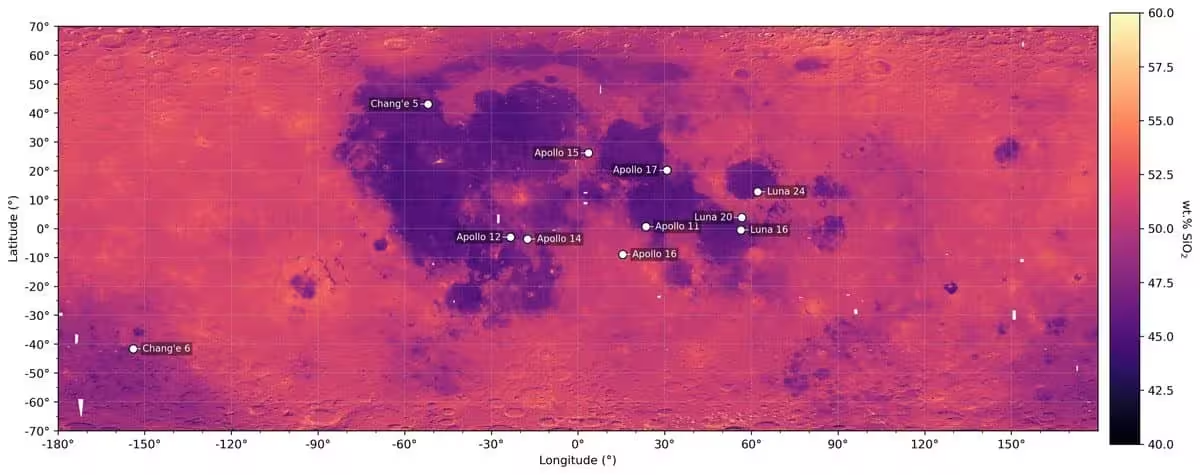
Investigating Mercury’s composition remains a complex task due to the total absence of physical surface samples. Researchers currently rely on interpreting infrared radiation signatures collected by orbital instruments and Earth-based telescopes. To refine the accuracy of these readings, the team developed specialized laboratory glass beads with strictly controlled silicon dioxide levels.
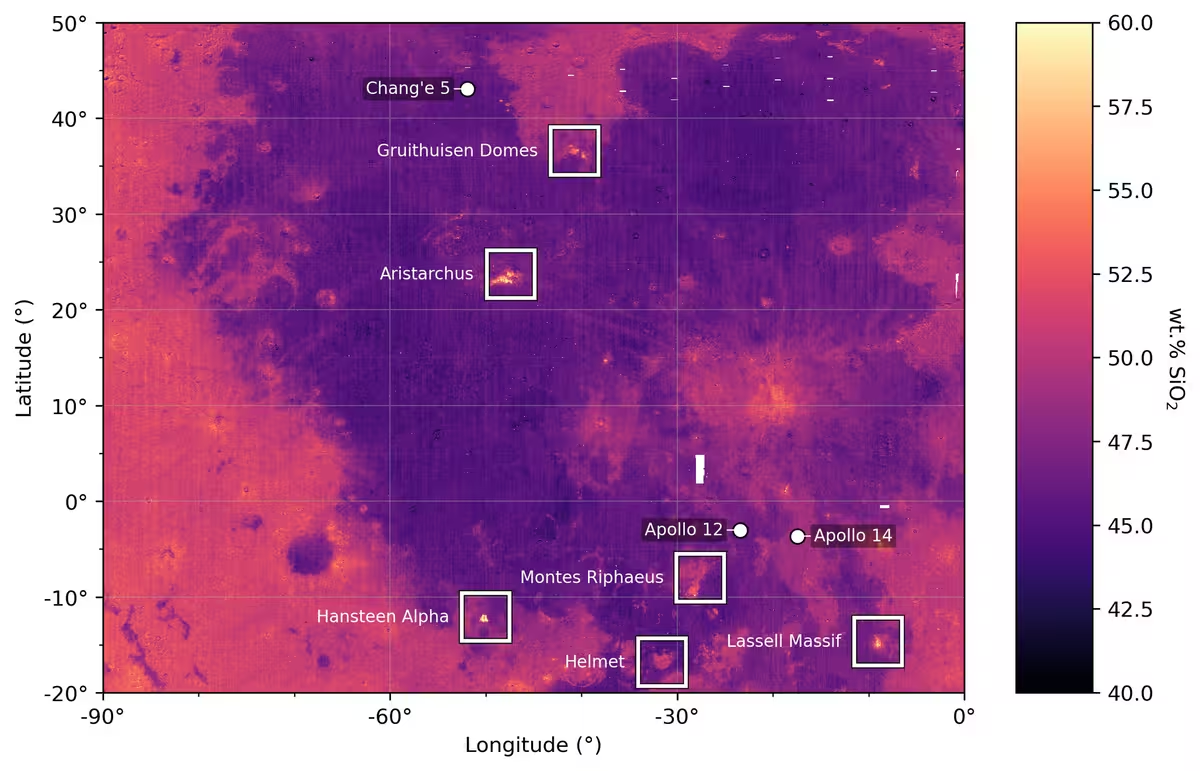
These samples acted as vital benchmarks for calibration. By establishing a direct link between mineral composition and infrared signals, the scientists could improve the precision of their spectral analysis. The researchers validated this methodology using the Moon, leveraging existing orbital data and physical samples returned by the Apollo missions to ensure their calibration techniques were sound.
“The glass beads serve a similar function as calibration weights on a scale,” explains Iris Weber from the University of Münster. “Their weight is known precisely. They therefore allow us to correctly interpret the scale’s balance. Similarly, the glass beads allow us to draw the correct conclusions from the properties of the infrared radiation.”
With the lunar model proving successful, the researchers applied their refined parameters to existing telescopic data of Mercury, notably observations obtained via the Bok Telescope at the Steward Observatory in Arizona.
Future Insights from the BepiColombo Mission
The team is now looking toward the BepiColombo mission—a joint endeavor between the European Space Agency and the Japan Aerospace Exploration Agency—to provide definitive validation. The mission carries the MERTIS (Mercury Radiometer and Thermal Infrared Spectrometer) instrument, which was developed by the German Aerospace Center and the University of Münster.
Once the mission begins its orbital operations, MERTIS will provide high-resolution infrared spectroscopy that could corroborate the current findings regarding the planet’s silicon dioxide levels. This forthcoming data is expected to clarify the thermal history of Mercury’s interior and offer a clearer picture of the violent, rapid cooling processes that ultimately left the planet in its current state.
“Our study lays the groundwork for deriving the most accurate information possible about the silicon dioxide content of Mercury’s surface from BepiColombo’s measurements,” Renggli noted.
This article has been fact checked for accuracy, with information verified against reputable sources. Learn more about us and our editorial process.
Last reviewed on .
Article history
- Latest version
Reference(s)
- Renggli, Christian., et al. “The SiO 2 abundance on the surfaces of the Moon and Mercury.” Planetary Research, vol. 1, no. 1, August 27, 2026 Université Paris Cité, doi: 10.53480/bf74-m226. <https://dx.doi.org/10.53480/bf74-m226>.
Cite this page:
- Posted by Aisha Ahmed