Pulsars May Have Just Revealed a Secret History of Ancient Dark Stars
Gravitational waves detected by pulsar arrays may reveal that mysterious Dark Stars provided the seeds for the universe’s earliest supermassive black holes.
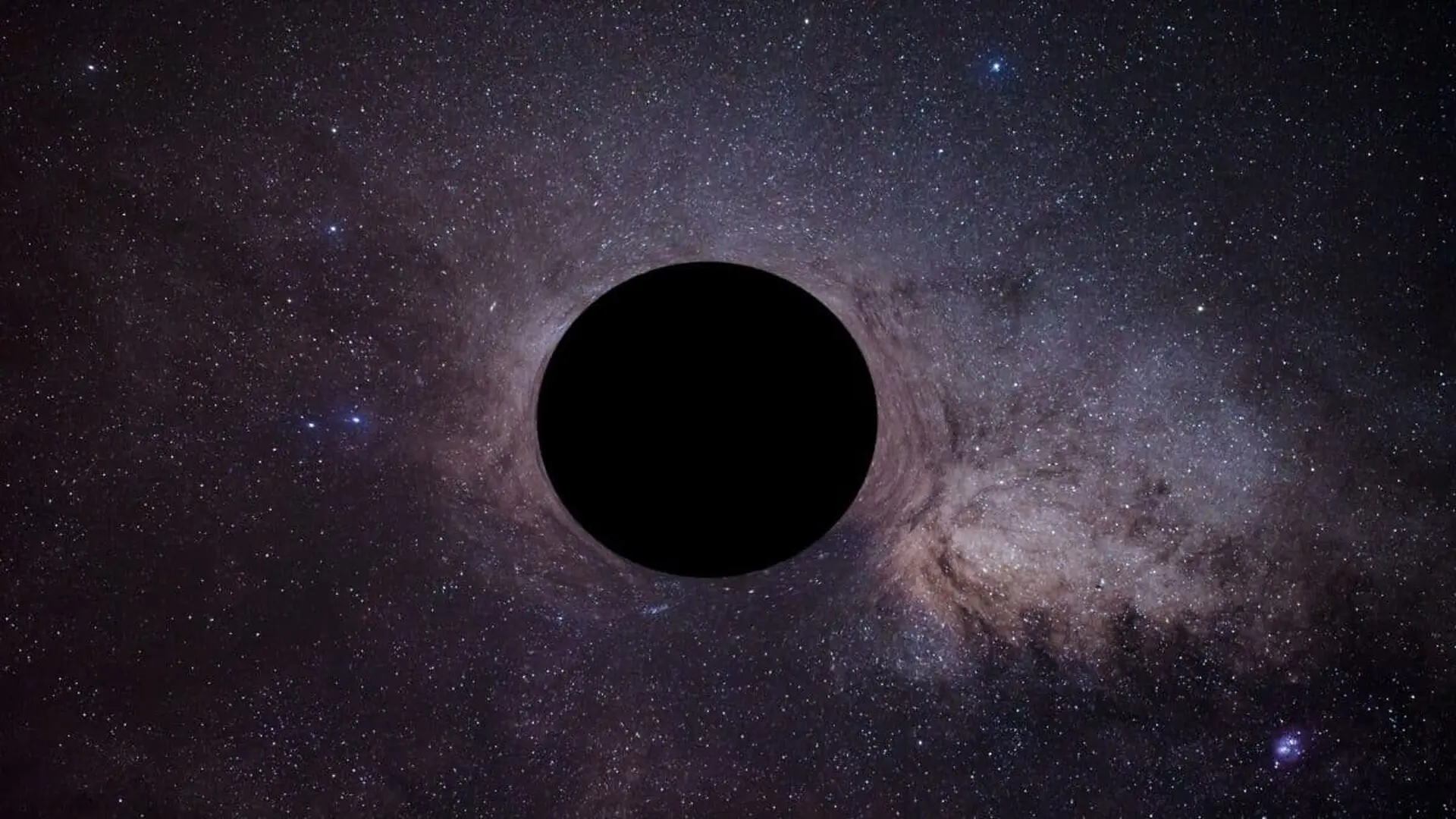
Astronomers may have found a hidden link between the enigmatic dawn of the universe and the rhythmic pulses of stars observed today. A new study published in Physical Review D suggests that the low-frequency gravitational-wave background, currently being mapped by Pulsar Timing Arrays (PTAs), could hold the fingerprints of ancient, massive black holes born from the collapse of so-called Dark Stars.
Pulsar Timing Arrays function as a colossal, galaxy-wide detector. By meticulously tracking the arrival times of radio signals from pulsars—rapidly spinning neutron stars that serve as nature’s most accurate clocks—researchers can identify minute distortions in spacetime caused by gravitational waves. Recent data has confirmed a persistent background hum of nanohertz-frequency waves, a phenomenon typically attributed to the inspiral and merger of binary supermassive black holes, each weighing in at over a billion solar masses.
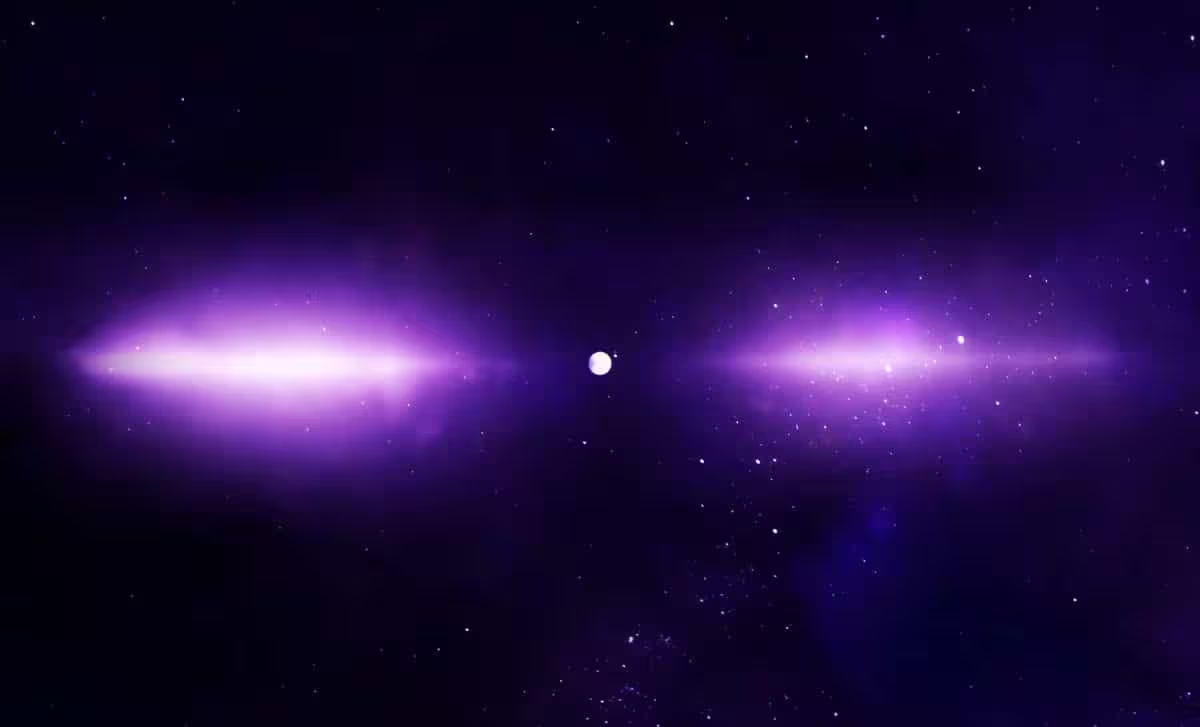
The existence of such gargantuan black holes when the universe was less than a billion years old, as revealed by the James Webb Space Telescope, has long puzzled cosmologists. Researchers Sohan Ghodla and Cosmin Ilie explored whether these early giants originated from massive “seeds” formed during the cosmic dawn. Their study focuses on two primary candidates for these seeds: black holes formed through direct collapse, and those originating from the collapse of Dark Stars.
Unlike stars that rely on nuclear fusion, Dark Stars are theoretical entities powered by the annihilation of dark matter trapped within their cores. According to the team’s models, these structures could have remained stable for long periods, accumulating vast amounts of matter and growing to millions of solar masses before finally collapsing into black holes.
The researchers simulated the evolution of these seeds over billions of years, tracking how frequently their host galaxies might merge and how those collisions would manifest in the gravitational-wave data collected by PTAs today. Their findings, detailed in their published paper, indicate that if Dark Star-seeded black holes existed at a comoving density of approximately 10^-3 Mpc^-3, they could serve as a primary source for the detected gravitational-wave background. By contrast, the direct collapse model appears less likely to be the dominant driver, as its expected population density is significantly lower, at roughly 10^-6 Mpc^-3.
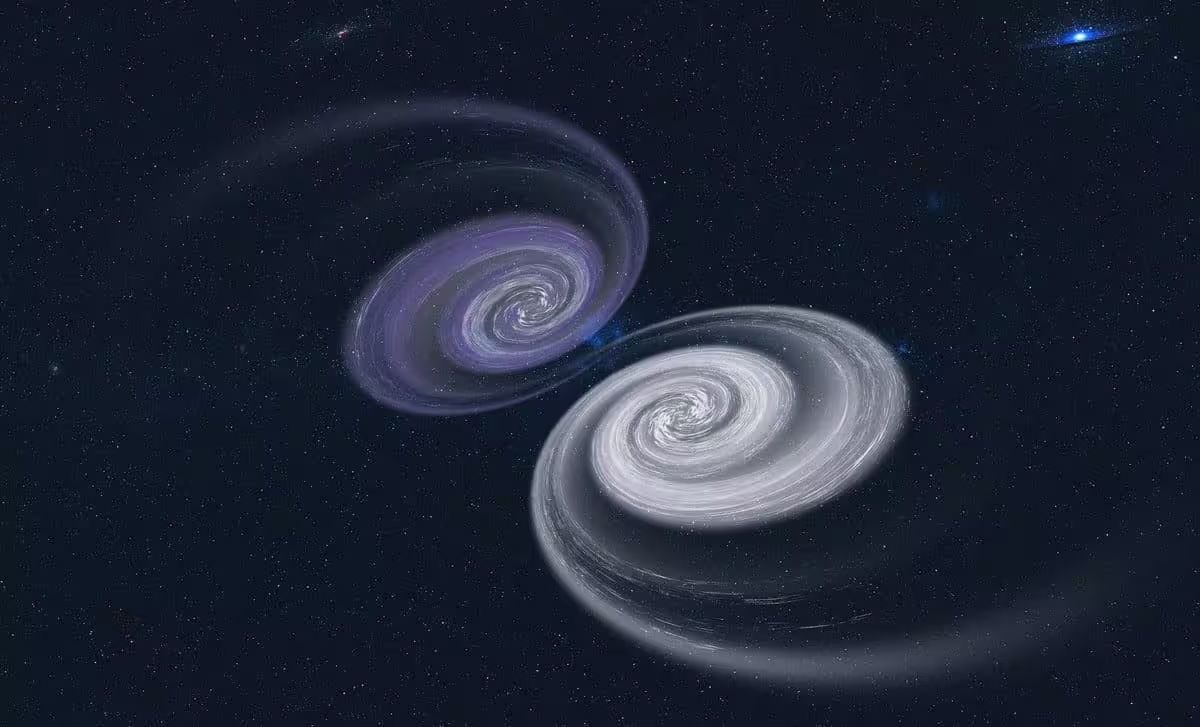
This analysis not only provides a potential explanation for the growth of early supermassive black holes but also establishes a new boundary for cosmological models. If the population of these seeds were too high, the resulting gravitational-wave background would exceed current observations. If it were too low, scientists would need to propose alternative mechanisms to account for the rapid growth of early black holes.
As Ghodla notes, this methodology offers a unique window into epochs at redshifts greater than 10, essentially allowing researchers to peer into the mechanics of the early universe through the echoes of long-dead stars. Future refinements in PTA sensitivity and continued observations of the early universe promise to clarify whether Dark Stars were indeed the architects of the universe’s first supermassive black holes.
This article has been fact checked for accuracy, with information verified against reputable sources. Learn more about us and our editorial process.
Last reviewed on .
Article history
- Latest version
Reference(s)
- <https://journals.aps.org/search/results?sort=relevance&clauses=%5B%7B%22operator%22%3A%22AND%22%2C%22field%22%3A%22author%22%2C%22value%22%3A%22Sohan+Ghodla%22%7D%5D>.
- Ghodla, Sohan., et al. “Reconstructing PTA measurements via early seeding of supermassive black holes.” Physical Review D, vol. 114, no. 4, August 17, 2026 American Physical Society (APS), doi: 10.1103/hvfd-8fkr. <https://journals.aps.org/prd/abstract/10.1103/hvfd-8fkr>.
Cite this page:
- Posted by Aisha Ahmed