A New Startup Plans To Light Up The Night With Orbiting Space Mirrors Despite Astronomer Outcry
Giant 18-meter mirrors could soon illuminate the night sky, sparking new debates about the future of artificial light and its impact on our planet.

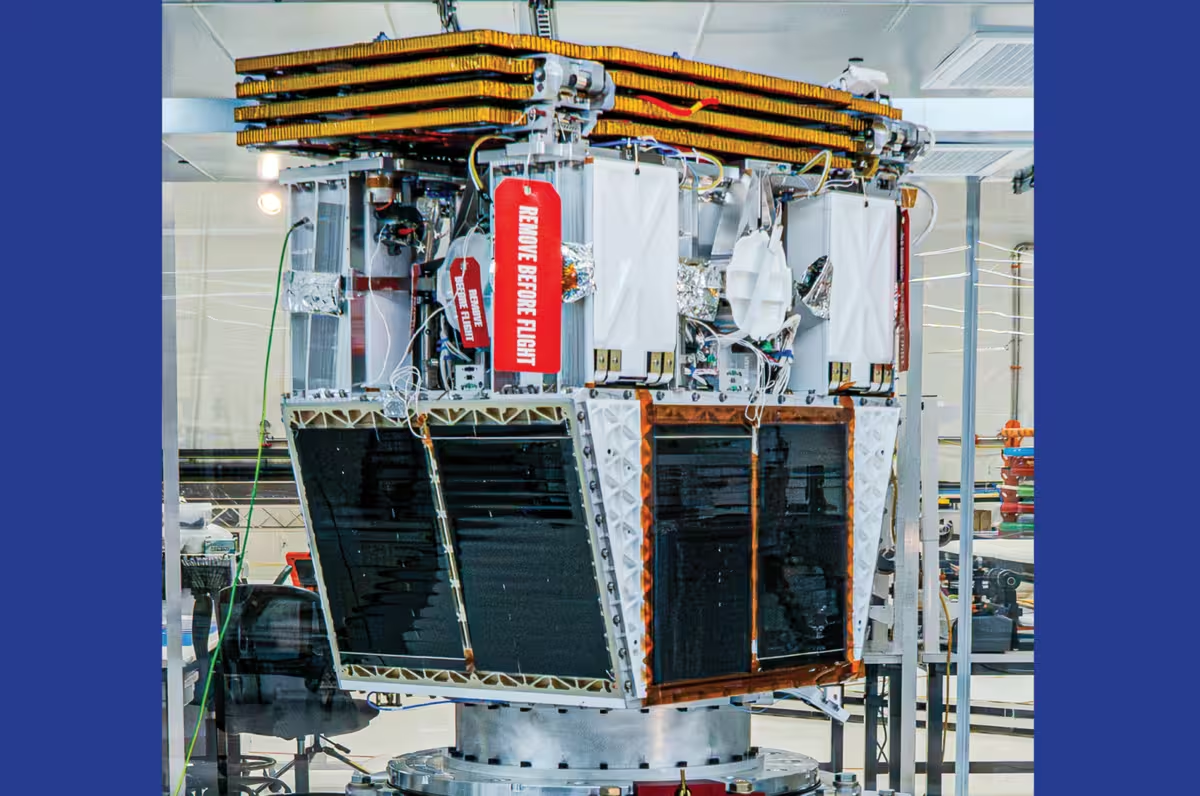
A California-based startup, Reflect Orbital, is preparing to test a controversial satellite technology designed to redirect sunlight onto specific locations on Earth after sunset. The company’s prototype, dubbed Eärendil-1, is scheduled for a SpaceX Falcon 9 launch later this year, following a July 9, 2026, regulatory approval by the Federal Communications Commission.
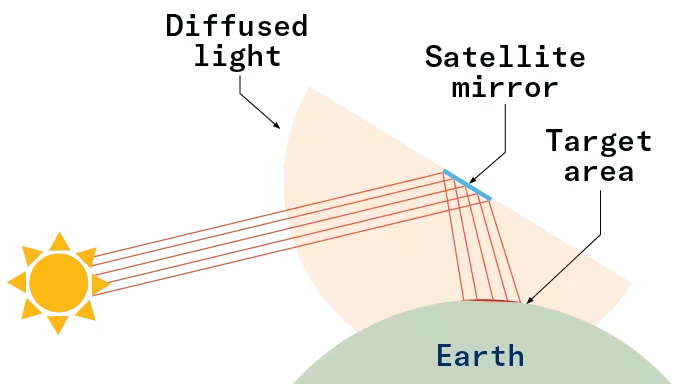
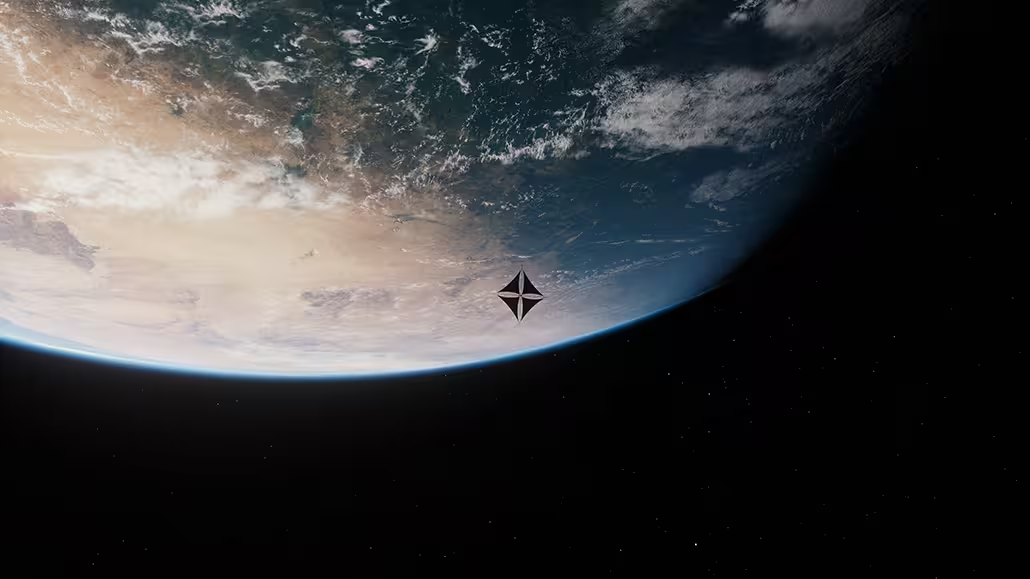
The satellite, which measures roughly twice the size of a microwave oven when stowed, is engineered to deploy four triangular, aluminum-coated plastic panels. These panels, each only about 15,000 atoms thick and weighing approximately 0.5 kilograms, will form an 18-meter flat square mirror once in orbit. Operating from an altitude of 625 kilometers, the device is designed to capture sunlight and focus it into a 5-kilometer-wide beam, potentially illuminating a target area on the ground with the intensity of a full moon for about four minutes at a time.
“Sun is the most powerful resource in the solar system,” Reflect Orbital CEO Ben Nowack noted in an interview. The company argues that its technology could support emergency response operations, extend the operational hours of solar farms, and provide lighting for large-scale outdoor events.
Engineering the Night Sky
Precision is the primary technical hurdle for the 134-kilogram spacecraft. To maintain a stationary light patch on a rapidly moving planet, the satellite must perform constant, intricate maneuvers while orbiting at roughly 7.5 kilometers per second. Reflect Orbital has equipped the prototype with oversized reaction wheels to manage this orientation. While the test unit has a one-year design life, the firm has ambitious long-term goals, proposing a fleet of 5,000 mirrors by 2030, eventually scaling to 50,000 units by 2035 using larger, 54-meter structures.
Astronomical Concerns and Regulatory Pushback
The prospect of artificial light beams disrupting the night sky has drawn sharp criticism from the scientific community. Simulations conducted by astrophysicist Gaspar Bakos at Princeton University suggest that a single 54-meter mirror would outshine the full moon for individuals within a 30-kilometer radius of the target site. Further, professional observatories located as far as 100 kilometers away could face significant data interference. European Southern Observatory researcher Oliver Hainaut has warned that a full-scale deployment could introduce hundreds of objects as bright as Venus into the night sky, significantly increasing ambient light pollution.
In early 2026, the American Astronomical Society petitioned the FCC to block the licensing, citing potential harm to astronomical research and safety risks for amateur observers. Similarly, DarkSky International mobilized thousands of signatures against the project. The FCC, however, determined that its regulatory authority is strictly limited to telecommunications frequencies and does not extend to the optical environmental impact of the spacecraft. Regarding public safety, the commission concluded that the risk of eye damage is minimal, requiring a specific, unlikely set of conditions involving high-magnification telescopes.

Despite the approval, the legal battle may not be over. Organizations including Earthjustice are reportedly exploring policy options to challenge the decision. Meanwhile, the historical precedent for this technology remains sparse. In 1993, the Russian Znamya 2 experiment successfully deployed a 20-meter Mylar mirror from the Mir space station. While it briefly cast a beam of moonlight-intensity light across parts of Europe, heavy cloud cover obscured the event from most observers, rendering it largely a technical proof-of-concept rather than a widespread public spectacle.
This article has been fact checked for accuracy, with information verified against reputable sources. Learn more about us and our editorial process.
Last reviewed on .
Article history
- Latest version
Reference(s)
- “DA 26 706A1.” <https://docs.fcc.gov/public/attachments/DA-26-706A1.pdf>.
- Pflughoeft, Aspen. “Reflect Orbital readies for first on-orbit demo of shining sunlight at night - Aerospace America.”, July 20, 2026 Aerospace America <https://aerospaceamerica.aiaa.org/reflect-orbital-approaches-first-on-orbit-demo-of-shining-sunlight-at-night/>.
- <https://darksky.org/news/organizational-statement-reflect-orbital/>.
Cite this page:
- Posted by Aisha Ahmed