A 300 Year Old Novel Eerily Predicted The Core Flaw Of Modern AI
Jonathan Swift’s 1726 Gulliver’s Travels featured a fictional knowledge machine that mirrors modern debates over the reliability of AI chatbots.
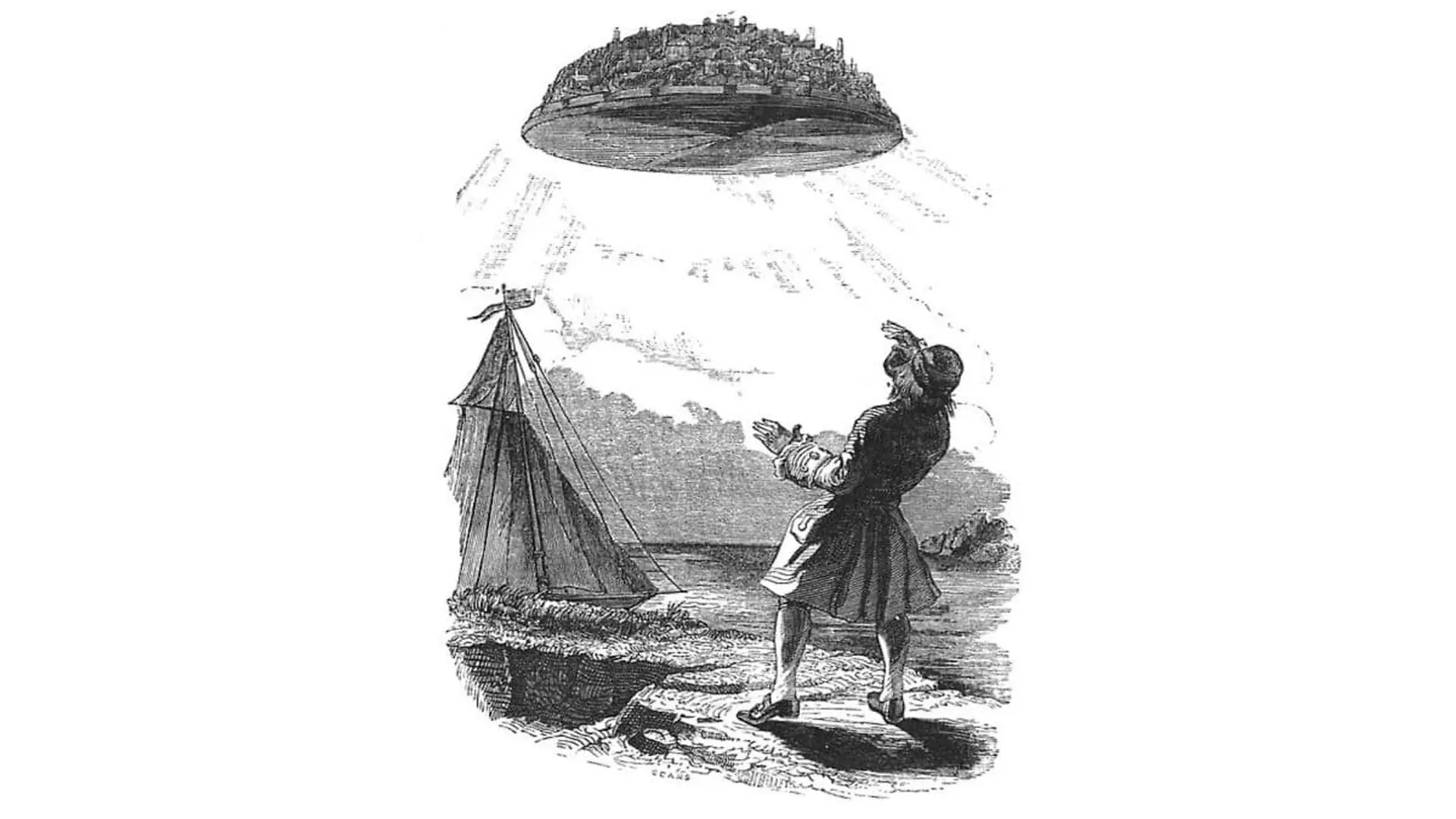
Jonathan Swift’s 1726 masterpiece, Gulliver’s Travels, remains a landmark of political and social satire, but modern readers are finding that its pages contain strangely prophetic echoes of 21st-century technological dilemmas. From the automated generation of text to the precise observation of celestial bodies, Swift’s fictional world often feels closer to our reality than it did to his own.
A Literary Precursor to Large Language Models
Deep within the third part of the novel, Gulliver visits the Great Academy of Lagado, a satirical institution populated by academics pursuing bizarre and impractical research. Among the curious contraptions housed there is a wooden frame laced with wires and iron handles, intended to automate the composition of books. By manipulating these cranks, students could shuffle word fragments to generate sequences that might, in theory, form coherent thoughts on philosophy, law, or science.
The device was envisioned as a way to allow even the uneducated to produce scholarly works without the burden of study. While the mechanics of Swift’s machine differ from the silicon-based architecture of modern AI, the conceptual parallels are striking. As noted by IFLScience, the core issue Swift highlighted was the decoupling of information output from genuine understanding. Just as today’s LLMs process vast datasets to predict the next token in a sequence, Swift’s machine prioritized the construction of text over the comprehension of text itself. The satire centers on the human tendency to mistake high-volume generation for true knowledge, leaving the task of filtering valid content from nonsense to overwhelmed human observers.
The Martian Coincidence
Beyond his commentary on academic trends, Swift displayed a keen, albeit fictional, interest in the heavens. In the same volume, he describes astronomers on the flying island of Laputa who have identified two moons orbiting Mars. He provided specific details regarding their orbital distances and periods, figures that align with uncanny accuracy to the real-world discovery of Phobos and Deimos—a realization that would not occur until 151 years after the book’s publication.
Swift’s calculations were not the result of supernatural foresight, but rather an extrapolation of contemporary scientific trends. He utilized Kepler’s laws of planetary motion and the then-recent discoveries surrounding the Galilean moons of Jupiter to project what might exist around Mars. By applying the prevailing physics of his era to the Red Planet, he managed a mathematical approximation that future telescopes would eventually validate.
#onthisday 28 October 1726 – The novel Gulliver’s Travels written by Jonathan Swift is published.
Gulliver’s Travels, or Travels into Several Remote Nations of the World. In Four Parts. By Lemuel Gulliver, First a Surgeon, & then a Captain of Several Ships is a 1726 prose satire… pic.twitter.com/F5dKF9XJOh— BRITISH History – On This Day (@BritishHistorym) October 28, 2024
Ultimately, these passages underscore the dual nature of Swift’s legacy. The Martian moons remain a testament to his engagement with the burgeoning science of his day, while the writing machine serves as an enduring critique of intellectual shortcuts. As society grapples with the rapid integration of artificial intelligence into daily life, the Academy of Lagado stands as a reminder that the allure of effortless production has been a human temptation for centuries.
This article has been fact checked for accuracy, with information verified against reputable sources. Learn more about us and our editorial process.
Last reviewed on .
Article history
- Latest version
Reference(s)
- <https://www.iflscience.com/a-300-year-old-novel-eerily-foresaw-the-rise-and-issues-of-modern-ai-chatbots-84859>.
- “https://twitter.com/BritishHistorym/status/1851015734652027227/photo/1.” <https://t.co/F5dKF9XJOh>.
Cite this page:
- Posted by Asif Iqbal