AI Decodes Cryptic Napoleon Letter Hidden for Two Centuries
An AI-powered breakthrough has finally deciphered a coded 1809 letter from Napoleon Bonaparte, revealing secret military plans lost for over two centuries.
A sophisticated artificial intelligence has successfully broken a 217-year-old secret cipher written during the height of the Napoleonic Wars. The message, sent in March 1809 by Eugène de Beauharnais, the Viceroy of Italy and stepson of Napoleon Bonaparte, was intended for General Auguste de Marmont. At the time, Marmont’s troops were isolated in Dalmatia, separated from the rest of the French army by Austrian territory, making the secure delivery of intelligence a critical strategic priority.
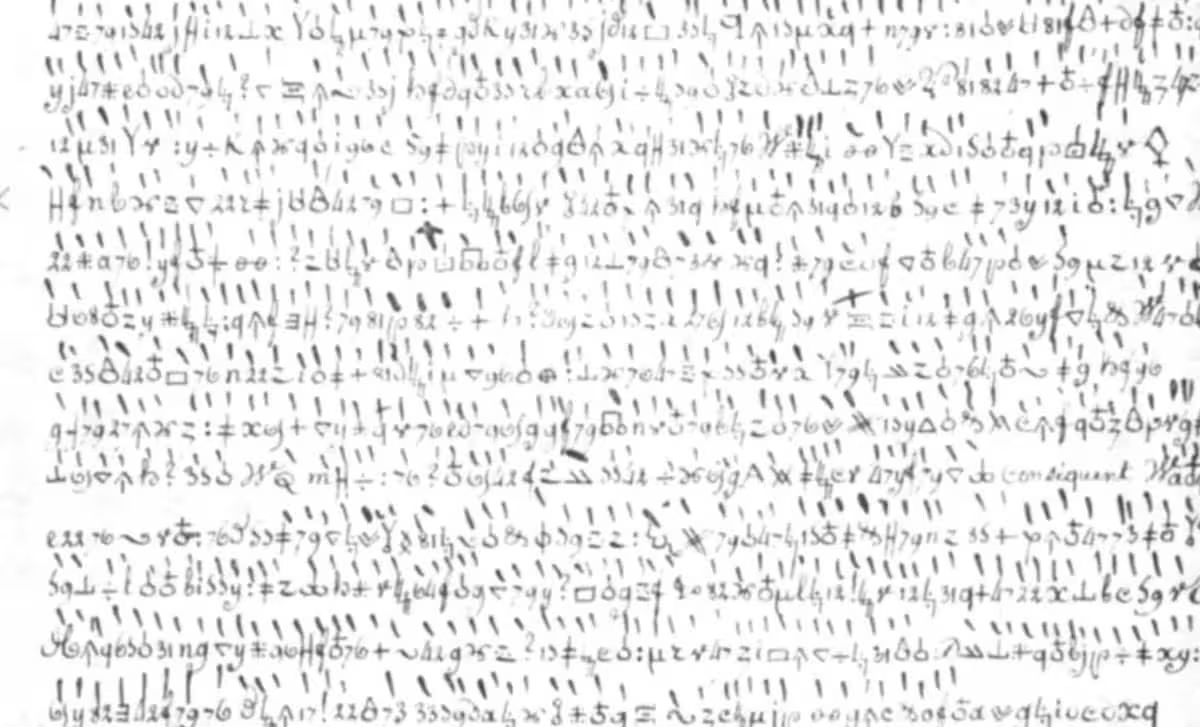
The original dispatch had remained an enigma for over two centuries, as the necessary key to decipher the code was lost to history. While researchers had previously attempted to crack the code, the document remained largely unread until software engineer Carter Church utilized AI to reconstruct its contents. The process relied on a low-resolution scan of the letter, which had been published in a 1969 military history journal.
Unlocking the Napoleonic Code
The document features a brief introduction in standard French, followed by 24 rows of cryptic text comprising roughly 1,300 units and 155 unique symbols. This system was a homophonic substitution cipher, a method designed to thwart frequency analysis by using multiple different symbols to represent the same letter, preventing codebreakers from easily identifying characters based on their repetition.
Church employed a multi-modal approach to translate the document, taking approximately six hours of computational time. The AI was tasked with segmenting the image, identifying the handwritten symbols, and determining which marks were variants of the same character. By integrating a partial decryption table previously compiled by cryptology expert Daniel Tant—which accounted for roughly one-third of the symbols—the AI used statistical modeling and simulated annealing to assign values to the remaining characters. The final output was subsequently verified by cryptographer Satoshi Tomokiyo, who maintains the Cryptiana database of historical ciphers.
I used GPT-6 Astra to break an unsolved cipher to one of Napoleon’s generals that had gone unread for 217 years.
What makes this impressive isn’t actually the codebreaking, but that Astra completed the entire multi-modal workflow in ~6 hours from a single image and goal.
The decrypted text provides a detailed snapshot of French military dispositions during a period of escalating tension. Napoleon instructed Eugène to inform Marmont of the exact troop counts and locations of key forces across Europe. The letter detailed several major deployments:
The Duke of Danzig commanding 40,000 Bavarian troops near Munich and Passau.
Prince Poniatowski leading 30,000 Polish soldiers along the Vistula.
The Duke of Auerstaedt stationed at Bayreuth with 80,000 French troops.
The Duke of Rivoli overseeing 60,000 men near Ulm and Donauwörth.
General Oudinot holding 40,000 men at Augsburg.
Beyond logistics, the message served as a morale booster, urging Marmont not to be intimidated by the gathering Austrian threat. Napoleon boldly asserted that Austria was “hastening toward her ruin” and noted that Russia was expected to mobilize against the Austrian empire, creating a multi-front conflict.
Despite the confidence displayed in the cipher, the subsequent weeks proved difficult for the French army. Austria launched an invasion of Bavaria in April 1809, and Napoleon’s forces suffered notable setbacks, including defeat at the Battle of Aspern-Essling. Marmont eventually successfully marched his forces out of Dalmatia to reinforce Napoleon at the Battle of Wagram, a victory that cemented his status as a marshal.
Historians, such as Michael Rowe of King’s College London and Zack White of the University of Portsmouth, have noted that while the decipherment provides an fascinating look at period communication, it does not fundamentally rewrite history. Much of the information contained in the letter aligns with existing archival records of Napoleon’s correspondence. Nevertheless, the project demonstrates the growing utility of AI in archival research, offering a bridge between complex historical cryptography and modern analytical methods.
Fact Checked
This article has been fact checked for accuracy, with information verified against reputable sources. Learn more about us and our editorial process.
Last reviewed on .
Article history
Latest version
Reference(s)
Church, Carter. “Breaking the Marmont Cipher, 1809.”, September 18, 2026 Carter Church <https://carter.church/writeups/the-letter-to-marmont/>.
Iqbal, Asif. “AI Decodes Cryptic Napoleon Letter Hidden for Two Centuries.” BioScience. BioScience ISSN 2521-5760, 06 October 2026. <https://www.bioscience.com.pk/en/subject/technology/napoleons-mysterious-1809-letter-has-been-decoded-after-more-than-two-centuries>.
Iqbal, A. (2026, October 06). “AI Decodes Cryptic Napoleon Letter Hidden for Two Centuries.” BioScience. ISSN 2521-5760. Retrieved October 06, 2026 from https://www.bioscience.com.pk/en/subject/technology/napoleons-mysterious-1809-letter-has-been-decoded-after-more-than-two-centuries
Iqbal, Asif. “AI Decodes Cryptic Napoleon Letter Hidden for Two Centuries.” BioScience. ISSN 2521-5760. https://www.bioscience.com.pk/en/subject/technology/napoleons-mysterious-1809-letter-has-been-decoded-after-more-than-two-centuries (accessed October 06, 2026).