Why Everyday Stress Feels Impossible to Break and How a New Four-Step Brain Map Explains the Cycle
A novel conceptual framework connects established neuroscience with everyday somatic practices to show how people can interrupt automatic stress reactions.

Everyday stress often traps people in a familiar loop of automatic reactions and persistent bodily tension, even long after a triggering event has ended. While body-based practices like mindfulness, yoga, and somatic therapy aim to soothe these patterns, they are typically taught as isolated techniques without a clear map of the underlying biological mechanisms. To address this gap, researcher Sundeep Kapila from The Swasth Institute in Mumbai has proposed a structured conceptual framework available on the arXiv preprint server.
How Does the Four-Step Action Loop Map Everyday Human Stress?
The newly outlined model breaks down any daily action, from a sudden reflex to a deliberate choice, into four distinct chronological stages. These steps include sensing the environment and body, processing that input through context and expectations, choosing between a habit or a response, and finally executing the output through autonomic and muscular systems. Instead of treating stress as a mysterious emotional flaw, the framework aligns established neuroscience principles into a sequence that non-specialists can easily recognize in their own lives.
The first phase involves sensing external sights and sounds, body position, and internal signals from organs like the heart and gut. The author notes that interoception, which is the perception of internal bodily states, plays a major role in anxiety because mismatched internal predictions can signal false alarms of danger. By widening attention across all sensory channels, individuals can catch missed or noisy signals before they escalate into overwhelming stress.
Why Does Context Change the Meaning of Body Signals?
During the processing stage, the brain compares incoming sensory data against its own expectations to infer whether a physical sensation means danger or safety. For instance, a racing heart and sweating palms might be interpreted as a severe threat before a difficult conversation, but as normal physical effort during a vigorous run. This means changing the surrounding context or the environmental cues can entirely alter how a person experiences their own bodily state.
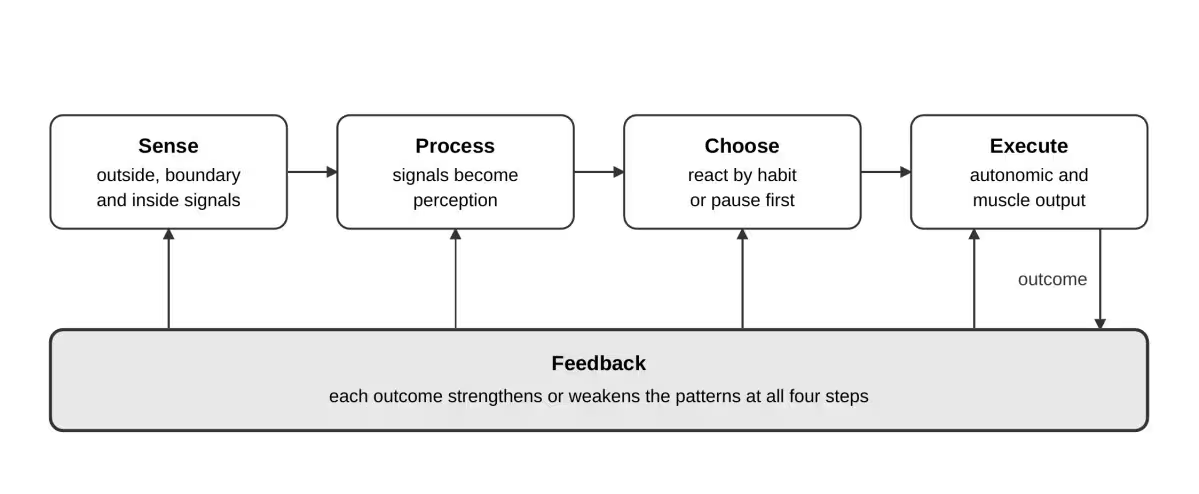
The model also incorporates a crucial fifth layer operating beneath all four steps, known as feedback. Every time an action occurs, its outcome physically alters the nervous system through synaptic plasticity and habit formation. Repeated stress activation without adequate recovery accumulates allostatic load, which is the biological wear and tear that gradually shifts baseline functioning into a chronic stuck state.
Can Understanding Biological Mechanisms Transform Mental Wellbeing?
By mapping specific somatic practices directly onto each step of the loop, the framework helps learners target precise points of intervention. Grounding and full sensory awareness practices act on the sensing stage, while slow movement and relaxation exercises work on execution to release chronic muscular tension. Meanwhile, taking a deliberate pause before acting helps shift behavior away from rigid habits and toward flexible, goal-directed choices.
The author emphasizes that this model is designed as a teachable educational tool for everyday wellbeing rather than a clinical treatment for mental health disorders. Future evaluation of the framework will rely on seven testable propositions, including tracking whether learning the loop increases a person’s awareness of automatic reactions and whether regular practice measurably reduces perceived stress scores over time.
The study was posted to the arXiv preprint server on November 20, 2026.
This article has been fact checked for accuracy, with information verified against reputable sources. Learn more about us and our editorial process.
Last reviewed on .
Article history
- Latest version
Reference(s)
- Kapila, Sundeep. “The Four-Step Action Loop with Feedback: A teachable perception-action framework for everyday self-regulation.” arXiv.org <http://arxiv.org/abs/2611.27795v1>.
Cite this page:
- Posted by Jessica Martin