Single Dose of Ketamine Restructures Risk-Taking and Reward Choices in Healthy Adults
A new controlled study shows ketamine sharpens loss sensitivity and accelerates behavior, while lorazepam leads to less selective choices.

Healthy volunteers who received a single dose of ketamine made sharper, more strategic choices in a virtual risk-taking game than when they were given a calming medication or no drug at all. The findings offer a fresh look at how the fast-acting antidepressant changes human motivation and decision-making when facing potential threats.
Human decision-making constantly balances the desire for rewards against the threat of negative consequences, a dilemma known as approach-avoidance conflict. In mental health conditions such as major depressive disorder, anxiety, and post-traumatic stress disorder, this balance often skews heavily toward avoidance, trapping individuals in patterns of excessive caution and reduced reward seeking. While ketamine is well known for its rapid antidepressant effects, researchers have remained uncertain about how it alters motivational behavior and restores engagement with the environment.
To investigate how different pharmaceutical agents reshape these choices, a team of researchers led by Stefan Vestring and Juan Carlos Baldermann at the University Medical Center Freiburg published in Communications Medicine a study examining 34 healthy participants. The group comprised 24 women and 10 men with an average age of 25 years, all carefully screened to ensure no history of neurological or psychiatric conditions and no regular medication use.
How Did the Researchers Test Drug Effects on Risk and Reward?
The investigators used a counterbalanced, within-subject crossover design where each participant completed three separate study visits separated by seven days. The first visit established baseline behavior without medication, while the subsequent two visits involved receiving either a 50-milligram dose of intranasal ketamine or a 1-milligram dose of oral lorazepam, a widely prescribed anxiolytic drug that enhances inhibitory signaling in the brain.
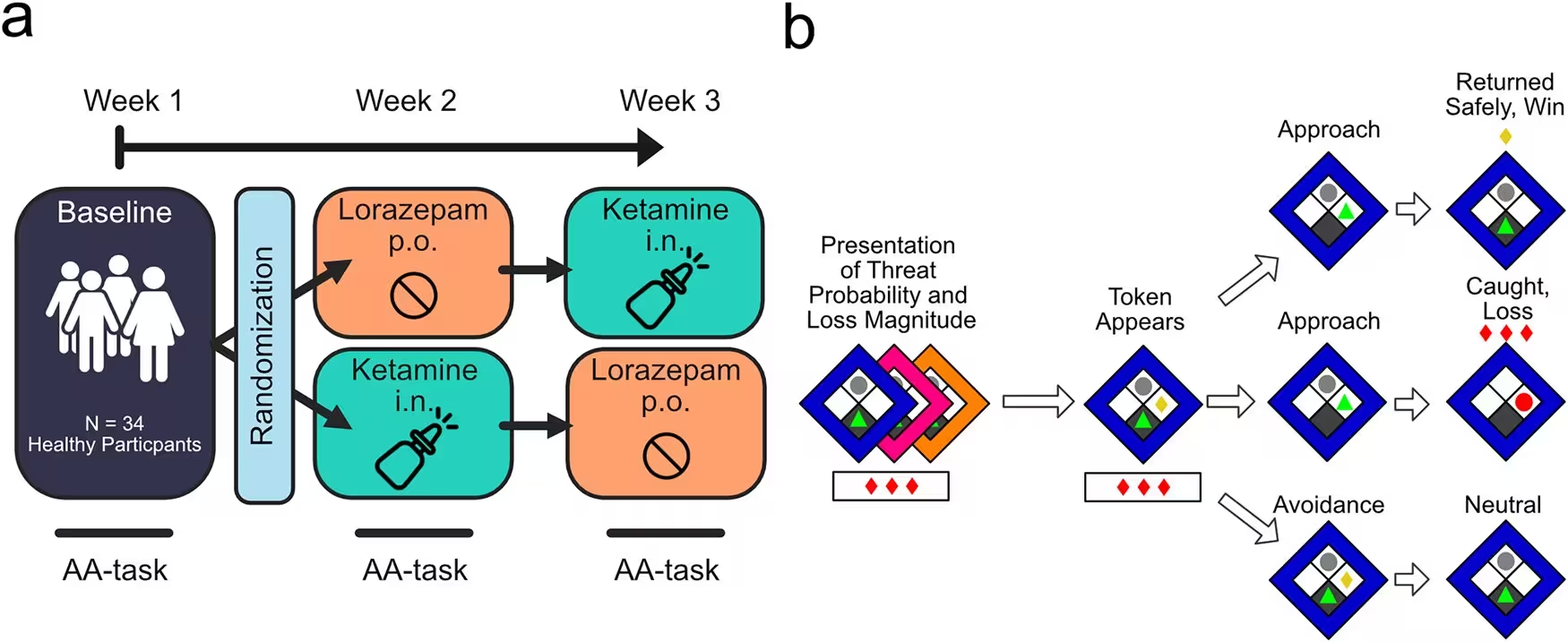
During each session, participants played a computer-based approach-avoidance conflict task on a grid. They started in a safe zone and decided whether to approach and collect virtual tokens while avoiding a moving virtual predator. The task independently varied two factors across trials: the probability of a predator attack, which was signaled by the color of the screen frame, and the magnitude of potential token loss, displayed at the bottom of the screen. Behavioral testing occurred 90 to 150 minutes after drug administration, after ketamine’s acute dissociative phase had subsided but while its rapid behavioral influence remained active.
What Did Participants Do Differently After Taking Ketamine?
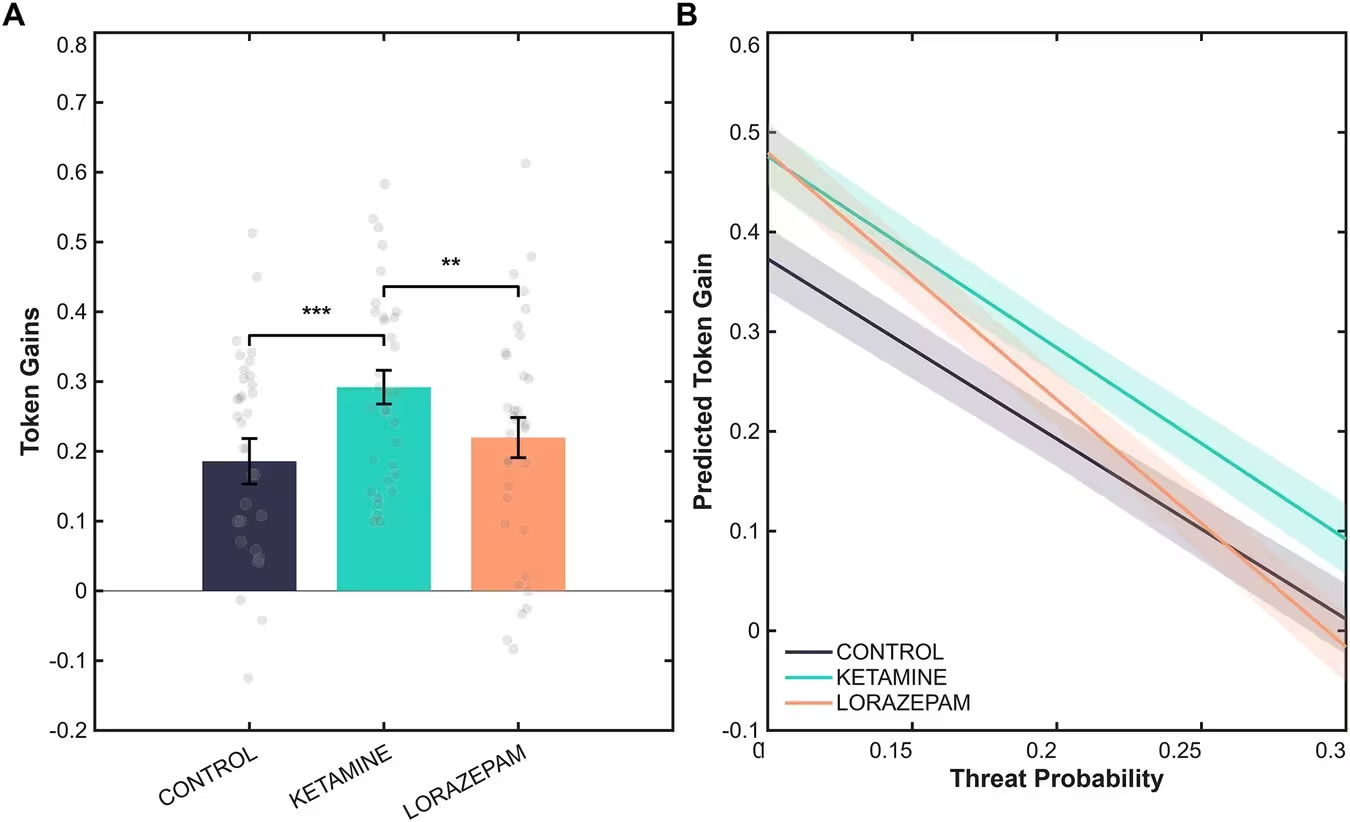
The results revealed that participants earned 57 percent more tokens after taking ketamine compared to the control condition, and 33 percent more tokens than when they took lorazepam. This performance boost did not stem from reckless behavior or a loss of general attention. Instead, ketamine specifically altered how participants weighed environmental risks.
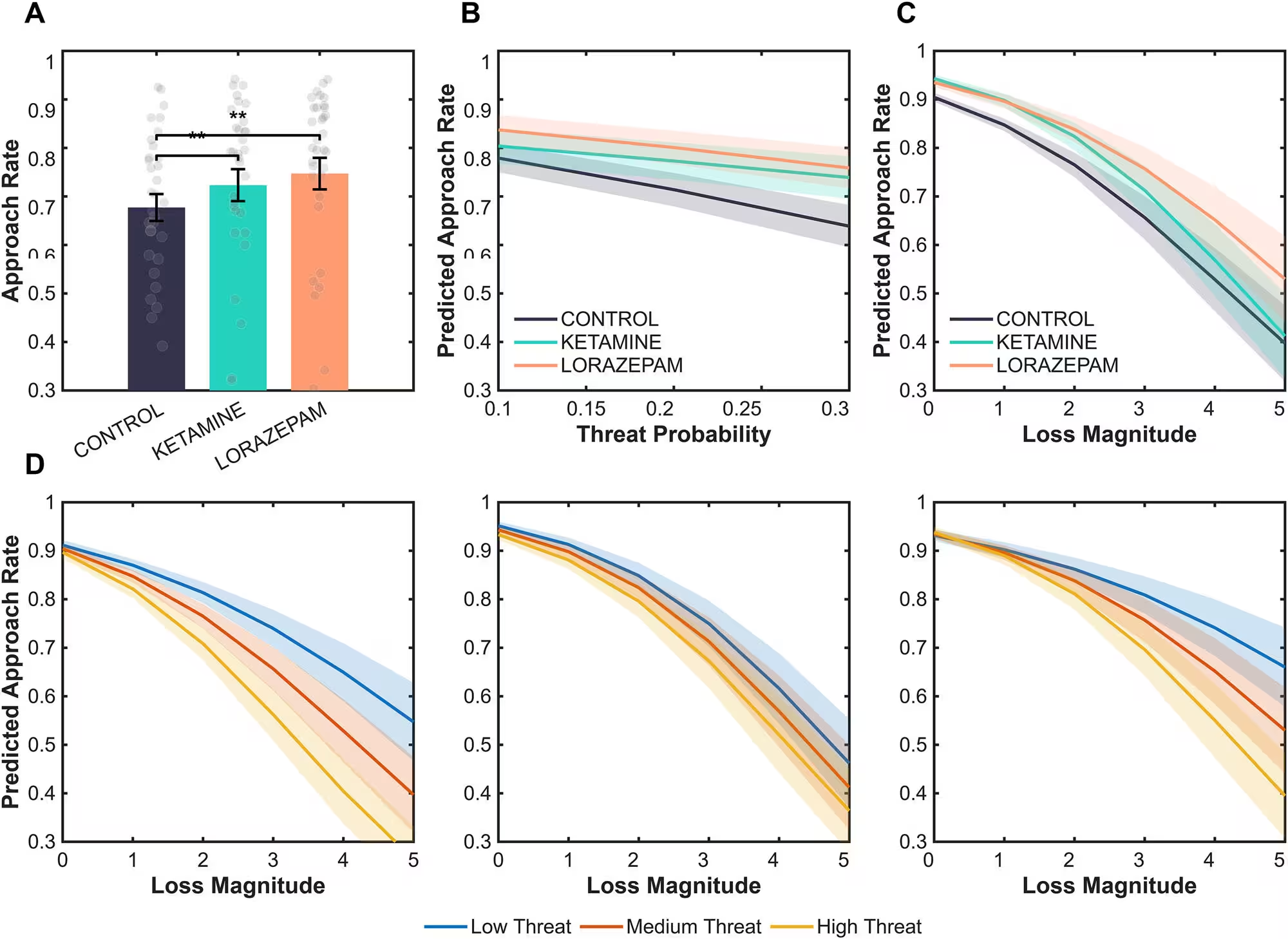
Under ketamine, participants showed a reduced sensitivity to implicit threat probabilities, meaning their approach decisions declined much less steeply as the danger of an attack increased. At the same time, they became significantly more sensitive to explicit loss magnitude, taking chances when potential losses were small and holding back when losses were large. Furthermore, ketamine accelerated behavioral dynamics, significantly shortening both the time it took participants to initiate an approach toward a token and the time required to retreat safely back to the starting zone.
Why Did Lorazepam Produce a Different Behavioral Profile?
In contrast to ketamine, oral lorazepam produced a broadly elevated approach rate that flattened both threat-related and loss-related decision slopes. While lorazepam increased overall movement toward rewards, it failed to generate the same selective adaptation to concrete financial losses. At the highest threat levels, token gains under lorazepam declined steeply, whereas ketamine maintained stable and efficient performance.
Control analyses confirmed that these differences were not driven by changes in general attention, task repetition, or the order in which participants received the drugs. The accuracy of button presses corresponding to the correct direction of tokens did not differ across conditions, indicating that the behavioral changes stemmed from motivational shifts rather than perceptual impairments.
What Are the Limitations of These Findings?
The authors noted several important limitations to keep in mind when interpreting the results. The study was conducted exclusively on a small sample of healthy young adults rather than clinical patients, meaning the observed behavioral changes may not directly translate to individuals currently experiencing clinical depression or anxiety disorders.
Additionally, full participant and physician blinding was not feasible due to the distinct administration routes and subjective effects of intranasal ketamine versus oral lorazepam, although personnel responsible for analyzing behavioral data were blinded to the conditions. The control session was always administered first rather than being randomized, and session-level mood, anxiety, and dissociation ratings were not systematically collected. Finally, the study only captured behavior during a single subacute time window while the drugs remained pharmacologically active, leaving open questions about whether these motivational shifts persist long-term.
The research was published in Communications medicine on November 20, 2026.
This article has been fact checked for accuracy, with information verified against reputable sources. Learn more about us and our editorial process.
Last reviewed on .
Article history
- Latest version
Reference(s)
- Vestring, Stefan., et al. “Ketamine promotes strategic and efficient approach-avoidance conflict resolution.” Communications Medicine, vol. 6, no. 1, November 20, 2026 Springer Science and Business Media LLC, doi: 10.1038/s43856-026-01998-5. <https://doi.org/10.1038/s43856-026-01998-5>.
Cite this page:
- Posted by Jessica Martin