Psychology Says That People Who Prefer to Remain Silent Rather Than Engage in Conflict Tend to Have More Self-Control Than Others
Choosing silence over conflict reflects complex self-control dynamics beyond simple avoidance

Choosing not to speak up in a dispute is often read as calmness – no raised voices, no visible tension, no obvious clash. Yet new evidence shows that this outward composure can mask a deeper avoidance driven by anxiety rather than confidence.
A recent investigation published in Scientific Reports by scholars at Columbia Business School uncovers a consistent reluctance to engage in situations where one person’s gain would come at another’s expense. The researchers label the pattern “zero‑sum aversion,” and demonstrate that fear of conflict, not a desire for fairness, fuels the behavior.
Fear Overrides Potential Gains
Across 13 experimental setups – ranging from negotiation simulations to performance‑review scenarios, job‑application choices, and monetary games – participants repeatedly favored options that insulated their outcomes from others. Even when a competitive alternative promised higher probabilities of success or larger payouts, respondents chose the non‑competitive route.

In a financial‑stakes lottery task, the competitive choice improved its odds stepwise, eventually gaining a 40 percent advantage over the safe alternative. Still, 89 percent of participants declined the competitive option.
When evaluating compensation structures, MBA students demanded roughly 14 percent higher base salaries to accept positions at firms that rank employees against one another, compared with firms that assess performance on absolute metrics. This premium persisted even after accounting for confidence in personal performance.
Anticipated Tension Drives the Avoidance
The team probed the underlying motive by asking participants to predict the emotional climate of competitive interactions. The expectation of heightened tension, animosity, and friction explained most of the avoidance, while general preferences for cooperation did not.
When researchers explicitly framed conflict as acceptable or inevitable within the experimental environment, the zero‑sum aversion largely vanished. Participants then entered previously avoided scenarios, reinforcing the conclusion that fear of conflict—not personality traits or ethical values—is the primary catalyst.
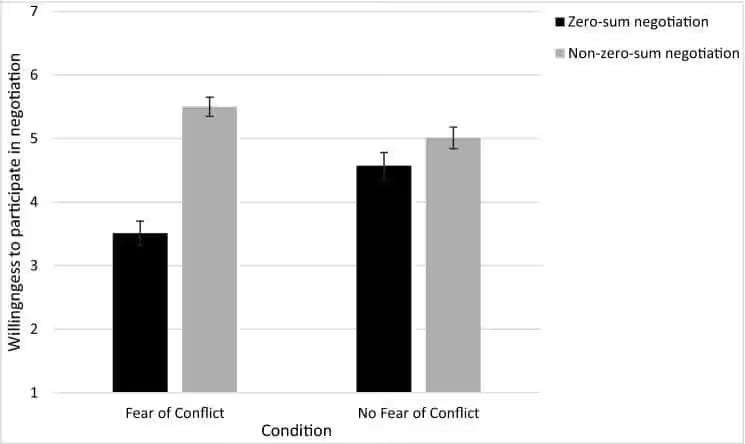
Even when acting as managers tasked with selecting performance‑evaluation systems for their teams, participants avoided competitive designs, anticipating that such structures would spark discord among subordinates.
Silent Patterns and Their Roots
Beyond the experimental data, existing psychological research suggests that chronic silence in disputes can stem from early experiences where dissent attracted punishment, relational strain, or withdrawal of affection. For some, remaining quiet becomes an ingrained coping strategy rather than a conscious choice.

Such patterns often intersect with high agreeableness, a strong drive for harmony, or attachment styles that prioritize relationship preservation over personal expression. In intimate partnerships, the outward calm can mask unresolved tension, creating an illusion of stability while emotional needs remain unmet.
Prolonged avoidance may accumulate hidden costs: lingering resentment, emotional distance, and a blurred sense of one’s own priorities. What begins as self‑protection can, over time, become a source of psychological strain.
Scope and Limits of the Findings
The Columbia team observed that zero‑sum aversion was unrelated to gender or to participants’ orientation toward prosocial versus individualistic values. The effect persisted across diverse samples – online respondents, MBA cohorts, and broader community participants – and manifested in both real‑money and hypothetical decisions.
However, the research does not address whether chronic conflict avoidance translates into poorer long‑term outcomes in personal or professional realms. The authors also note that steering clear of zero‑sum situations can be rational when actual social or reputational stakes are high. They deem the behavior irrational only in contexts where conflict would have negligible consequences, such as anonymous one‑off games.
This article has been fact checked for accuracy, with information verified against reputable sources. Learn more about us and our editorial process.
Last reviewed on .
Article history
- Latest version
Reference(s)
- Davidai, Shai. “The fear of conflict leads people to systematically avoid potentially valuable zero-sum situations.”, vol. 12, pp. 17944 PubMed Central (PMC), doi: 10.1038/s41598-022-22849-y. <https://pmc.ncbi.nlm.nih.gov/articles/PMC9605973/>.
Cite this page:
- Posted by Zubair Ali