Experts Say People Who Constantly Apologize for Things That Aren’t Their Fault May Not Be Overly Polite. It’s a Learned Childhood Survival Reflex
Repeatedly saying sorry might seem innocuous, yet psychological insights indicate it could stem from childhood experiences where emotions had to be navigated before their causes were truly grasped.

I apologized reflexively when someone bumped into me. I apologized when the barista handed me the wrong drink. I apologized when my friend arrived late. None of it was my fault, and I’d been awake for ninety minutes. For the first time in roughly forty years, I noticed what I was doing. The apologies had been on autopilot since childhood. The noticing felt like a revelation.
Why am I saying sorry, I thought. None of this is mine. The honest answer arrived hours later during the drive home. It wasn’t politeness. It never had been. It was a reflex built at age eight, in a house where someone else’s mood was always, somehow, the child’s job to fix.
The Unseen Pattern of Emotional Parentification
Psychologists call this emotional parentification, a chronic role reversal where a child takes on the job of managing a parent’s emotional state. The child learns to scan faces, read the temperature of a room within seconds, and fire off apologies as a tool to thaw an adult’s unpredictable coldness.
Researchers have extensively studied this dynamic. A mixed-methods systematic review published in June 2023 in the International Journal of Environmental Research and Public Health examined 95 studies across six continents. The review, led by researchers from the University of Illinois Urbana-Champaign and Georgia State University, confirmed that emotional parentification pushes children into adult-sized emotional roles long before they are ready for them.

Children in these homes become stand-in parents, confidants, emotional supporters, and peacemakers for the adults who are supposed to be caring for them. Apologizing worked. It sometimes broke the cold. It said, I see you, I know something is off, I’m taking it on, please come back. Whether the child had actually done anything wrong didn’t matter. What mattered was that the apology was the only tool they had.
The Long-Term Consequences
The systematic review linked parentification to a range of negative outcomes. Parentified youth developed higher rates of depression and anxiety, more behavioral problems, poorer physical health, and lower educational attainment. The review also noted that the effects can spill into sibling relationships and even carry into the next generation, a process researchers call intergenerational transmission.
A separate 2023 Japanese study sharpened the picture further. Adults who had provided emotional care for their parents during their school years were more than three times as likely to report high psychological distress in adulthood compared to those who had not.
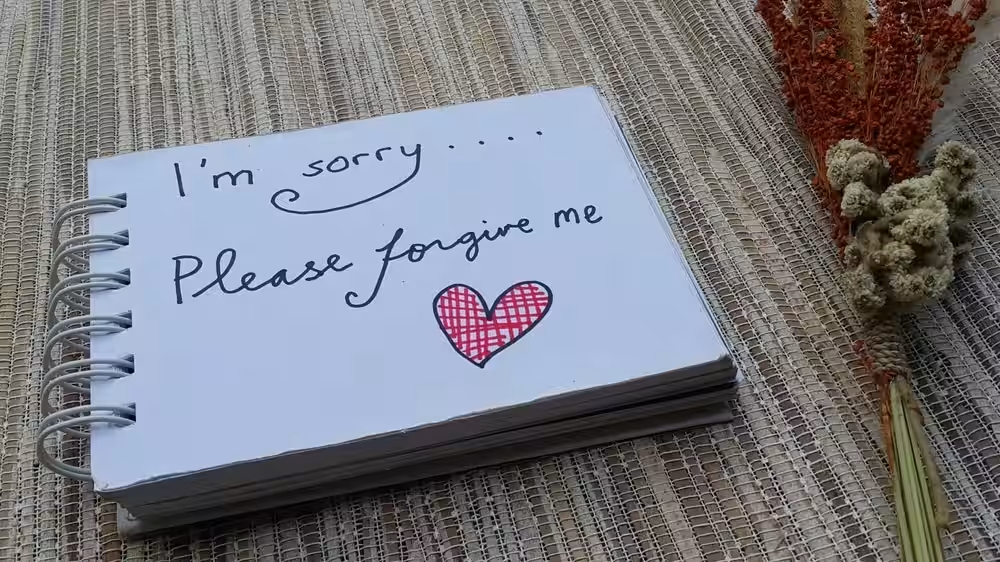
The pattern does not stop when someone leaves home. It changes clothes. The child who scanned the kitchen for a mother’s mood becomes the adult who scans the office for a boss’s mood, the dinner party for tension between friends, the bedroom for a partner’s tiredness. The pre-emptive sorry stays on the shelf, firing before conscious thought enters the room.
The Consequences in Adulthood
Once you start watching for it, you see it everywhere. It is apologizing for taking up space in a queue. Apologizing when someone else is rude to you. Apologizing when your colleague is late to the meeting, as if your punctuality somehow inconvenienced them. Apologizing before asking for something you have every right to ask for. Apologizing for crying, for being tired, sometimes for things that haven’t happened yet.
None of this is politeness. Politeness involves thank you, please, excuse me. This is the adult version of the eight-year-old’s emotional regulation tool, still activating every time the room’s temperature shifts even slightly. The cost from the outside stays invisible because everyone thinks you are just very nice. The cost from the inside is that you pour enormous energy into taking on responsibility that isn’t yours and almost no energy into asking others to carry what belongs to them.

The cold the child learned to fear was specific to one house, with one set of adults, in one particular decade. The rest of the world does not run on that thermostat. But teaching the nervous system that truth takes time. It happens one withheld apology at a time.
Breaking the Pattern
The starting point is practical and backed by the research. Notice the sorry before it lands. Hold it for two seconds. Ask, quietly, is this actually mine? Most of the time, the answer is no. You can put it down. Nothing bad will happen. The room will not go cold.
The 2023 parentification review reinforces that protective strategies matter. Youth who leaned on coping skills, found some meaning in their contributions, or had outside social supports showed more resilient outcomes. For adults still carrying the reflex decades later, the protective strategy is awareness itself: catching the apology before it leaves the mouth and recognizing that the debt was never real to begin with.
The apology reflex is not a personality trait. It is a learned behavior, built inside a specific environment, and it can be unlearned one conscious moment at a time.
This article has been fact checked for accuracy, with information verified against reputable sources. Learn more about us and our editorial process.
Last reviewed on .
Article history
- Latest version
Reference(s)
- Dariotis, Jacinda. “Parentification Vulnerability, Reactivity, Resilience, and Thriving: A Mixed Methods Systematic Literature Review.”, vol. 20, no. 13, pp. 6197 PubMed Central (PMC), doi: 10.3390/ijerph20136197. <https://pmc.ncbi.nlm.nih.gov/articles/PMC10341267/>.
- Kageyama, Masako. “Childhood Adversities and Psychological Health of Adult Children of Parents with Mental Illness in Japan.”, vol. 11, no. 2, pp. 214 PubMed Central (PMC), doi: 10.3390/healthcare11020214. <https://www.ncbi.nlm.nih.gov/pmc/articles/PMC9859196/>.
Cite this page:
- Posted by Zubair Ali