Neanderthals Were Once Thought to Communicate with Grunts, Scientists Now Believe They Had Language
Neanderthals may have possessed a surprisingly advanced language ability according to groundbreaking new research
Neanderthals may have been far more like us than once believed. A new synthesis of genetic, archaeological and fossil data indicates that speech and language could have been shared by modern humans and Neanderthals, with origins stretching back hundreds of thousands of years before our species appeared.
For decades, Neanderthals were depicted as primitive hominins lacking many of the capabilities associated with modern humans. Recent discoveries have reshaped that picture, revealing a far more intricate portrait of our closest extinct relatives. A persistent question concerns language: could Neanderthals have spoken, and did they use a linguistic system comparable to ours?
Ancient Roots of Human Speech
The notion that language sprang up suddenly in the recent past has dominated thinking for many years. Some scholars have argued that modern language emerged around 50,000 years ago, perhaps after a handful of genetic tweaks. Researchers Dan Dediu and Stephen C. Levinson contend that the available evidence does not support such a rapid onset. Their review proposes that speech and language are likely much older traits within the human lineage.
Published in Frontiers in Language Sciences, the authors suggest that the foundations of modern language may trace back to the last common ancestor of Homo sapiens, Neanderthals and Denisovans, roughly 500,000 years ago.
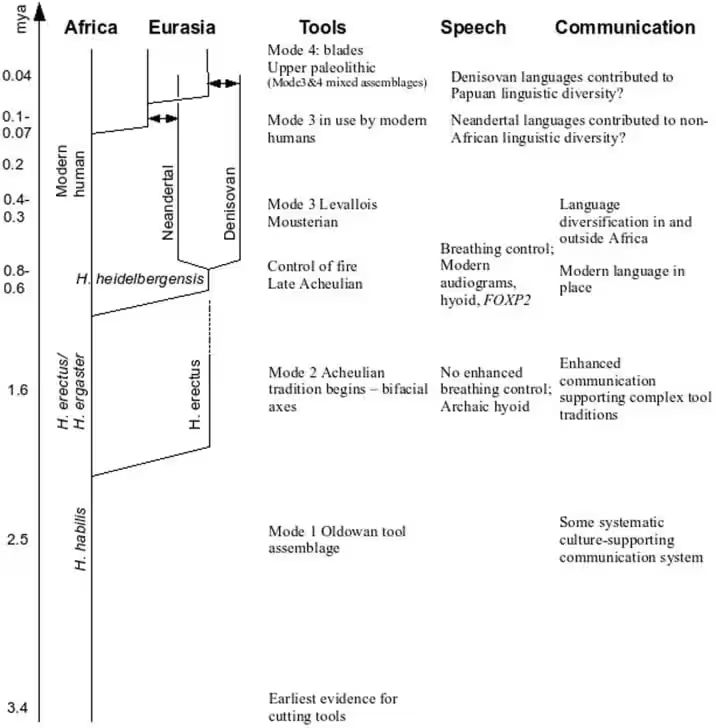
The authors even push the possible origin of language back to roughly one million years ago, far earlier than many conventional estimates. Rather than emerging in a single event, language may have evolved gradually through a cascade of biological and cultural transformations.
Revisiting the Neanderthal Reputation
Scientists have been intrigued by Neanderthals since their first remains were identified nearly 200 years ago. Early accounts often portrayed them as dim‑witted and unsophisticated, capable of only rudimentary communication.
That image has steadily faded. According to the study team, fresh archaeological finds, re‑examination of older specimens and breakthroughs in ancient DNA analysis have uncovered a population whose cognitive abilities and cultural practices rival those of modern humans.
Neanderthals occupied vast stretches of western Eurasia for several hundred thousand years, weathering major climatic swings that included both glacial and interglacial periods. Their long‑term presence across such an extensive area signals a degree of adaptability that earlier researchers tended to underestimate. Accumulating evidence now prompts many scholars to reconsider the role of Neanderthals in the broader narrative of human evolution.
Do Echoes of Neanderthal Speech Persist Today?
Genetic investigations have revealed that modern humans who migrated out of Africa interbred with both Neanderthals and Denisovans, leaving detectable traces in our genomes. The study suggests that these encounters may have involved not only genes but also linguistic exchange.
If early human groups shared knowledge and culture, it is plausible that linguistic influences were part of those interactions. The researchers propose that elements of modern linguistic diversity could reflect these ancient contacts. This hypothesis could be examined by comparing structural features of African and non‑African languages and by employing computer simulations to model language spread over time.
Although no direct artefacts of Neanderthal speech have been uncovered, the review argues that the case for language among our extinct cousins is considerably stronger than it was a decade ago. As new data accumulate, the distance between Neanderthals and modern humans appears to be narrowing.
This article has been fact checked for accuracy, with information verified against reputable sources. Learn more about us and our editorial process.
Last reviewed on .
Article history
- Latest version
Reference(s)
- “Dan Dediu | Master in Cognitive Science and Language.” <https://ccil.ub.edu/faculty-member/dan-dediu>.
- “Max Planck Institute.” <https://www.mpi.nl/people/levinson-stephen>.
- Dediu, Dan. “On the antiquity of language: the reinterpretation of Neandertal linguistic capacities and its consequences.” Frontiers in Psychology, vol. 4, July 5, 2013, pp. 46239 Frontiers, doi: 10.3389/fpsyg.2013.00397/full. <https://www.frontiersin.org/journals/psychology/articles/10.3389/fpsyg.2013.00397/full>.
Cite this page:
- Posted by Zubair Ali