New Gaussian AI Map Method Reconstructs Gene Activity and Cuts Memory Usage
A novel spatial transcriptomics framework models gene expression using adaptive Gaussian fields, improving map accuracy while reducing memory demands by up to ninety-nine percent.
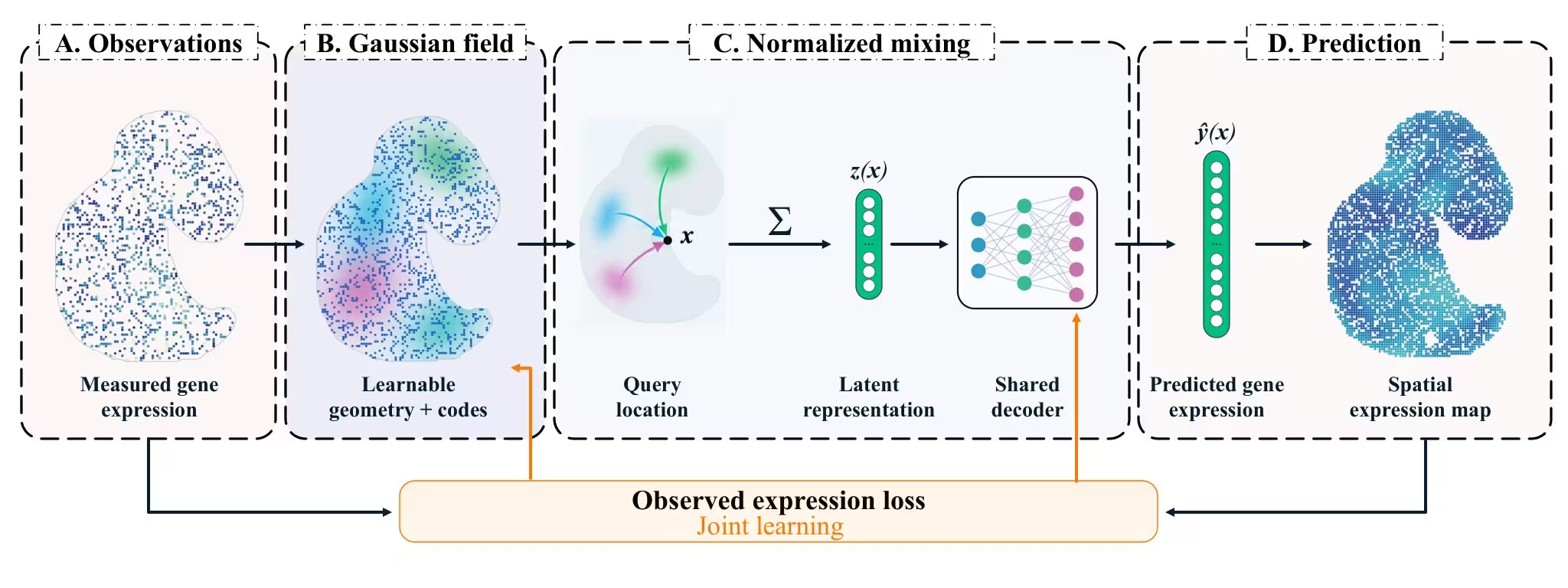
A new machine learning method models gene activity across tissue coordinates using thousands of adaptive Gaussian shapes, successfully reconstructing gene expression maps while slashing computer memory demands by up to ninety-nine percent. Spatial transcriptomics measures gene expression at known locations within biological tissues, helping scientists understand cell organization and function. However, limited spatial sampling and sparse data often leave gaps in these molecular maps. To overcome this, Baichuan Yang and researchers at Renmin University of China developed a technique called GaLF-ST, which represents gene activity as a continuous field driven by learnable spatial coordinates.
The study, published in arXiv, introduces a framework that places over a thousand Gaussian primitives across tissue coordinate space. Each primitive features adjustable centers and anisotropic covariances, meaning they can scale and rotate to capture directional variations in gene expression. These spatial basis functions determine the mixing weights of low-dimensional latent vectors at any given location. A shared nonlinear decoder then maps this combined latent state into multigene expression predictions, while observed errors jointly update the geometry, latent vectors, and decoder parameters from initialization.
How Does This Gaussian Approach Outperform Traditional Coordinate Networks?
Most existing spatial reconstruction tools rely on coordinate neural networks that map spatial positions directly to gene expression or latent features through shared network weights. While effective, these older architectures keep local spatial relationships implicit, making it difficult to capture sharp boundaries between different tissue regions. By explicitly modeling spatial geometry with adjustable Gaussian primitives, GaLF-ST explicitly defines local position, scale, and orientation for gene expression patterns.
To evaluate performance fairly, the authors established a unified benchmark across seven dataset groups and three held-out fractions, ranging from twenty to eighty percent hidden data. The collection covered whole mouse embryos, brain sections sampled at near-cellular resolution, human cortical sections, and a three-dimensional organ stack. Across twenty-one distinct experimental settings, GaLF-ST achieved leading overall reconstruction performance, improving mean squared error and spatial correlation metrics compared to established baselines like STAGE, SUICA, CPS, and reference-guided STINR.
What Happens to Tissue Domain Preservation Under Extreme Data Scarcity?
When researchers tested how well reconstructed expression profiles preserved biological tissue structures, the results showed distinct advantages in high-density and sparse observation conditions. Using clustering algorithms evaluated against anatomical annotations, GaLF-ST maintained higher adjusted Rand index and normalized mutual information scores on human dorsolateral prefrontal cortex data across every held-out fraction. At an eighty percent holdout level, its clustering agreement scores exceeded older methods by up to forty-five percent.
Ablation experiments within the study revealed that replacing the explicit Gaussian field with standard neural architectures like Fourier feature networks or periodic activation networks led to higher reconstruction errors and poorer spatial correlation. Furthermore, testing different numbers of Gaussian primitives showed that one thousand twenty-four primitives provided an optimal balance between empirical accuracy and computational overhead, avoiding the overfitting risks seen at larger scales while maintaining robust performance across diverse biological tissues.
The study was posted to the arXiv preprint server on November 20, 2026.
This article has been fact checked for accuracy, with information verified against reputable sources. Learn more about us and our editorial process.
Last reviewed on .
Article history
- Latest version
Reference(s)
- Yang, Baichuan. “GaLF-ST: Gaussian Latent Fields for Spatial Transcriptomics Reconstruction.” arXiv.org <http://arxiv.org/abs/2611.27143v1>.
Cite this page:
- Posted by Faisal Qureshi