Sixteen-Cell Alga Transforms Into a Saddle Shape Through Unequal Growth Rates
Researchers discover how differential cell expansion creates mechanical stress that forces a microscopic green alga to buckle out of plane.
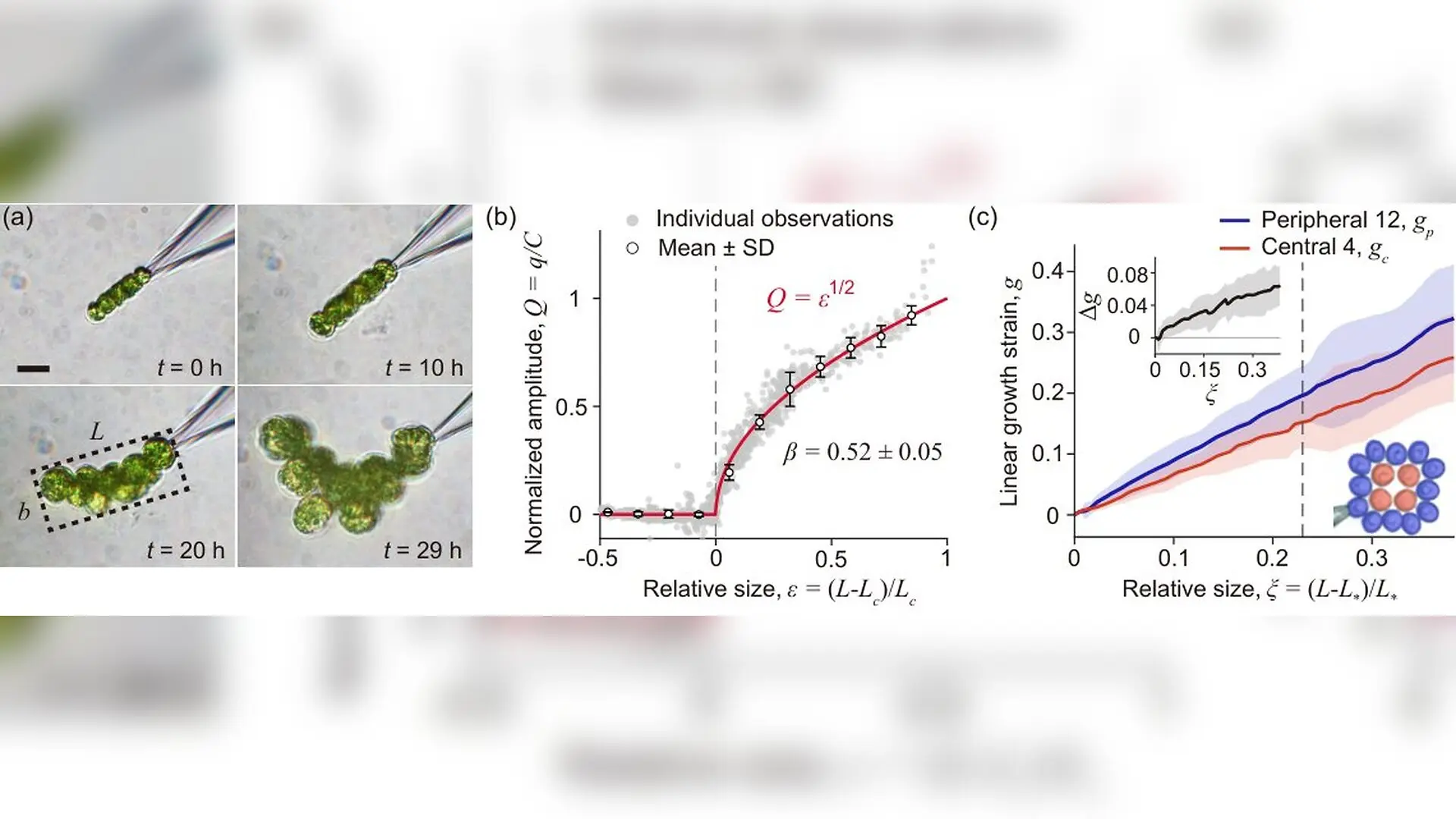
A tiny green alga with just sixteen cells transforms its flat body into a striking saddle shape as it grows, driven entirely by unequal expansion rates rather than cell division. Researchers discovered that the twelve cells on the outer edge of the microalga grow faster than the four cells in the center, generating internal mechanical stresses that force the sheet to buckle out of plane.
Many simple multicellular organisms rely on a complex interplay between cell growth and the generation of an extracellular matrix, which is a structural network of proteins and molecules surrounding the cells that provides physical scaffolding. In higher organisms, tissue growth involves constant cell division and migration, making it difficult to separate these mechanical forces. To bypass this complexity, a team led by researchers at the University of Cambridge turned to a colonial green alga known as Gonium pectorale.
How Does Unequal Cell Growth Bend a Flat Microscopic Alga?
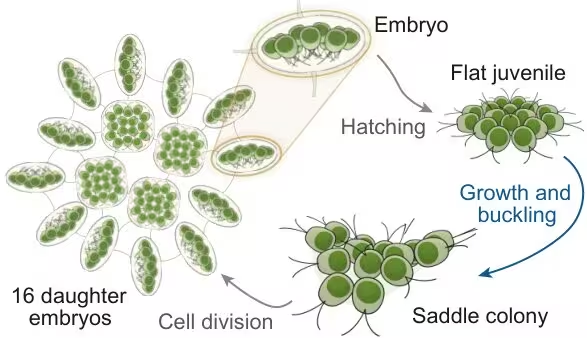
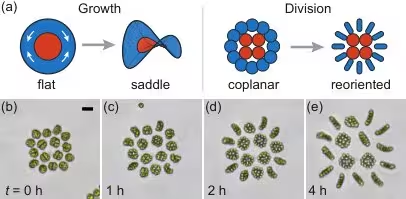
The organism features a fixed arrangement of sixteen cells embedded in a shared extracellular matrix, starting out as a flat plate in its juvenile stage. As the colony grows over a period of about twenty-nine hours without any cell division or rearrangement, it develops a pronounced out-of-plane deformation resembling a saddle. Using micropipette aspiration to hold individual colonies gently in place, the researchers tracked how shape changes unfolded over time.
Cell-level measurements and three-dimensional reconstructions revealed that the twelve peripheral cells outgrow the four central cells, leading to a measurable growth mismatch. This faster expansion at the outer edges creates what physicists call hoop compression, where the outer ring is squeezed because it cannot expand freely. Within elasticity theory, this incompatible growth generates residual stress that is relieved through out-of-plane bending.
What Controls the Saddle Shape and Its Sudden Appearance?
The team analyzed the shape changes using a continuum model of differential growth published in arXiv, building upon classical elasticity principles. The mathematical model shows that the growth pattern naturally selects a specific saddle-like buckling mode, matching the experimental observations where the second azimuthal mode dominates every colony.
When measuring the amplitude of the deformation relative to the critical size of about forty-seven micrometers, the researchers found that the shape change follows a continuous square root growth pattern. This behavior points to a supercritical pitchfork bifurcation, meaning the transition happens smoothly rather than abruptly once a specific size threshold is crossed.
Why Does This Mechanical Transformation Matter for Multicellularity?
The findings offer a rare look at how physical forces shape early multicellular life. Unlike unicellular relatives where daughter cells separate immediately, or larger algae where complex invagination occurs, Gonium pectorale demonstrates how simple differential growth within a shared matrix can dictate overall morphology.
Furthermore, the physical crowding observed during growth reappears later during cell division, when sixteen new daughter colonies form inside the tethered matrix. The outer daughters are forced to stand edge-on in a ring around the central ones, showing that relieving geometric crowding through out-of-plane bending is a recurring adaptive trait. This mechanical coupling suggests that tuning growth patterns and matrix remodeling provide two distinct evolutionary routes for organisms to control their physical form.
The study was posted to the arXiv preprint server on November 20, 2026.
This article has been fact checked for accuracy, with information verified against reputable sources. Learn more about us and our editorial process.
Last reviewed on .
Article history
- Latest version
Reference(s)
- Wang, Zhao. “Saddle Buckling of a Multicellular Alga Driven by Differential Growth.” arXiv.org <http://arxiv.org/abs/2611.27563v1>.
Cite this page:
- Posted by Hassan Raza