Self-Assembling Lipid Coatings Track Cancer Cell Signals Without Sample Purification
A new microfluidic surface strategy suppresses biological background interference to enable real-time tracking of extracellular vesicles in native fluids.

Lung cancer cell models release microscopic communication packets that scientists can now track in real time using a self-assembling lipid coating that stops biological background interference. The new technique allows researchers to measure cellular signals directly from untreated biological fluids without losing vital temporal data.
Conventional biosensing methods often struggle with sample-driven cross-reactivity, a phenomenon where non-target proteins and molecules in complex fluids stick to sensor surfaces and obscure target signals. To overcome this obstacle, Pascal Rüedi and colleagues at ETH Zurich developed a one-stop surface functionalization strategy utilizing engineered lipid-based nanocarriers, as detailed in a study available on the arXiv preprint server. These nanocarriers self-assemble within minutes inside microfluidic channels into uniform, immunoassay-ready interfaces that combine robust polymer brush passivation with site-specific antibody probes.
How Does One-Step Lipid Self-Assembly Prevent Background Interference?
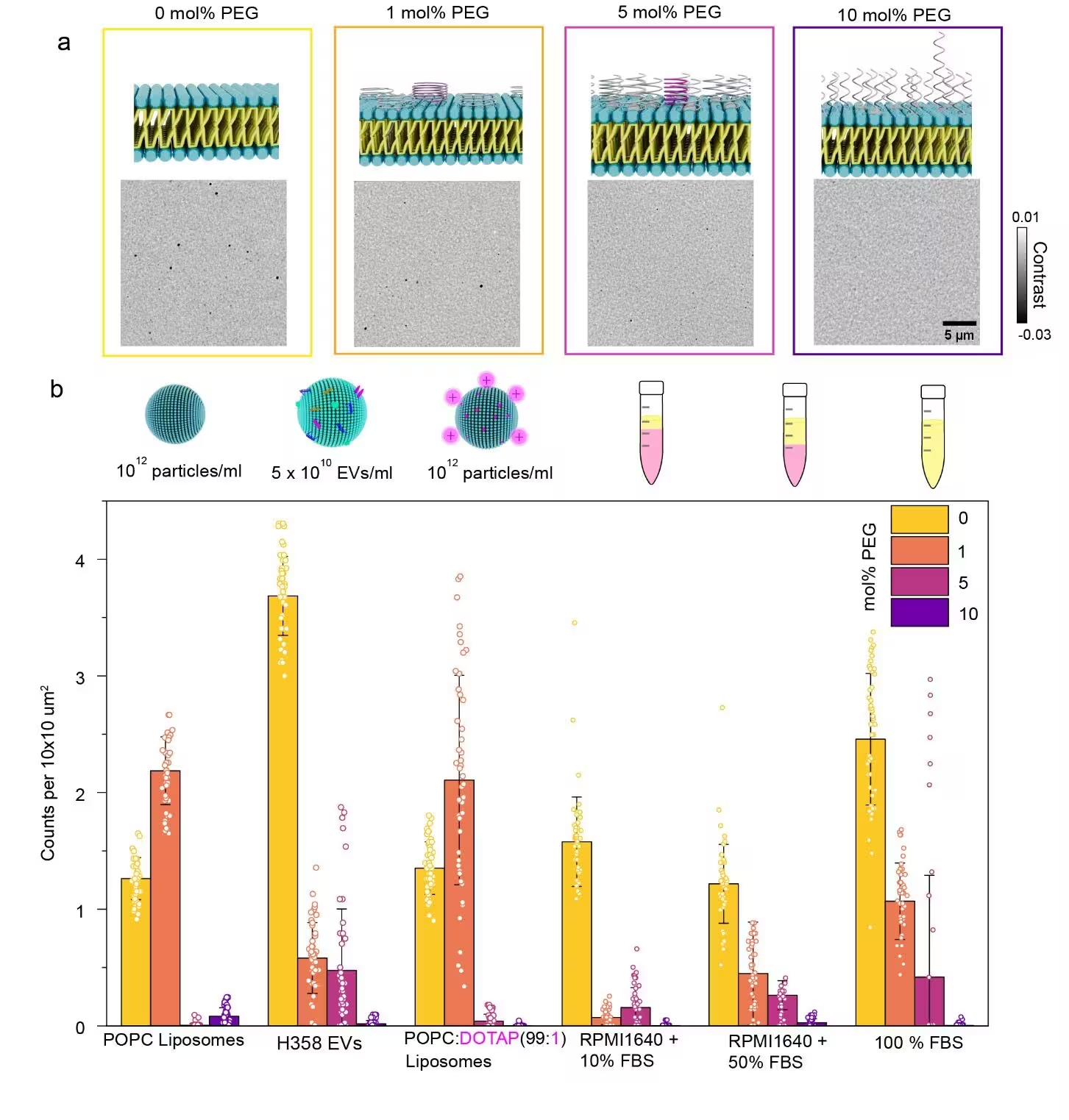
The research team engineered 30 nanometer liposomes composed of three specific lipid species: a fluid matrix component called POPC, a short-chain polymer modifier for surface passivation, and a functionalized lipid carrying azide groups for targeted antibody attachment. When these nanocarriers contact the inner surfaces of microfluidic channels, they spontaneously form a continuous coating across both glass and polydimethylsiloxane substrates. The team found that optimizing the density of the polyethylene glycol polymer units shifted the coating into a brush regime that completely repelled non-specific binding, even when challenged with undiluted fetal bovine serum and highly concentrated nanoparticle solutions.
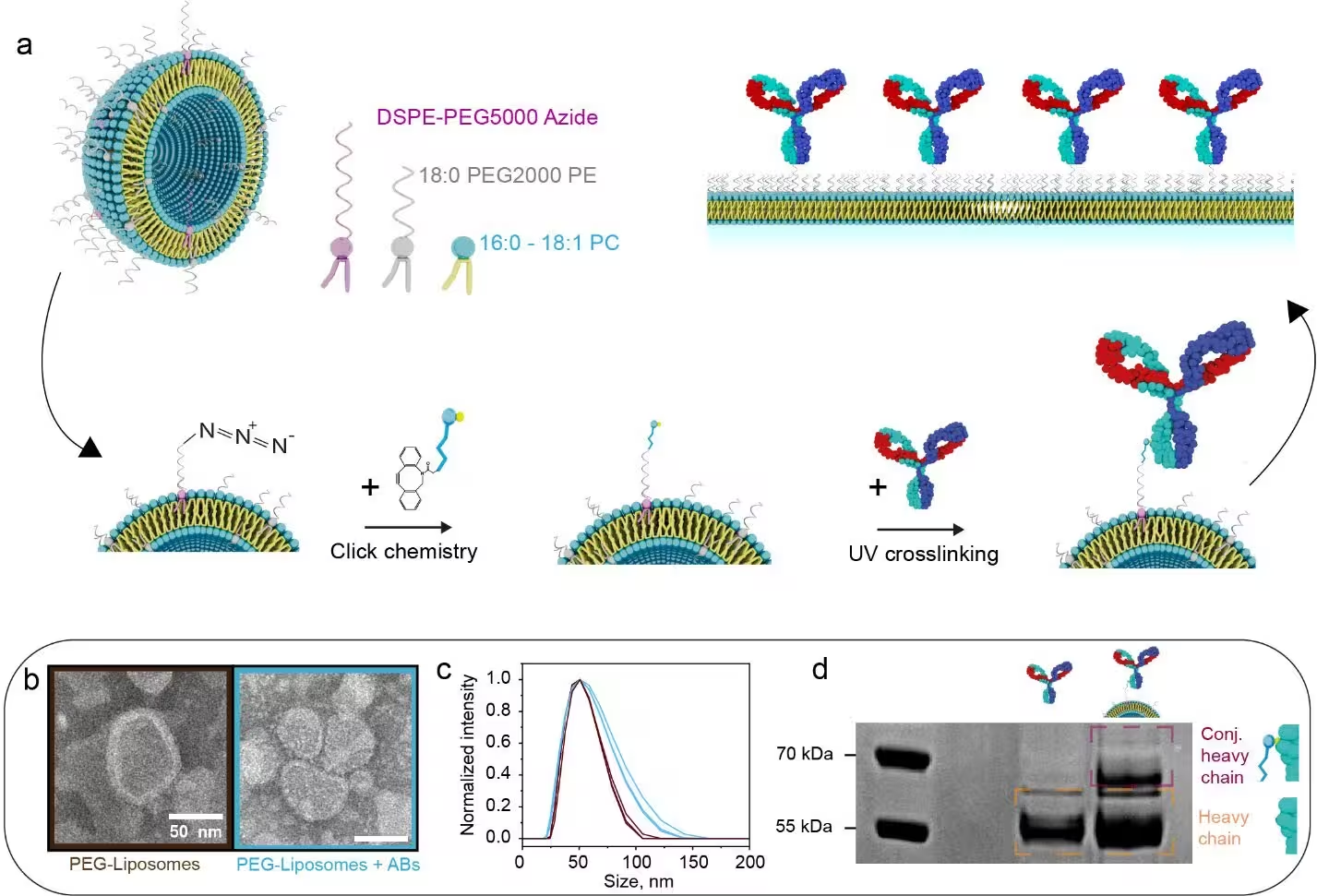
By bypassing the multi-step chemical treatments typically required for biosensor preparation, this modular approach decouples surface chemistry from device fabrication. A single fluid injection coats and passivates the entire microfluidic flow chamber. This setup prevents background interference and allows sensitive detection in native biological environments.
Can Researchers Track Extracellular Vesicle Secretion Without Purification Steps?
To demonstrate the practical utility of their platform, the authors applied the self-assembling coating to monitor extracellular vesicles, which are tiny lipid-bound nanoparticles secreted by cells to mediate intercellular communication. These vesicles are notoriously difficult to study because standard laboratory protocols rely on upstream isolation and centrifugation steps that are time-consuming, require large sample volumes, and can alter sample composition. Using a label-free optofluidic microscope that combines digital in-line holography with microfluidics, the team quantified the secretion dynamics of vesicles carrying specific surface proteins, known as tetraspanins, directly from human lung cancer cell cultures.
What Did Continuous Monitoring Reveal About Cancer Cell Spheroids?
The investigators tracked tetraspanin marker profiles, including CD9, CD81, and CD63, from human bronchioalveolar carcinoma cell supernatants over 36 hours. The platform required only fifty microliters of sample per measurement and detected target vesicles with high linearity and a calculated limit of detection of two hundred twenty million particles per milliliter. Extending the approach to three-dimensional spheroid models, which more closely mimic physiological tissue, the researchers subjected the cell clusters to thermal stress by elevating temperatures to 39 degrees Celsius and subsequently 41 degrees Celsius.
The longitudinal tracking revealed that elevated temperatures induced a measurable decrease in vesicle secretion rates, which partially recovered when the system returned to standard physiological conditions. These observations highlight how isolation-free monitoring uncovers dynamic biological responses that standard end-point assays would otherwise miss. The authors suggest that this versatile surface engineering strategy could improve biosensing applications ranging from therapeutic vesicle manufacturing to organ-on-a-chip diagnostics.
The study was posted to the arXiv preprint server on November 20, 2026.
This article has been fact checked for accuracy, with information verified against reputable sources. Learn more about us and our editorial process.
Last reviewed on .
Article history
- Latest version
Reference(s)
- Rüedi, Pascal. “One-Step Self-Assembling Lipopolymer Coatings Enable Direct Longitudinal Biosensing in Native Biological Matrices.” arXiv.org <http://arxiv.org/abs/2611.27422v1>.
Cite this page:
- Posted by Priya Sharma