Hidden Clumps Orbiting a Young Star Point to Planetary Birth Paces
New telescope observations reveal stable orbiting structures around the star DR Tau, offering a rare glimpse into early planetary systems.
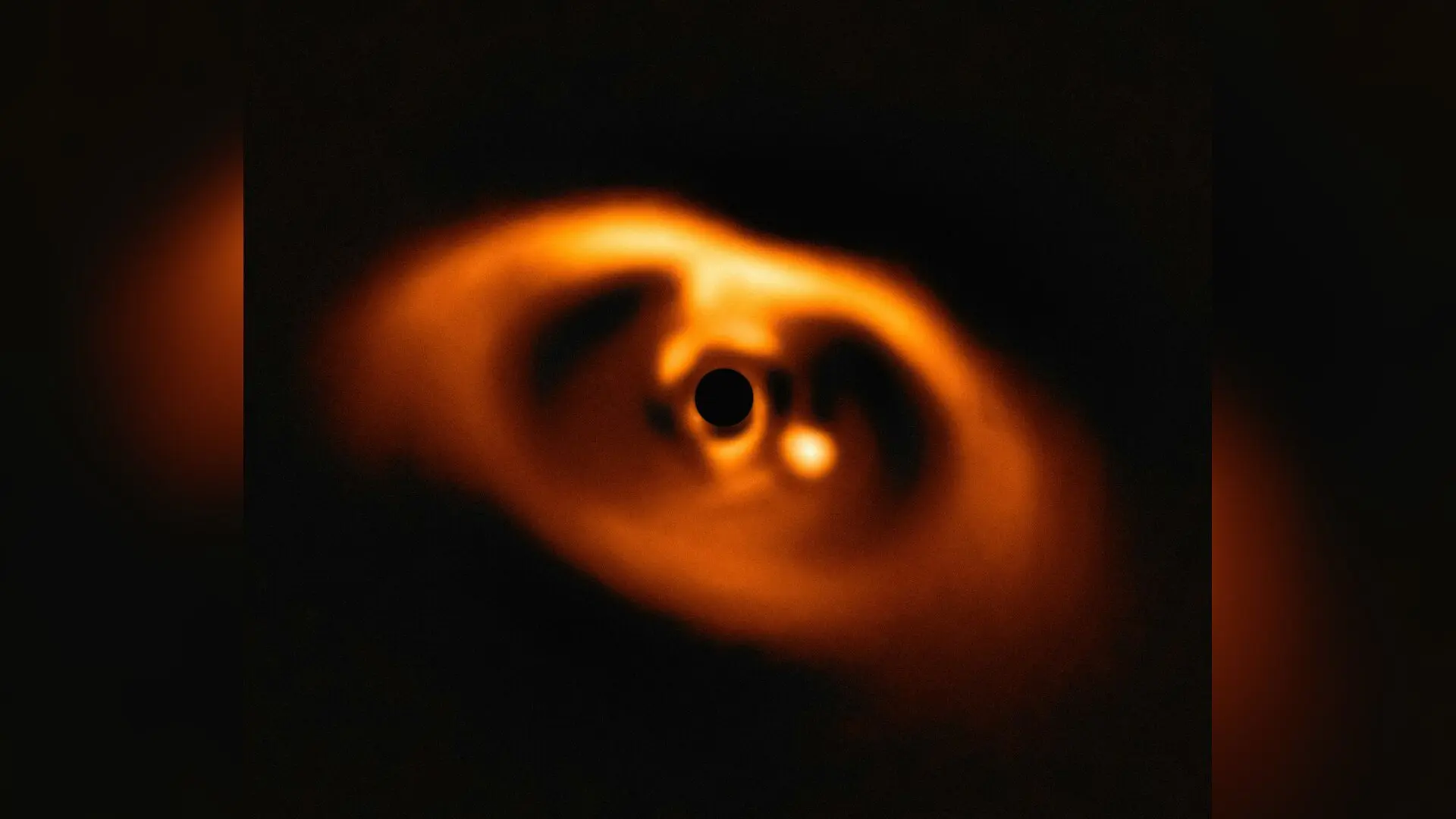
Deep within the dusty cradle of a young star system located roughly one hundred and ninety light-years away, astronomers have spotted tantalizing hints of a giant planet taking shape. The observations reveal two distinct structures orbiting the variable star DR Tau, a youthful stellar object surrounded by a massive disk of gas and dust.
While direct images of planets still embedded in their natal material remain exceedingly rare, this new investigation offers one of the most comprehensive looks yet at the complex mechanics of early planetary systems. The findings point to a potential planetary companion with a mass several times that of Jupiter, though researchers caution that alternative explanations cannot yet be completely ruled out.
How did powerful new telescopes capture these hidden disk structures?
To peer through the thick shroud surrounding DR Tau, a large international team led by astronomer D. Mesa from the INAF Osservatorio Astronomico di Padova turned to twin high-contrast imagers mounted on the Large Binocular Telescope in Arizona. The instruments, known as SHARK-VIS for visible light and SHARK-NIR for near-infrared wavelengths, utilized advanced adaptive optics to correct for atmospheric blurring in real time.
The research is published on the arXiv preprint server and outlines a multi-wavelength observation strategy designed to isolate specific signatures of active matter falling onto forming sub-stellar objects. By combining narrow-band filters targeting hydrogen emissions with broad-band filters for multi-wavelength characterization, the team aimed to catch a newborn planet in the very act of gathering gas.
What do the two mysterious clumps reveal about orbital motion?
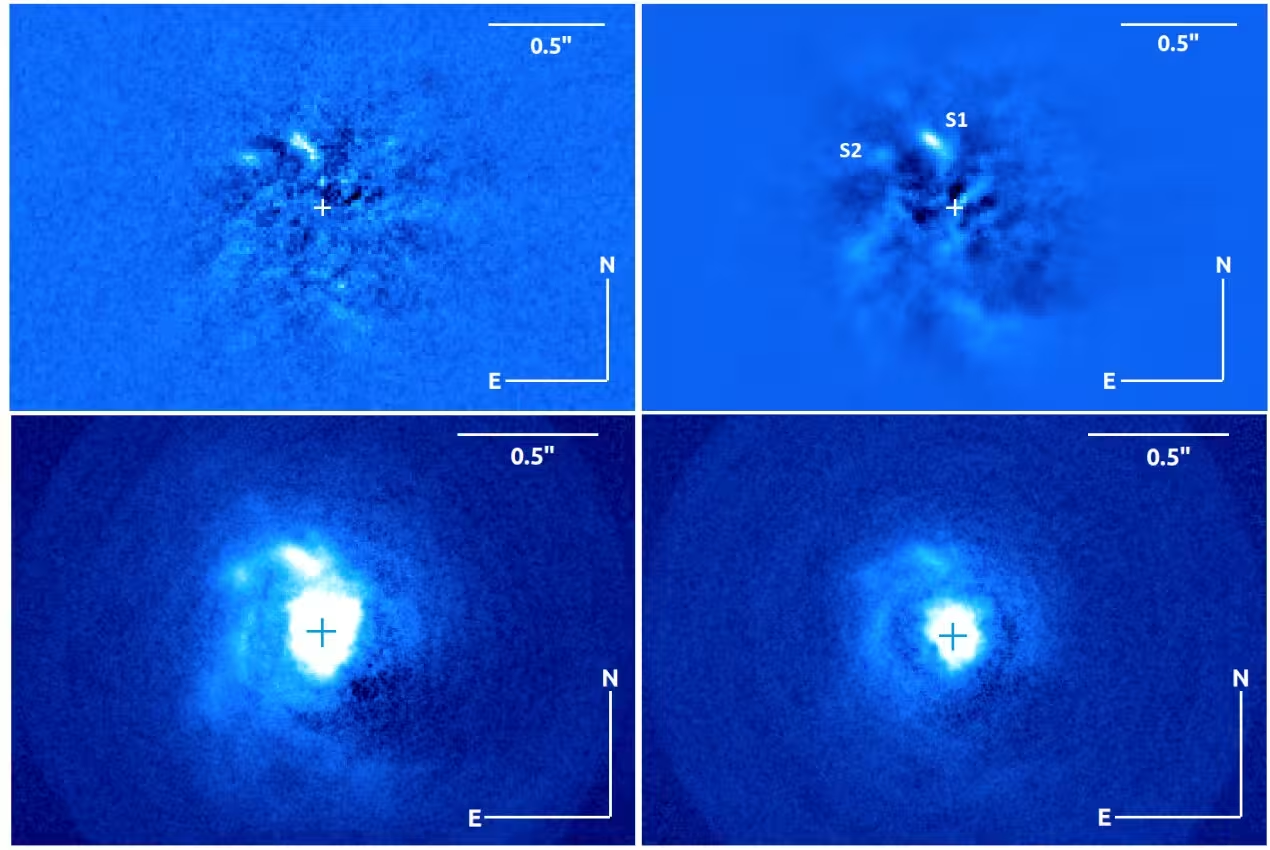
The imaging campaign successfully recovered two primary compact features, designated as S1 and S2, which were compared against archival data spanning a seven-year baseline. The first structure, S1, appears elongated and sits at a projected separation of about fifty-nine astronomical units from the star, aligning closely with the inner cavity edge of the dust disk mapped by the Atacama Large Millimeter/submillimeter Array.
The second structure, S2, lies further out at roughly seventy-four astronomical units and exhibits a compact morphology that appeared faintly in earlier observations but now receives firm confirmation. By tracking both features over nearly seven years, the authors determined that their observed orbital motion matches Keplerian rotation, meaning they move in orderly orbits dictated by the gravity of the central star. This steady orbital pace strongly suggests that the features represent physical structures embedded within the disk rather than fleeting optical artifacts caused by telescope processing.
Could a giant world explain the gaps in the surrounding dust?
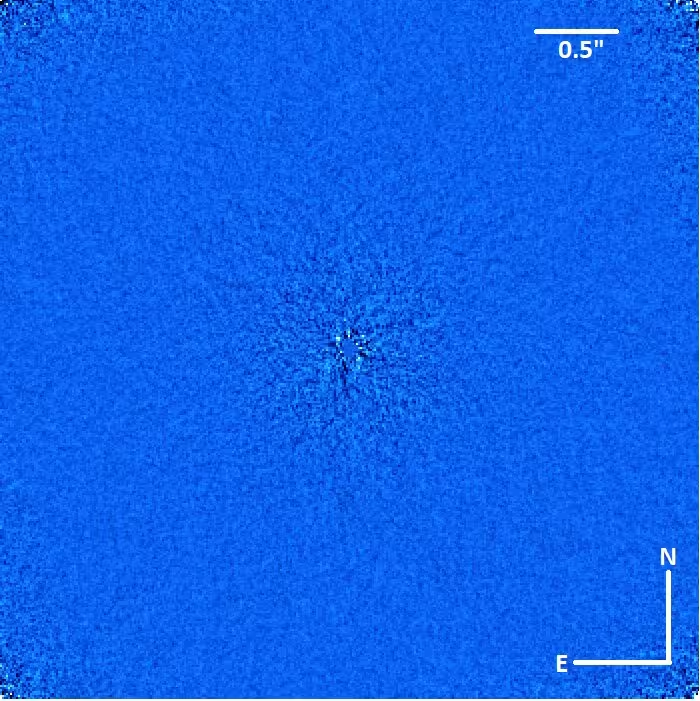
The presence of structure S2 opens up the intriguing possibility that a massive planet of one to two Jupiter masses is carving out gaps in the surrounding material. Mathematical modeling of the system shows that a companion of this size would naturally generate spiral arms and clear out specific ring gaps through mean motion resonances, matching the distribution of dust seen in high-resolution millimeter maps.
However, the team encountered a puzzling contradiction when analyzing light emissions across different wavelengths. While the features shine brightly in hydrogen-alpha and Paschen-beta filters, detailed calculations indicate that this light is primarily stellar illumination scattered by large dust clumps rather than direct radiation from active accretion onto a proto-planet. Furthermore, the apparent position of S2 shifts slightly between visible and infrared views, a discrepancy that the researchers modeled as an optical depth effect within an extended cloud of gas and dust.
Ultimately, while the geometry and rotation rates strongly support the presence of a forming world, definitive proof will require deeper spectroscopic observations. If confirmed by future instruments, DR Tau will provide astronomers with an unprecedented laboratory for witnessing the birth of planets at an exceptionally early stage in stellar evolution.
The study was posted to the arXiv preprint server on November 20, 2026.
This article has been fact checked for accuracy, with information verified against reputable sources. Learn more about us and our editorial process.
Last reviewed on .
Article history
- Latest version
Reference(s)
- Mesa, D.. “Hints of planet formation in progress around DR Tau from observations with LBT SHARK-NIR and SHARK-VIS.” arXiv.org <http://arxiv.org/abs/2611.27643v1>.
Cite this page:
- Posted by Nida Rehman