New Space-Based Interferometry Technique Tests Limits of Mapping Spacetime Ripples
Advanced simulations reveal how a novel cosmic mapmaker handles spacecraft motion and overlapping signals, though high noise thresholds remain a hurdle.
A new mathematical approach designed to map gravitational wave sources using space-based detectors reveals both unexpected promise and strict physical limits. Researchers have successfully tackled key data hurdles for a specialized technique known as coronagraphic time-delay interferometry, which acts like an optical telescope coronagraph by blocking out signals from specific sky coordinates to isolate sources.
The Laser Interferometer Space Antenna, a future space-based observatory featuring three spacecraft flying in a triangular formation with two and a half million kilometer arms, aims to detect ripples in spacetime across the millihertz frequency band. To extract clean signals from this data, scientists rely on time-delay interferometry, a pre-processing method that combines and delays measurements to cancel out overwhelming laser frequency noise. Building on earlier theoretical models, a team led by Raissa Costa Barroso at the University of Portsmouth and the University of Caen Normandie, alongside Ian Harry, has advanced the concept of coronagraphic interferometry to handle realistic space conditions. Their findings are available on the arXiv preprint server as of November 2026.
How Does Second-Generation Interferometry Silence Spacecraft Motion?
In previous formulations, coronagraphic methods were restricted to first-generation variables that fail to suppress laser frequency noise once spacecraft motion is introduced. To overcome this limitation, the authors derived a second-generation coronagraphic variable by substituting standard first-generation data streams with second-generation equivalents while keeping the geometric coronagraphic coefficients unchanged.
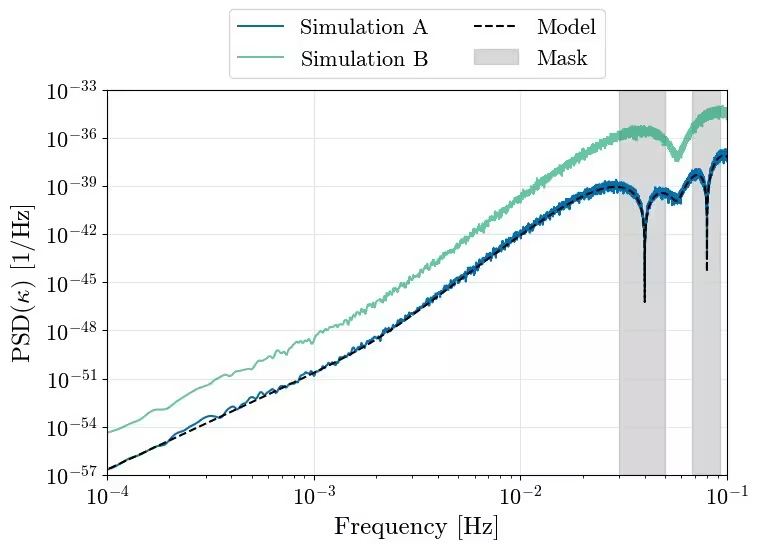
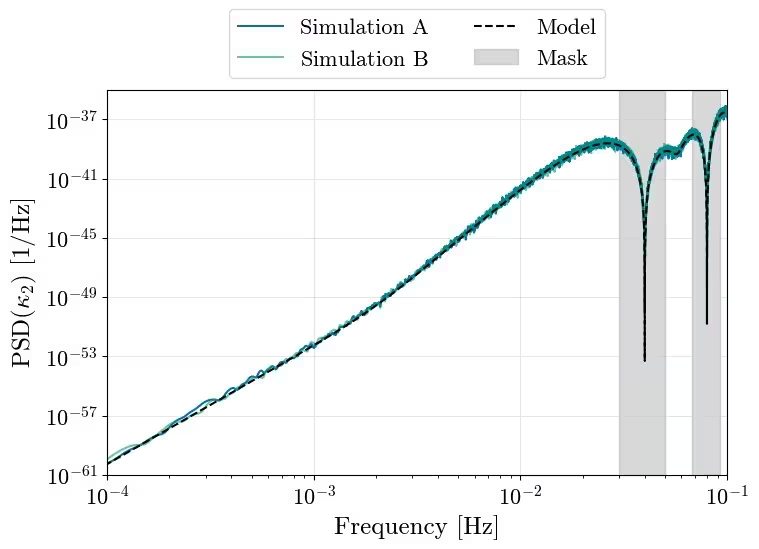
Using advanced instrument simulations incorporating Keplerian orbits, dynamic arm lengths, and laser frequency noise, the team demonstrated that this second-generation variable successfully reduces laser frequency noise down to baseline secondary noise levels, specifically test mass acceleration and optical metrology system noise. This marks a nearly three-thousand-fold improvement over first-generation combinations, while perfectly preserving the spatial nulling property that allows the instrument to cancel point-source signals when pointed directly at them.
What Happens When Multiple Cosmic Sources Overlap in Space and Frequency?
Real space data is crowded with millions of overlapping gravitational wave sources, primarily quiet pairs of white dwarf stars orbiting each other in our galaxy, known as Galactic binaries. When testing how coronagraphic techniques handle signal superposition, the researchers discovered that sources sharing identical sky positions can still be localized independently as long as their characteristic frequencies do not overlap.
However, when two sources overlap in frequency, the system can only isolate the dominant source if it is at least one hundred times louder than its neighbor. Expanding this test to include a massive black hole binary combined with forty-nine verification binaries, the team found that the massive black hole’s sky location could be recovered within roughly one pixel on average across its frequency band, though localized biases emerged near weaker frequencies and specific stellar binary interactions.
Can Statistical Noise Models Pinpoint Sources Rapidly Enough for Fast Alerts?
To evaluate the technique under realistic instrumental noise, the authors introduced a statistical test comparing the coronagraphic null stream against an analytic noise model, establishing confidence regions for sky localization. When analyzing synthetic stellar binaries with signal-to-noise ratios ranging from one thousand to over twelve thousand, the resulting ninety percent confidence regions remained surprisingly large, spanning thousands of square degrees, or about eight percent of the sky.
Narrowing the frequency window around a source improved localization by a factor of roughly two, but the resulting precision still falls short of demanding observatory requirements for rapid multi-messenger alerts. The authors note that because coronagraphic interferometry relies purely on the geometric response of the instrument without assuming a specific waveform model, it requires exceptionally high signal-to-noise ratios to constrain sky positions meaningfully.
Why Must Future Analysis Combine Geometry With Full Source Modeling?
The work demonstrates that pure geometric nulling is robust against instrumental noise and signal crowding, but its standalone performance is limited for low-latency searches. Overcoming these barriers will likely require pairing coronagraphic null streams with partial source modeling or extending the framework into time-frequency domains to break observational degeneracies and accumulate higher signal-to-noise ratios over longer observation windows.
The study was posted to the arXiv preprint server on November 20, 2026.
This article has been fact checked for accuracy, with information verified against reputable sources. Learn more about us and our editorial process.
Last reviewed on .
Article history
- Latest version
Reference(s)
- Barroso, Raissa. “Coronagraphic time-delay interferometry: fundamental steps towards concrete applications.” arXiv.org <http://arxiv.org/abs/2611.27651v1>.
Cite this page:
- Posted by Karan Das