Feeding Pulsar Fifty Five Thousand Light Years Away Sparks Debate Over Relativistic Winds
High-resolution X-ray data reveals high-speed outflow candidates around an accreting neutron star, but alternative models remain viable.
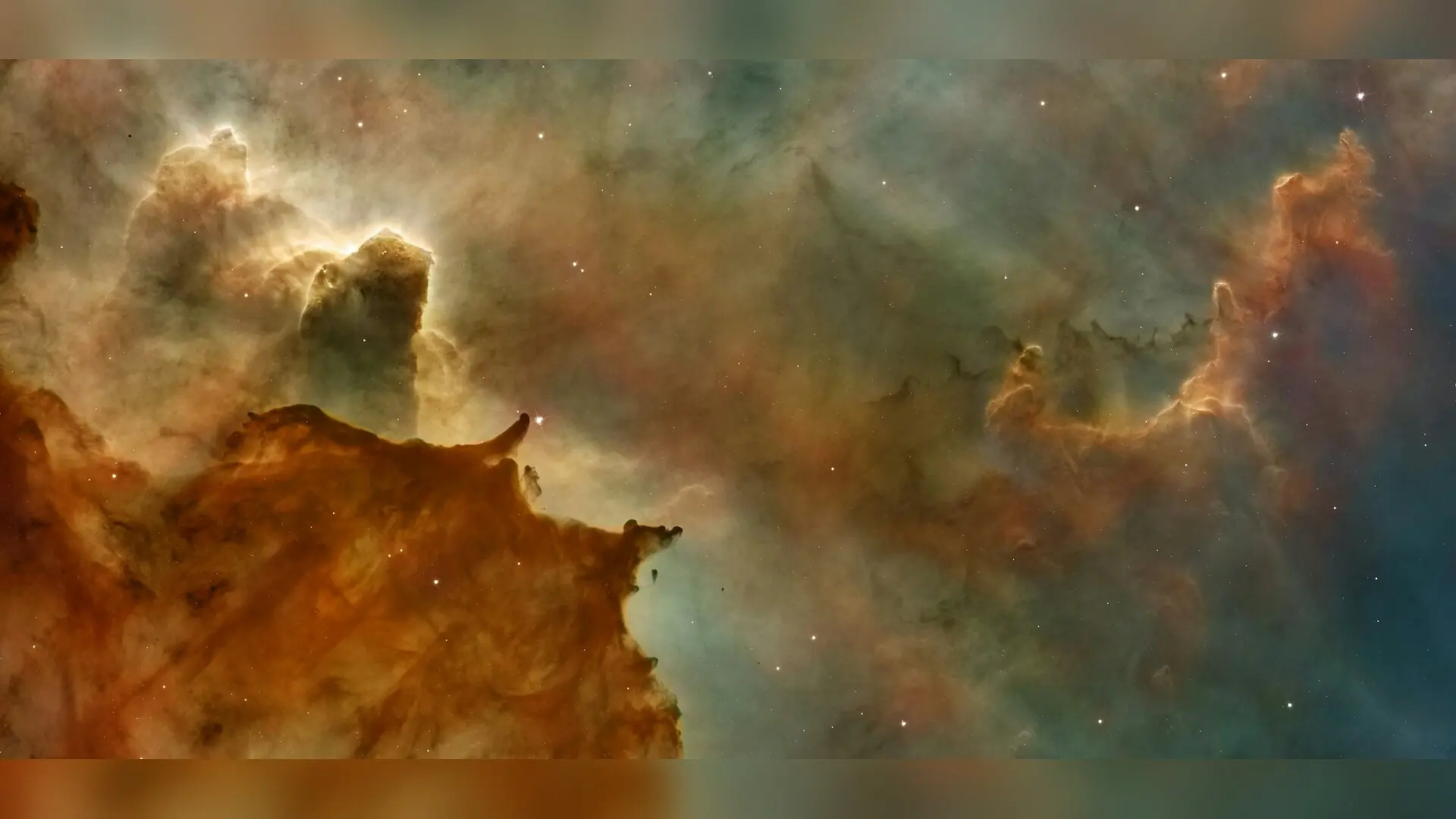
A rare feeding frenzy around a magnetized dead star fifty-five thousand light-years away has revealed hints of extreme cosmic winds, though researchers cannot yet rule out simpler explanations. When matter piles onto a compact stellar remnant faster than standard physical limits allow, astronomers expect powerful outflows to tear away from the surrounding accretion disc.
To investigate whether such high-speed gales are blowing from a system known as RX J0209.6-7427, an international team of researchers analyzed high-resolution X-ray observations gathered by space telescopes. The study is available on the arXiv preprint server, detailing measurements of a dazzling outburst that peaked in the year 2019. During this luminous event, the feeding rate of the dead star surpassed the theoretical maximum boundary known as the Eddington limit, shining brighter than roughly one hundred billion suns.
What Did The X-Ray Spectrum Reveal About The Stellar Outflows?
Led by F. Barra from the INAF - IASF Palermo in Italy, the team inspected archival data captured by the XMM-Newton observatory, collecting more than one hundred thousand photon counts from the target. The resulting spectrum offered an unprecedented look at the glowing gas swirling around the pulsar, which is a rotating neutron star with a 9.3-second spin period paired with a massive companion Be star in the outer wing of the Small Magellanic Cloud. Researchers fitted the continuous X-ray emission using standard models that account for hot inner discs and cooler outer regions.
However, the initial continuum fit left notable residuals, which are unexplained humps and dips in the data pointing toward specific chemical elements. A moving Gaussian line scan exposed prominent emission features matching neon, oxygen, and nitrogen, alongside a complex absorption trough between 0.71 and 0.83 keV. To decode these signatures, the authors deployed advanced plasma models that test both collisionally ionised equilibrium and photoionisation equilibrium across a wide multi-dimensional grid.
Could The Absorption Lines Be Caused By High-Speed Winds?
The spectral analysis suggests that the emission lines originate from a multi-phase, slowly moving plasma sitting roughly at rest relative to the source. Conversely, the absorption features can be successfully modeled in two distinct ways. One interpretation points to blueshifted photoionised absorbers rushing toward Earth at velocities of roughly 0.1c and 0.2c, representing fractions of the speed of light. Such ultrafast winds match theoretical predictions for systems operating in extreme super-Eddington regimes.
Yet, the researchers caution that these high-speed outflows are not the sole possible explanation. An alternative model incorporating collisionally ionised absorption at rest provides a comparably acceptable fit to the data. Furthermore, ambiguous line identifications and relatively weak constraints on the gas density prevent a definitive confirmation of relativistic winds. If the outflows are real, their measured column densities appear notably lower than those found in persistent ultraluminous X-ray sources, potentially reflecting the short duration of the 2019 outburst.
How Do These Findings Compare With Other Extreme Binary Systems?
The behavior of RX J0209.6-7427 shares striking similarities with other transient X-ray binaries in the Magellanic Clouds, such as the system designated A0538-66, which also displays rest-frame emission and blueshifted absorption components near 0.12c during high-luminosity phases. By contrast, persistent ultraluminous systems often display more robust, highly variable ultrafast winds that mirror active galactic nuclei. Future deep-space observations will be required to settle the debate and determine whether high-speed gales truly accompany this feeding neutron star.
The study was posted to the arXiv preprint server on November 20, 2026.
This article has been fact checked for accuracy, with information verified against reputable sources. Learn more about us and our editorial process.
Last reviewed on .
Article history
- Latest version
Reference(s)
- Barra, F.. “Probing for relativistic outflows in the Ultraluminous X-ray pulsar RX J0209.6-7427.” arXiv.org <http://arxiv.org/abs/2611.27693v1>.
Cite this page:
- Posted by Aisha Ahmed