Astronomers Find Rare Galaxy Where Star-Forming Gas Spins Backward
A compact elliptical galaxy houses a massive hydrogen disk rotating in one direction while its inner core spins completely in reverse.
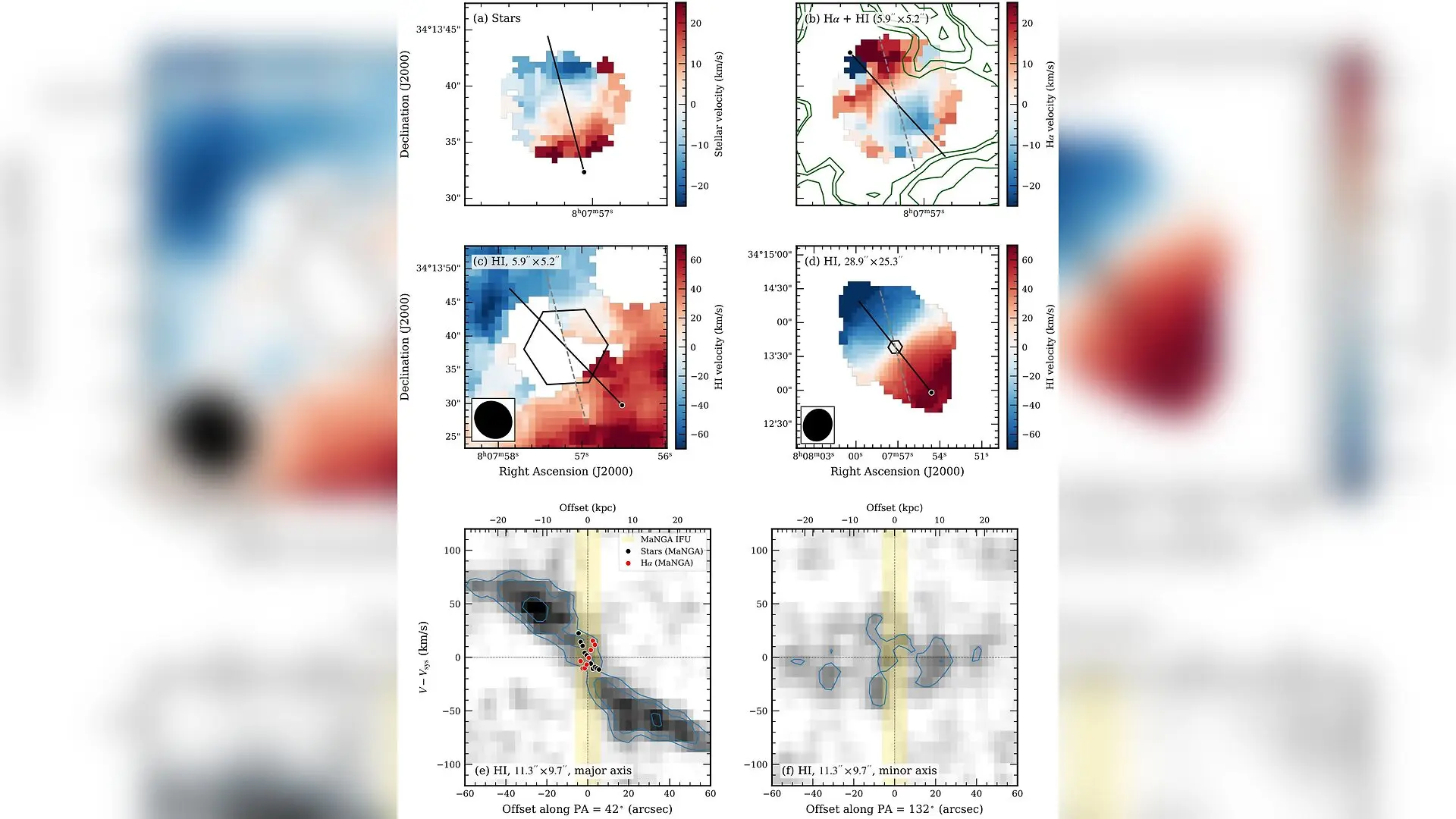
Astronomers have uncovered a rare cosmic engine in a compact elliptical galaxy where newborn stars spin in the exact opposite direction to the gigantic reservoir of atomic hydrogen surrounding them. The research team led by Pralay Biswas, Yogesh Wadadekar, Omkar Bait, and Sushma Kurapati analyzed the galaxy known as MaNGA 10214-1902, which spans a tiny physical radius of just 0.78 kiloparsecs (about 2,500 light-years) despite weighing in with a stellar mass roughly 8 billion times that of our Sun. The study is available on the arXiv preprint server and details an unusual three-part kinematic arrangement that challenges textbook theories of how early-type galaxies maintain active star formation long after they should have burned through their fuel.
How a Tiny Galaxy Manages to Spin in Two Directions at Once
Elliptical galaxies are typically viewed as passive, aging star systems containing old red stars and very little gas. Yet MaNGA 10214-1902 sits on the star-forming main sequence, meaning it continues to build new stars at a steady, measurable pace. To find out where the fuel comes from, the authors combined high-resolution 21-centimeter radio observations from the upgraded Giant Metrewave Radio Telescope with optical spectroscopy from the Sloan Digital Sky Survey. They discovered that the galaxy hosts a massive disk of neutral atomic hydrogen spanning 45 kiloparsecs, or roughly 147,000 light-years across, which co-rotates peacefully with the older stars.
However, the center of this massive hydrogen disk tells a wildly different story. Deep inside the innermost two kiloparsecs, ionized gas clouds rotate in the reverse direction relative to both the surrounding atomic hydrogen and the stellar body. The team measured a dramatic kinematic position angle difference of roughly 152 degrees between the stars and the inner gas, pointing to a complex history of gas acquisition.
What Happens When Counter-Rotating Gas Clouds Collide Inward
Gas captured from internal stellar winds naturally inherits the rotation of its parent stars, meaning external accretion is the only viable explanation for this counter-rotation. The researchers suggest that the galaxy captured fresh gas with opposite angular momentum through a minor merger or accretion from its cosmic surroundings. When counter-rotating gas streams meet inside a galaxy, the ensuing cloud-to-cloud collisions bleed away angular momentum and funnel material straight toward the center.
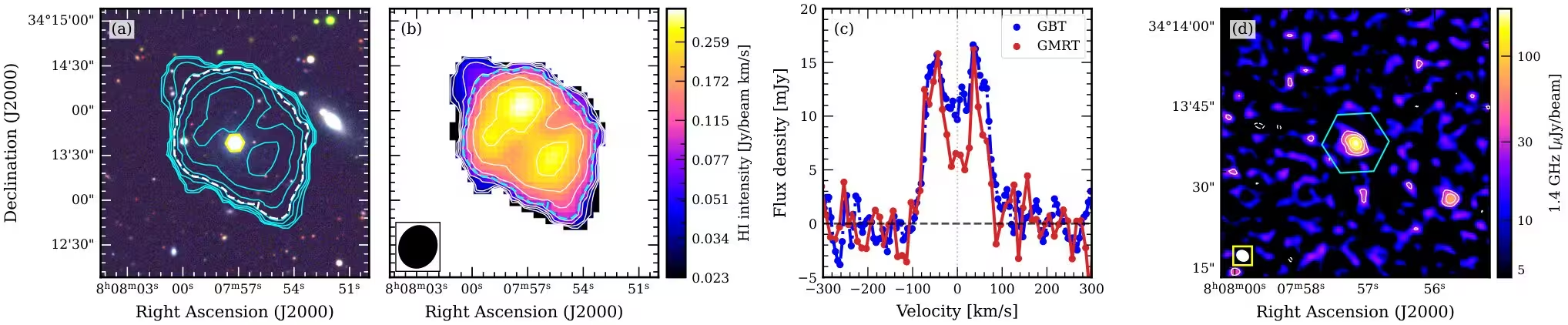
This inward funneling explains why the galaxy shows a central depression in its atomic hydrogen column density alongside a surge of young stars. Spatially resolved emission-line diagnostic diagrams confirm that this central gas is primarily photoionized by newborn stars rather than a hidden supermassive black hole. The central light-weighted stellar ages average around 1.9 billion years, significantly younger than the older populations residing in the outer parts of the galaxy.
Why This Rare Cosmic Setup Cannot Last Very Long
Because counter-rotating gas components cannot peacefully coexist at the same radius for extended periods, this peculiar architecture represents a short-lived phase lasting only a few hundred million years. The authors note that the current star formation rate will consume a minuscule fraction of the available stellar mass, leaving the vast outer atomic reservoir largely untapped due to its lengthy depletion timescale of roughly 16 to 20 billion years. Further carbon monoxide observations and deeper radio imaging will help astronomers determine how frequently low-mass elliptical galaxies rely on counter-rotating gas accretion to keep their stellar nurseries alive.
The study was posted to the arXiv preprint server on November 13, 2026.
This article has been fact checked for accuracy, with information verified against reputable sources. Learn more about us and our editorial process.
Last reviewed on .
Article history
- Latest version
Reference(s)
- Biswas, Pralay. “Counter-rotating Ionized and Neutral Gas in a Star-forming Elliptical Galaxy.” arXiv.org <http://arxiv.org/abs/2611.17740v1>.
Cite this page:
- Posted by Aisha Ahmed