Astronomers Map Dark Matter in Nearby Dwarf Galaxies Using AI-Powered Stellar Orbits
New dynamical models of Milky Way satellite galaxies test the limits of dark matter theories by analyzing stellar speeds.
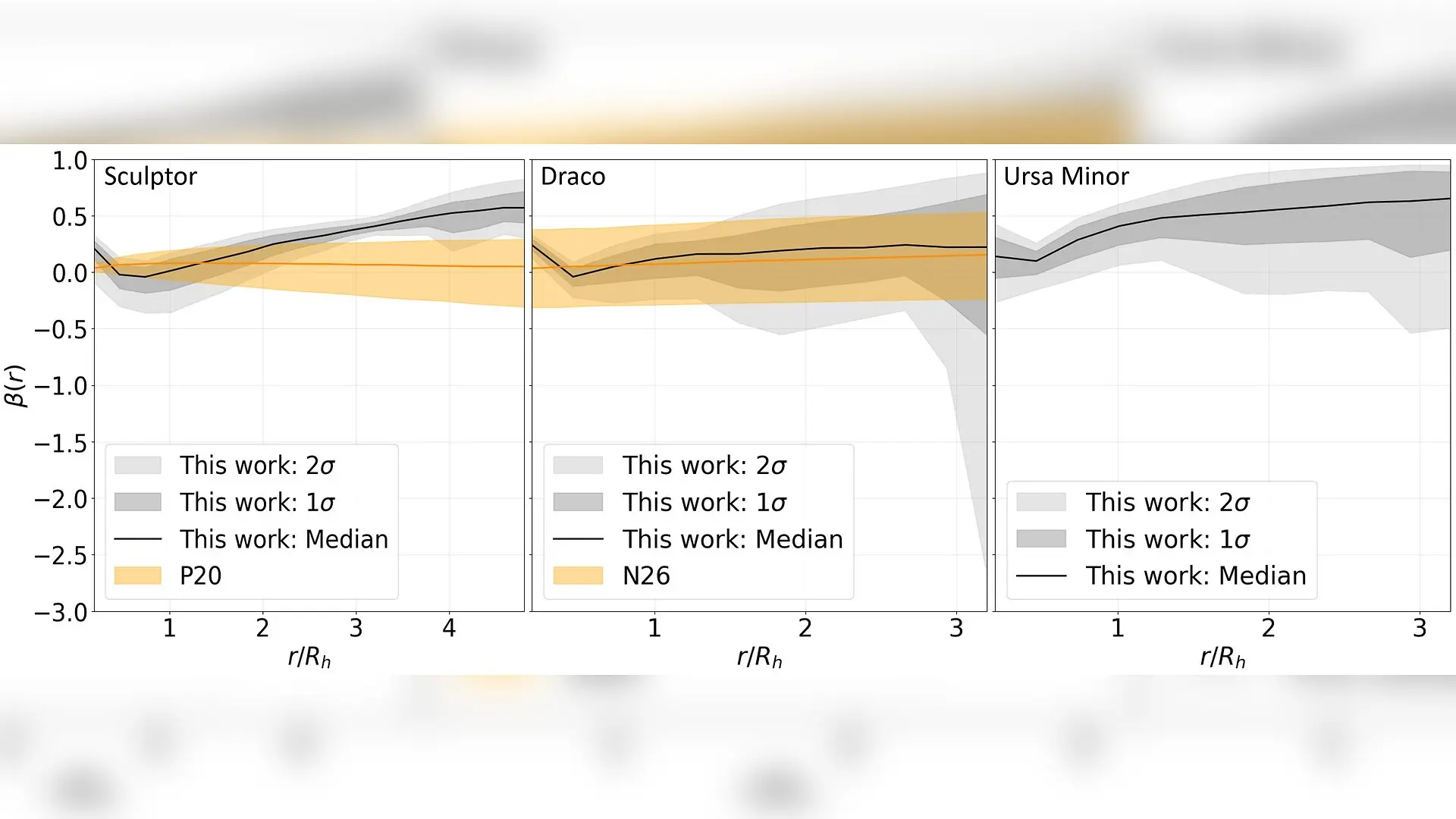
A team of astronomers has mapped the invisible dark matter shrouding three of the Milky Way’s smallest satellite galaxies by studying how their ancient stars move. The new study tests long-standing mysteries about dwarf galaxies located hundreds of thousands of light-years away.
Dwarf spheroidal galaxies orbiting our Milky Way, such as Sculptor, Draco, and Ursa Minor, are some of the most dark-matter-dominated systems in the universe. While these tiny star clusters contain almost no gas, their stars move under the influence of powerful gravitational fields that reveal the hidden structure of dark halos. However, deducing the exact distribution of this invisible mass has challenged astronomers for decades due to statistical noise in stellar velocity data.
A New Way to Read Stellar Speeds
To overcome past limitations, researchers Rin Miyazaki, Masashi Chiba, and Shunichi Horigome developed a sophisticated spherical Schwarzschild orbit-superposition framework. Their work is available on the arXiv preprint server (2026). Instead of grouping stars into noisy spatial bins, the authors used a mixture density network, an artificial intelligence tool trained on unbinned stellar velocities, to model the continuous line-of-sight velocity distribution of each galaxy. This statistical smoothing reduces fluctuations caused by finite stellar counts and accurately captures high-speed stellar tails.
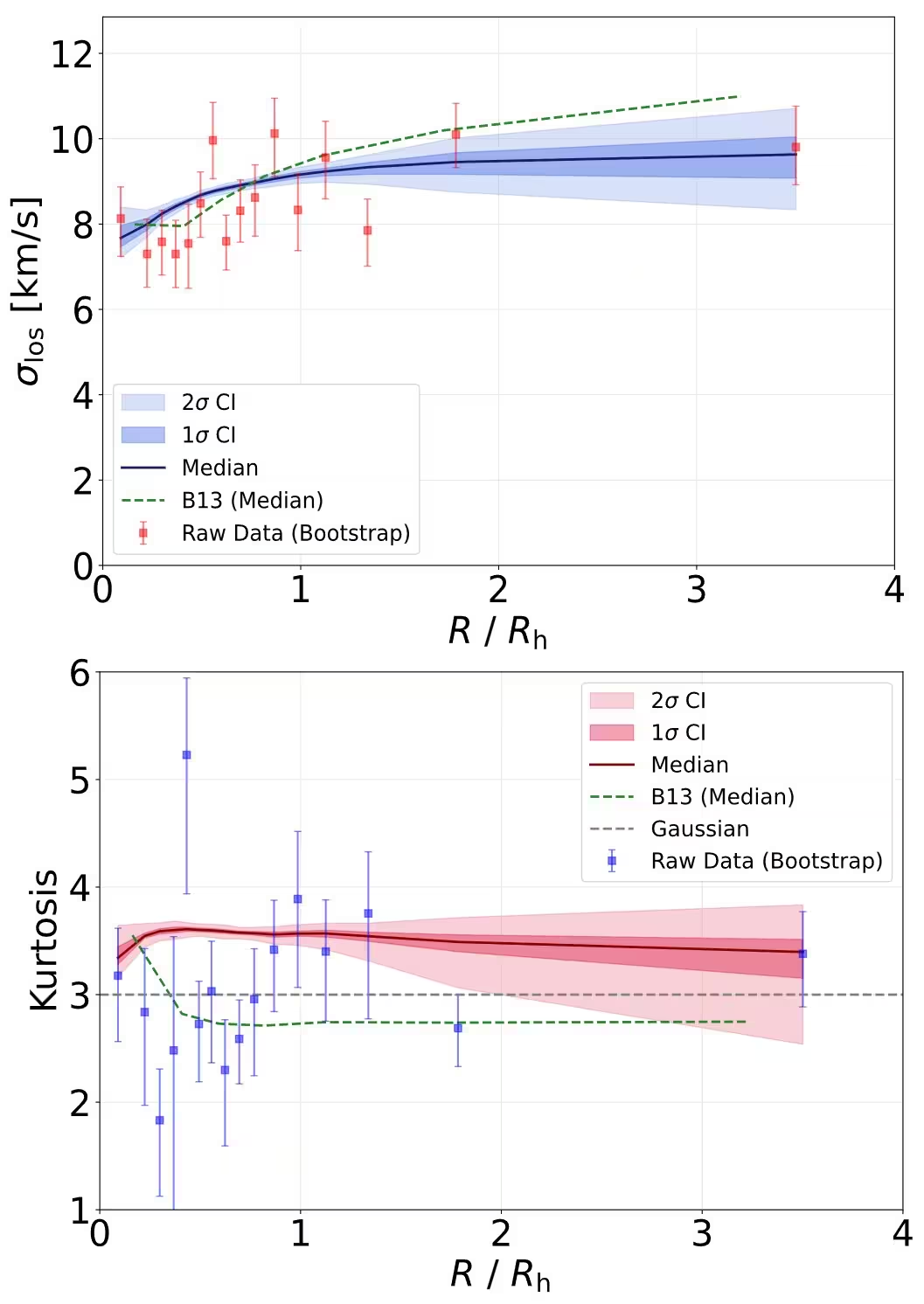
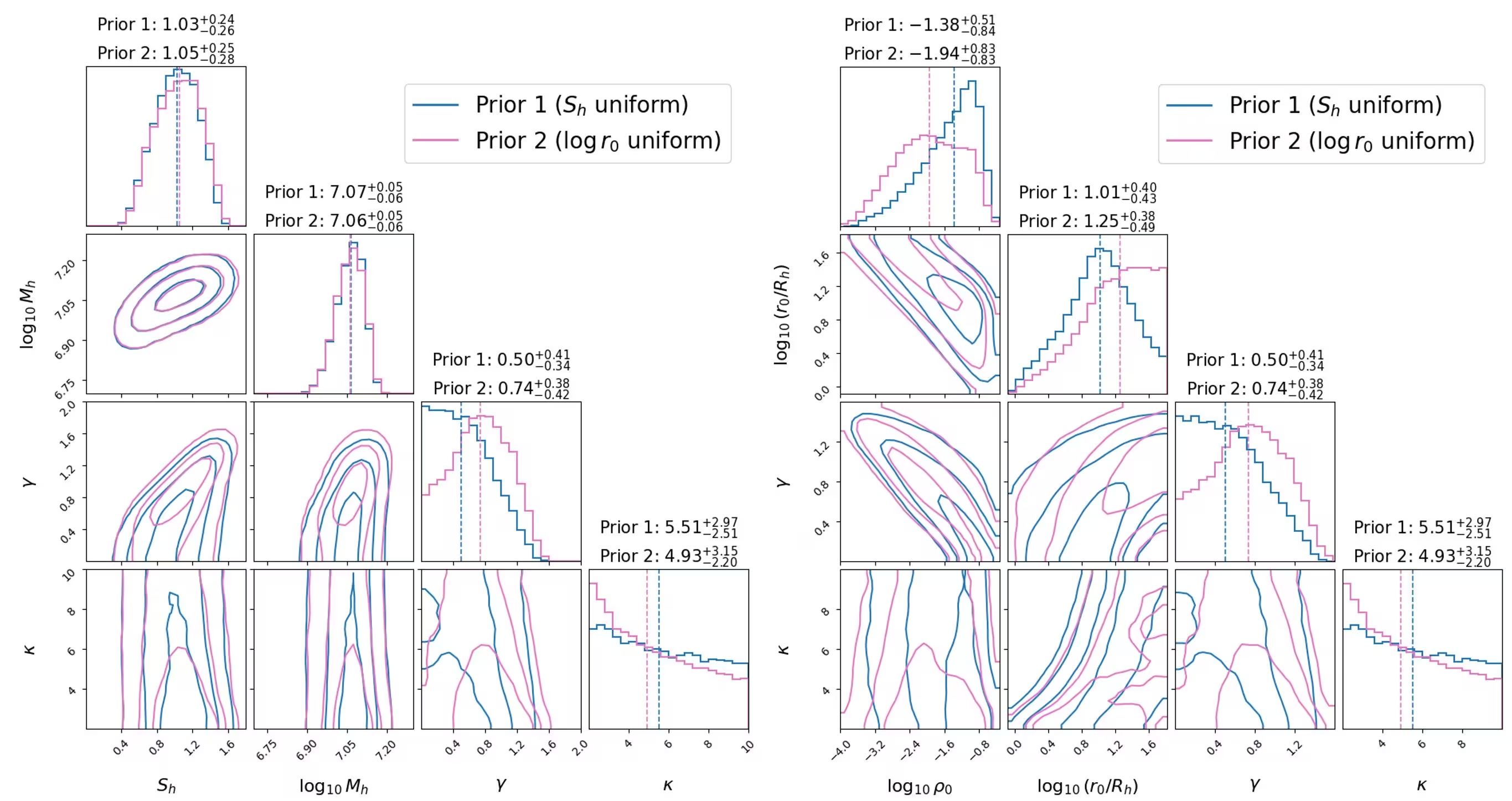
The researchers combined this neural network approach with quadratic programming to build physically realistic libraries of stellar orbits. They then used Markov Chain Monte Carlo sampling, a statistical technique that tests millions of parameter combinations, to constrain the dark matter properties of Sculptor, Draco, and Ursa Minor. The team examined how sensitive their dynamical models were to different prior assumptions regarding the halo scale radius and inner density slopes.
What the Halos Reveal About Galaxy Scales
When applied to the Sculptor dwarf galaxy, the analysis revealed that the enclosed mass and the logarithmic density slope evaluated at the projected half-light radius remain remarkably stable regardless of the chosen priors. The half-light radius defines the boundary enclosing half of the total stellar luminosity, which for Sculptor spans roughly 300 parsecs. The team found that the enclosed mass near this boundary is tightly constrained, confirming that stellar kinematics reliably trace intermediate-scale mass.
In contrast, the asymptotic inner slope near the absolute galactic center showed strong prior dependence. This indicates that stellar data restricted to finite radii cannot uniquely settle whether these dwarf galaxies possess a constant-density core or a sharply peaked central cusp. The authors report finite-radius logarithmic density slopes at the half-light radius of $S_h = 0.92$ for Sculptor, $1.31$ for Draco, and $1.11$ for Ursa Minor, each accompanied by statistical uncertainties of roughly $0.2$ to $0.4$.
Comparing Observations with Cosmological Simulations
The team compared their observational slopes against predictions from advanced cosmological simulations, including the FIRE-2 lambda cold dark matter models and self-interacting dark matter models. By evaluating slopes at the three-dimensional half-light radius and at half that distance, the researchers avoided relying on uncertain theoretical conversions for total halo mass and virial radius.
The measured density slopes for Sculptor, Draco, and Ursa Minor lie broadly within the range predicted by lambda cold dark matter simulations that include baryonic feedback from supernovae and star formation. However, current observational uncertainties and the small sample of modeled galaxies prevent a definitive distinction between competing dark matter theories. The authors emphasize that upcoming spectroscopic surveys, such as the Subaru Prime Focus Spectrograph project, will capture thousands of member stars per dwarf galaxy, greatly reducing these uncertainties and clarifying the true nature of dark matter.
The study was posted to the arXiv preprint server on November 13, 2026.
This article has been fact checked for accuracy, with information verified against reputable sources. Learn more about us and our editorial process.
Last reviewed on .
Article history
- Latest version
Reference(s)
- Miyazaki, Rin. “Beyond the Inner Slope $γ$: A Schwarzschild-based Probe of the Core-Cusp Problem in the Milky Way Dwarf Spheroidal Galaxies.” arXiv.org <http://arxiv.org/abs/2611.17835v1>.
Cite this page:
- Posted by John Williams