Solar Telescopes Reveal What Powers Mysterious Plasma Jets Around Sunspots
High-resolution observations of 176 dynamic fibrils show they are driven by slow magnetoacoustic waves rippling outward from sunspot umbrae.
High-resolution solar observations reveal that dynamic jet-like structures shooting from sunspot regions are driven by powerful upward pressure waves from below. Researchers tracked 176 of these dynamic features, known as dynamic fibrils, to understand how energy moves through the magnetized solar atmosphere.
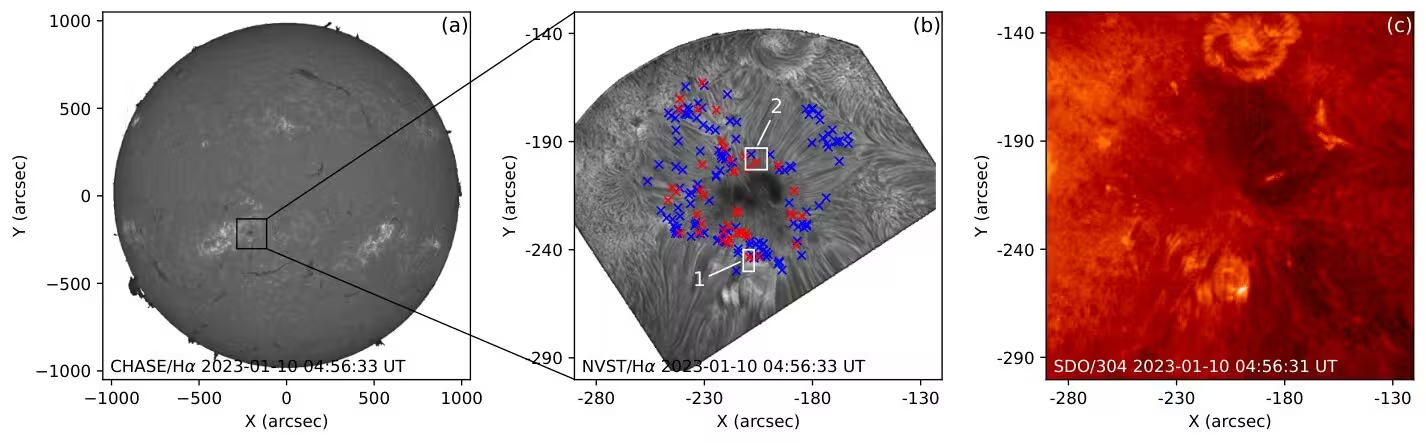
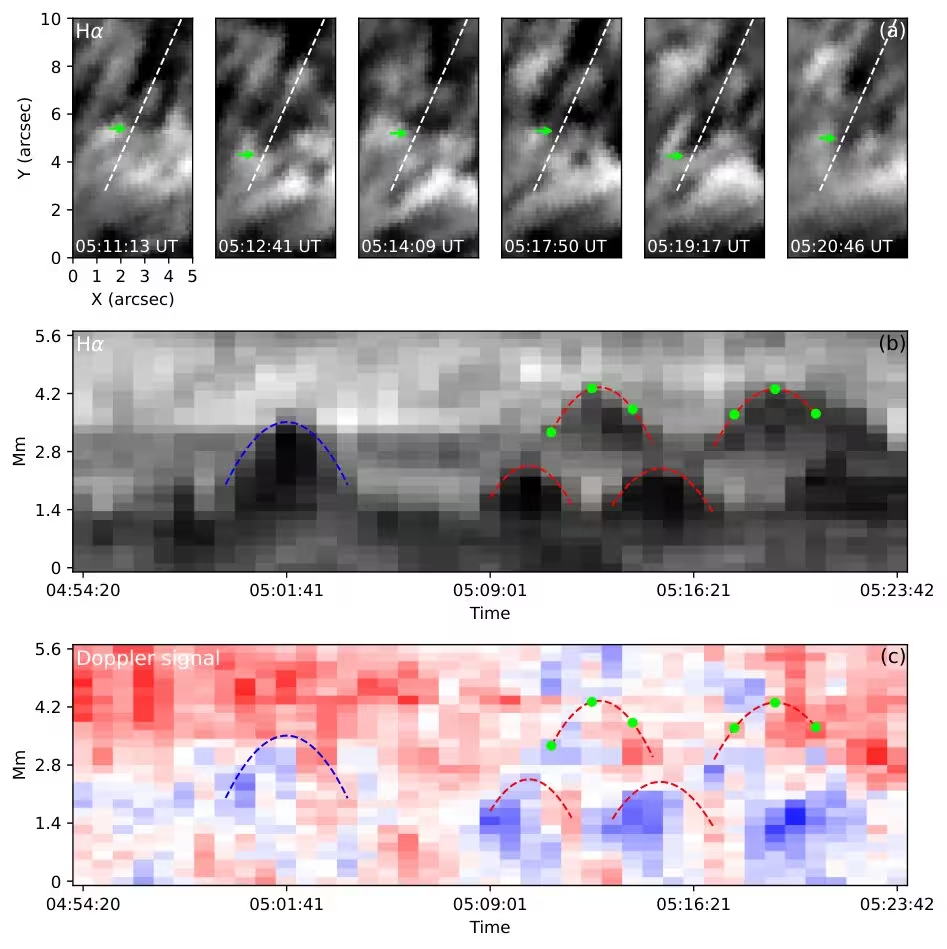
The team utilized ground-based imagery from the New Vacuum Solar Telescope in China, alongside data from spaceborne instruments, to catalog the physical behavior of 132 single-parabola events and 44 multiple-parabola events around active region NOAA 13182. They observed that these plasma tongues surge upward before falling back down in distinct parabolic trajectories. The findings are available on the arXiv preprint server, shedding new light on how the Sun heats its outer layers.
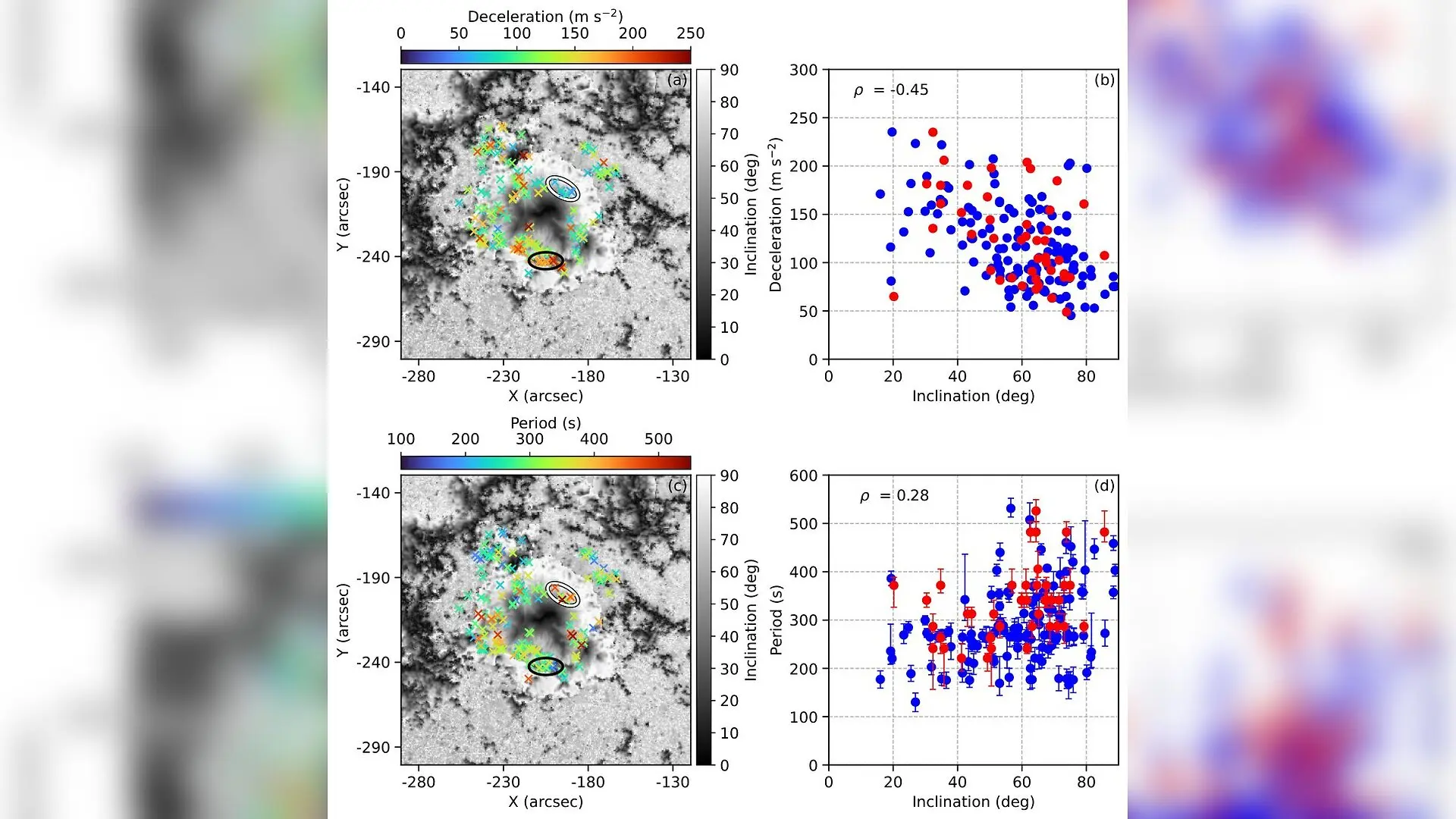
Statistical analysis showed that the dynamic fibrils possess a mean maximum velocity of 15.9 kilometers per second and decelerate at an average rate of 120 meters per second squared, well below the solar gravitational acceleration of 274 meters per second squared. This reduced deceleration occurs because the plasma travels along slanted magnetic field lines, where only a fraction of gravity pulls against the motion. The fibrils reach an average maximum length of 1.13 megameters and last for about 270 seconds.
How Magnetic Fields Shape Solar Jets
The researchers discovered clear statistical links between different physical traits of the fibrils. A strong positive correlation emerged between maximum velocity and deceleration, meaning faster jets experience sharper slowdowns. In contrast, fibrils with higher decelerations tend to have shorter lifespans, while taller jets typically last longer and reach greater speeds.
By comparing the motion of the fibrils with underlying magnetic data from the Solar Dynamics Observatory, the authors found that magnetic field inclination plays a major role in regulating their behavior. Regions with nearly vertical magnetic fields produced fibrils with larger decelerations and shorter oscillation periods. Conversely, areas with horizontal magnetic fields yielded smaller decelerations and longer periods.
Connecting Ground Jets to Coronal Waves
The study establishes a direct temporal and spatial connection between the pulsating fibrils and running penumbral waves rippling outward from the sunspot umbra. Wavelet analysis of a multi-parabola event revealed a dominant oscillation period of 287 seconds, matching the 263-second period of the surrounding penumbral waves.
Cross-power spectral analysis showed that the plasma jets lag behind the driving waves by an average phase angle of 64 degrees. This delay points to a propagation speed of roughly 20 kilometers per second for the underlying disturbances. Multiwavelength imaging further demonstrated that these events leave traceable signatures spanning from the chromosphere up into the transition region and corona.
While the observations strongly support the theory that slow magnetoacoustic waves drive these atmospheric jets, the authors note several limitations. The current spatial and temporal resolution may miss smaller, unresolved fine structures within the sunspot umbra, and the use of photospheric magnetic field measurements as a proxy for chromospheric inclination introduces uncertainties that future high-resolution instruments hope to resolve.
The study was posted to the arXiv preprint server on November 13, 2026.
This article has been fact checked for accuracy, with information verified against reputable sources. Learn more about us and our editorial process.
Last reviewed on .
Article history
- Latest version
Reference(s)
- Wu, Guotang. “High-resolution Observations of Physical Properties of Dynamic Fibrils Around a Sunspot.” arXiv.org <http://arxiv.org/abs/2611.17838v1>.
Cite this page:
- Posted by Nida Rehman