AI Cuts Cosmic Lens Preparation Time From Hundreds of Hours to Minutes
A new hybrid neural network automates the tedious component separation required to model strong gravitational lenses in massive space telescope surveys.
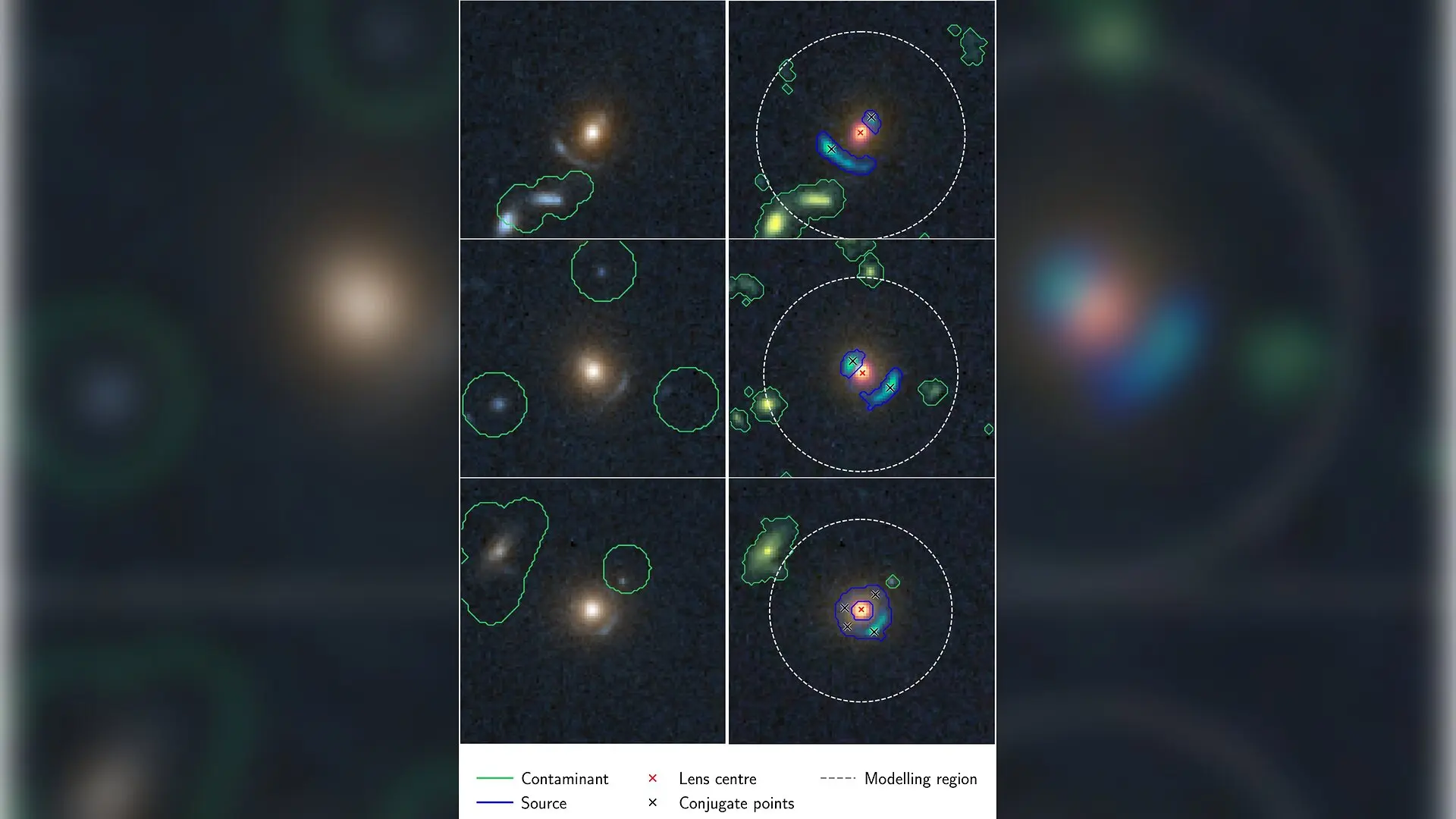
A new artificial intelligence network cuts the time needed to prepare cosmic magnifying glasses for analysis from hundreds of hours to just ninety minutes. The tool tackles a major bottleneck in processing observations from the European Space Agency’s Euclid Space Telescope.
Strong gravitational lenses occur when a massive foreground galaxy bends the light of a more distant background object into glowing arcs or rings. Astronomers use these natural telescopes to measure cosmic expansion rates and map invisible dark matter, but modeling them requires separating the foreground lens light, the distorted background source, and unwanted background noise. Previously, human experts had to mask and outline these components by hand for every single target, creating an impossible chore for modern astronomical surveys.
To solve this scaling crisis, the Euclid Collaboration developed a deep learning architecture named AstroVink-TREX, short for Transformer for Ring Extraction. The network was made available on the arXiv preprint server and generates automated pixel-level flux maps that feed directly into mass-modelling pipelines without requiring manual setup.
How the Hybrid Neural Network Separates Overlapping Starlight
Designing an algorithm for strong lenses is notoriously difficult because the light from the foreground galaxy and the background source often overlap. Traditional pixel classifiers fail because a single pixel can contain photons from both objects simultaneously. Furthermore, the distant background arcs can be physically disconnected across the sky while belonging to the same celestial source.
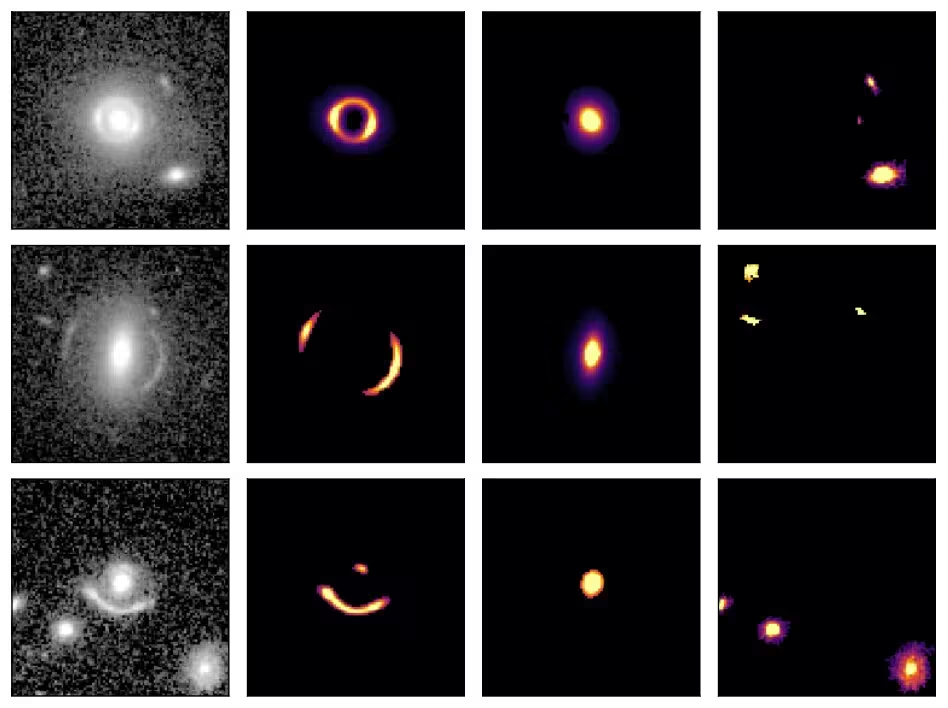
To overcome these challenges, the authors built a hybrid architecture that pairs a vision transformer encoder with a parallel convolutional branch. The transformer provides a global view that connects distant light fragments across the image, while the convolutional layers preserve fine local details such as thin, faint arcs. A custom loss function penalizes missing signal more heavily than over-prediction, ensuring the network does not accidentally erase faint background features.
Automating the Entire Preprocessing Pipeline
Beyond separating flux maps for the lens, source, and contaminants, AstroVink-TREX automatically derives all the secondary measurements required by modeling codes. It calculates the precise center of the lens system, determines the appropriate fitting radius, and identifies bright local maxima to serve as conjugate points for multi-image constraints.
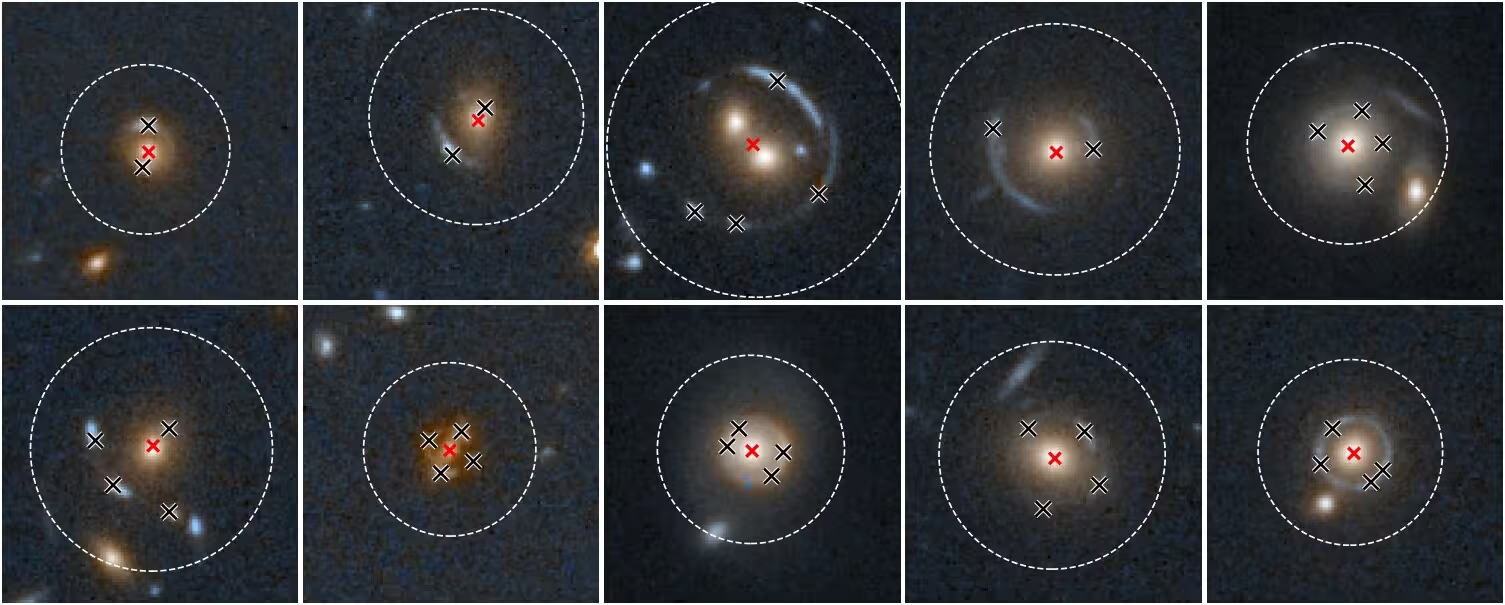
The research team tested the system on approximately 3,000 candidates from the first Euclid data release. When expert modellers inspected the resulting fits, segmentation errors accounted for only 1.3 percent of total model failures under a 75 percent consensus threshold. This indicates that the automated masks are reliable enough to handle the general population of lenses across the entire survey.
What Happens Next for Automated Cosmic Surveys
Manual preparation of 15,000 lens candidates in the Euclid catalog would demand an estimated 300 hours of painstaking expert labor. In contrast, running AstroVink-TREX on a standard laptop CPU takes about 0.35 seconds per system, completing the entire catalog in roughly 1.5 hours.
The authors note that current limitations mainly involve confusion between faint source structures and nearby contaminants, which can be flagged automatically by comparing pipeline reconstructions with network predictions. Because successful models generate new training targets, future iterations of the network can be retrained on increasingly diverse samples to improve performance on complex morphologies.
The study was posted to the arXiv preprint server on November 13, 2026.
This article has been fact checked for accuracy, with information verified against reputable sources. Learn more about us and our editorial process.
Last reviewed on .
Article history
- Latest version
Reference(s)
- Collaboration, Euclid. “Euclid Data Release 1 (DR1). AstroVink-TREX: Automated strong gravitational lens segmentation as input for mass modelling pipelines.” arXiv.org <http://arxiv.org/abs/2611.17894v1>.
Cite this page:
- Posted by Karan Das