A Mysterious Gas Could Finally Reveal What Is Hiding Inside Uranus and Neptune
Ancient argon from the solar system’s birth may mask radioactive signals in Uranus and Neptune, but a new isotope method could reveal their hidden cores.
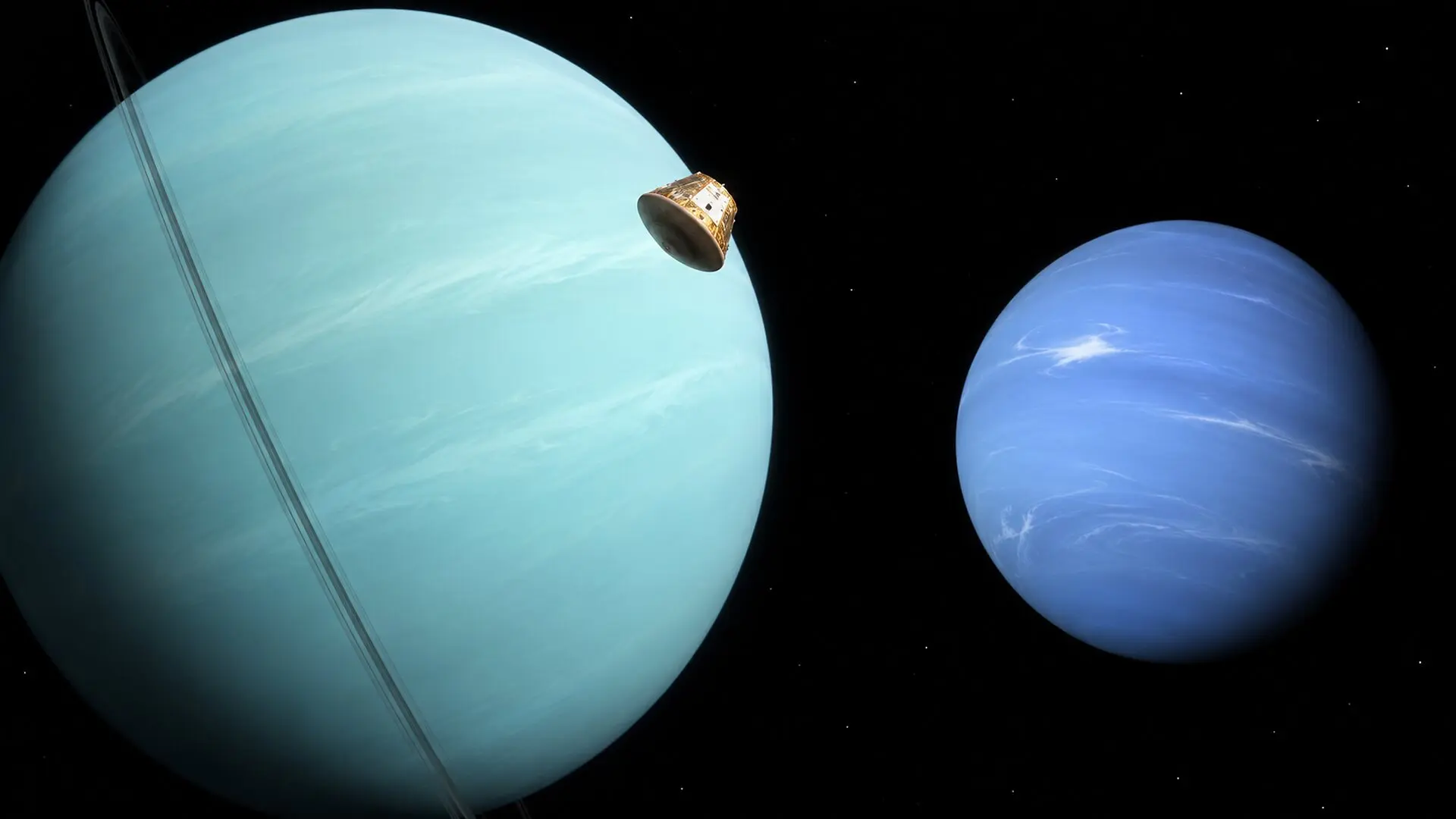
A humble trace gas could hold the key to unlocking the deepest secrets of our solar system’s ice giants, Uranus and Neptune. However, researchers warn that this same atmospheric signature might also lead scientists astray, obscuring the true composition of the planets’ rocky cores.
The element in question is argon-40, an isotope that serves as a double agent in planetary science. It can be found in the atmospheres of giant planets as a remnant from the primordial solar nebula, or it can be generated over billions of years through the radioactive decay of potassium-40 trapped within a planet’s rocky interior. Understanding the origin of this gas is essential for determining exactly how much rock lies beneath the icy shells of these distant worlds.
A new modeling study, published in The Planetary Science Journal and led by Olivier Mousis of the Southwest Research Institute, suggests that primordial argon-40 inherited from the early solar system could be so abundant that it completely masks the signal generated by radioactive decay in the core. If a future mission reaches these planets, it would first need to disentangle these two sources to reach an accurate conclusion about the planets’ internal structure.
Unmasking the Rocky Core
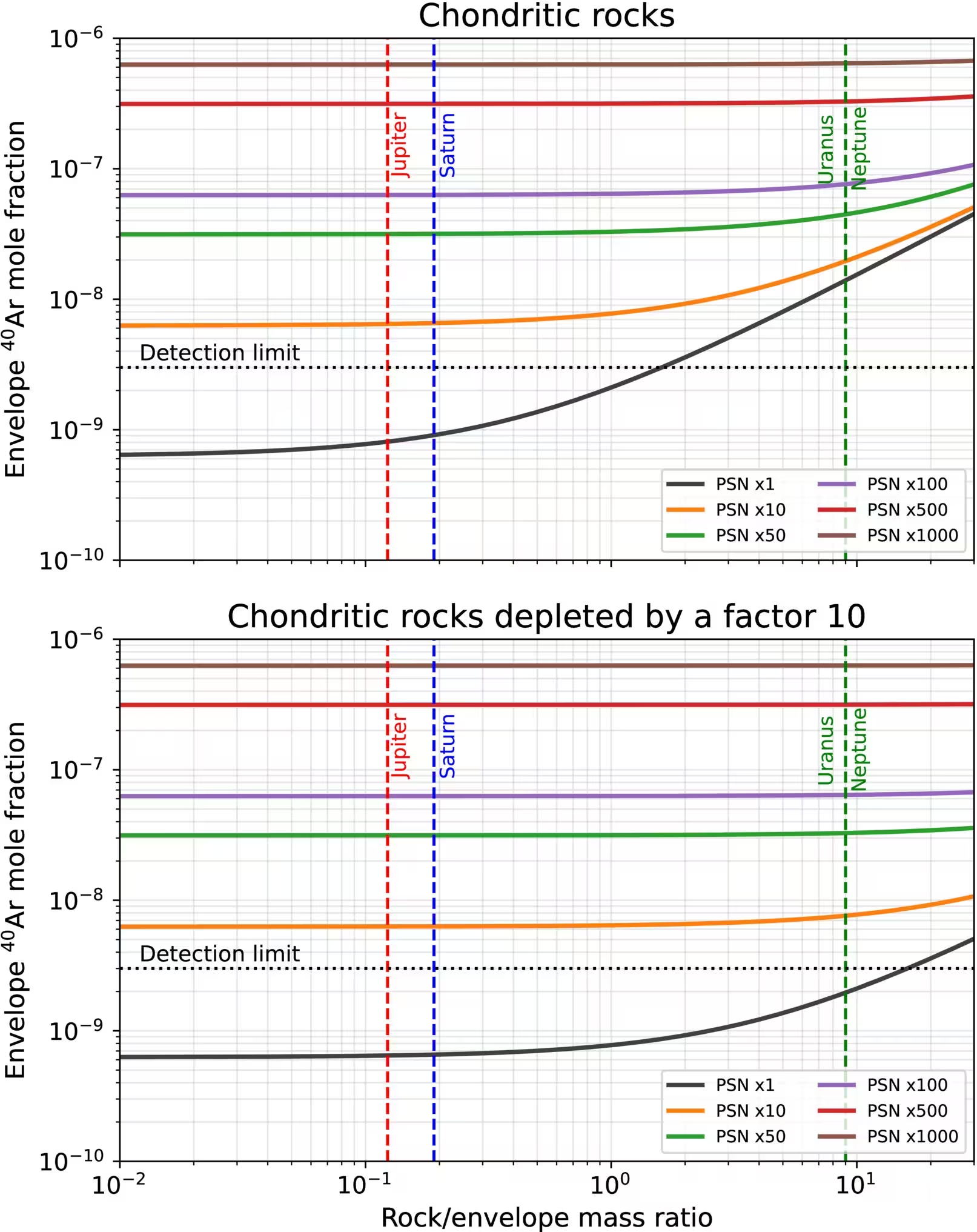
The potential for argon-40 to serve as a probe of planetary interiors relies on the decay of potassium-40, a common component of rocky material. As the rock decays, it releases argon-40 into the surrounding hydrogen and helium layers. If scientists can measure this gas, they might theoretically calculate the amount of rock present in the interior. Yet, the team’s research highlights significant uncertainties, particularly regarding the efficiency with which this gas migrates from the deep core to the upper atmosphere, where it could be sampled by a probe.
The challenge is compounded by the “dilution effect.” The concentration of argon-40 detected in the atmosphere depends not only on the amount of rock, but also on the mass of the planetary envelope it has dispersed into. Without a clear understanding of the internal mixing processes, interpreting the presence of this gas remains a complex analytical puzzle.
Echoes of the Primordial Disk
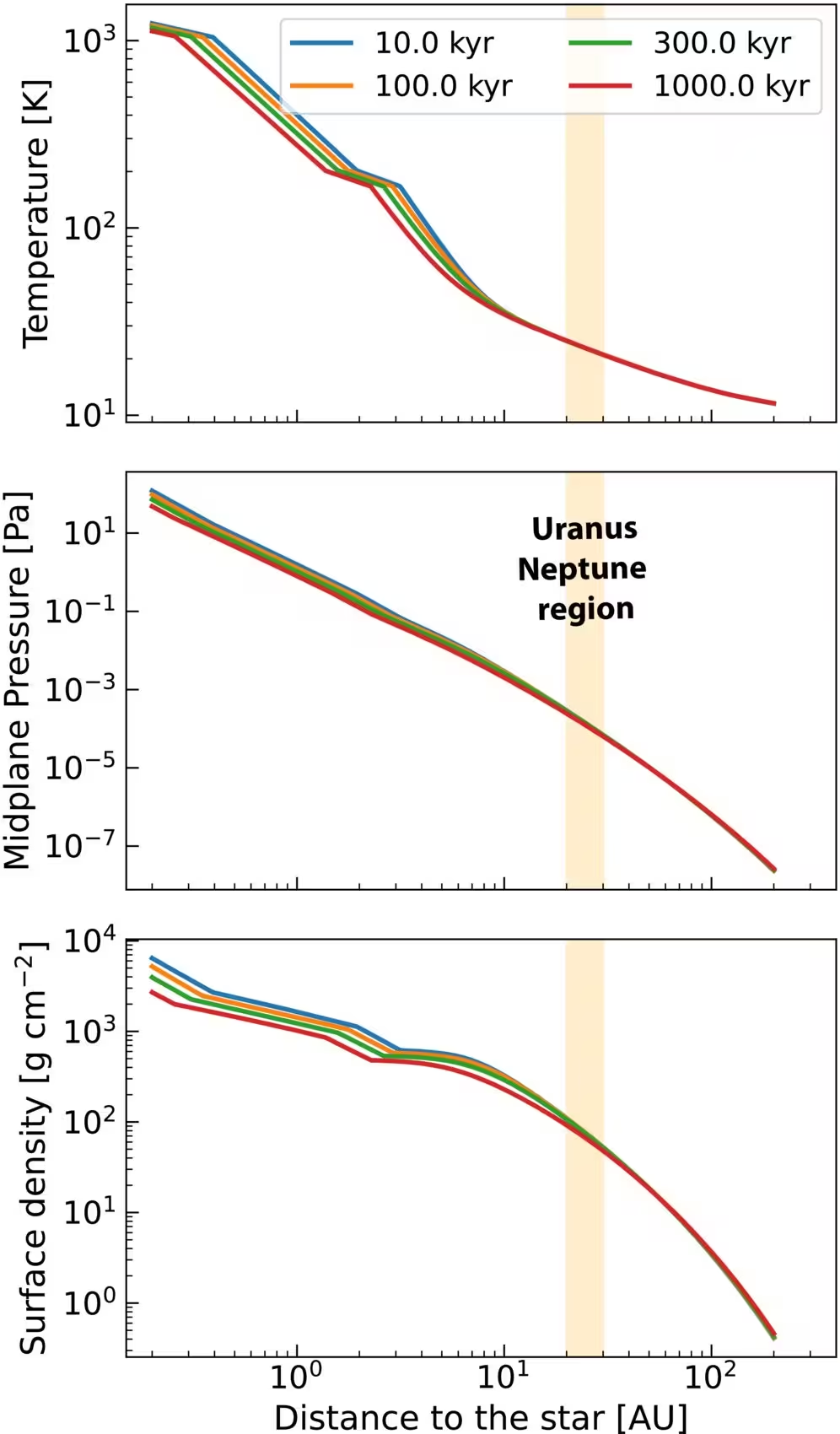
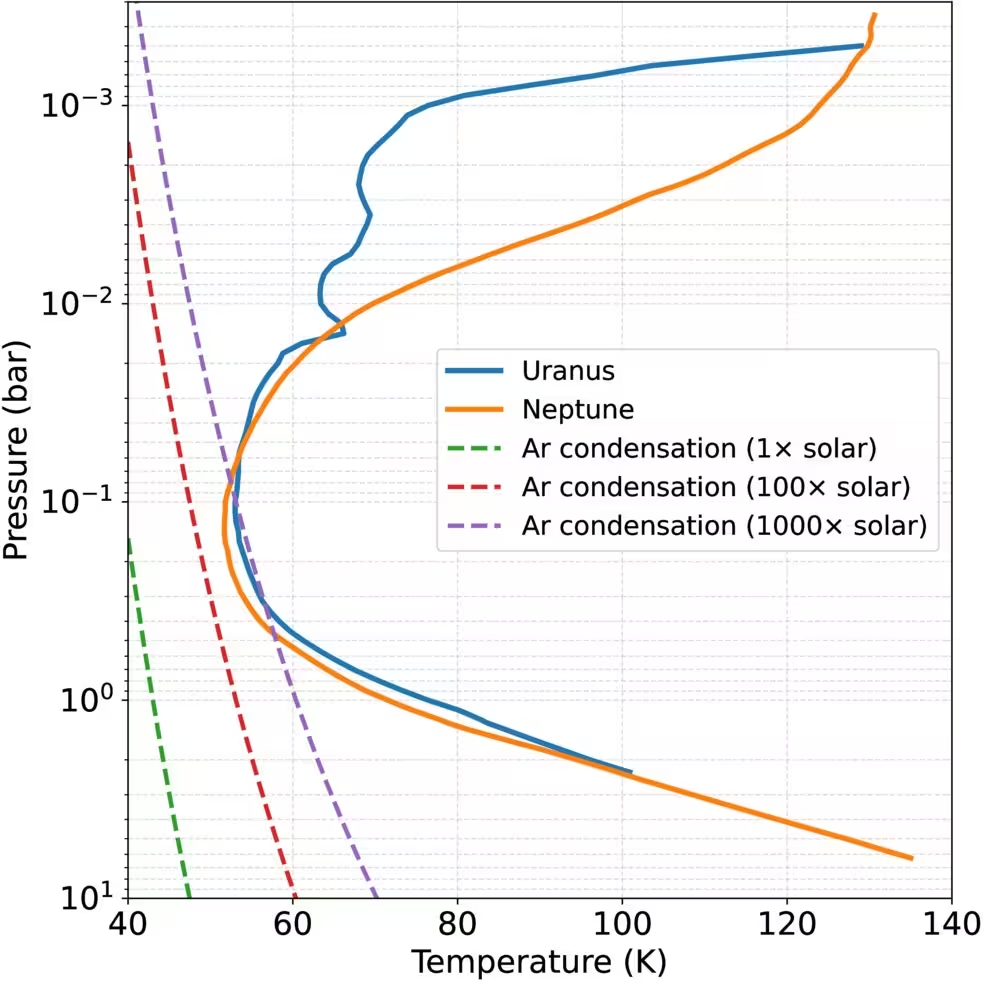
The second source of argon-40 is the solar nebula—the massive, rotating cloud of gas and dust that birthed the solar system. By simulating the cooling of this disk, researchers found that argon could have been trapped within solid ice structures, effectively “seeding” the forming planets with a specific isotopic signature. According to the study, this inherited supply could range from protosolar levels to over 1,000 times that amount, depending on the conditions under which the planet initially formed.
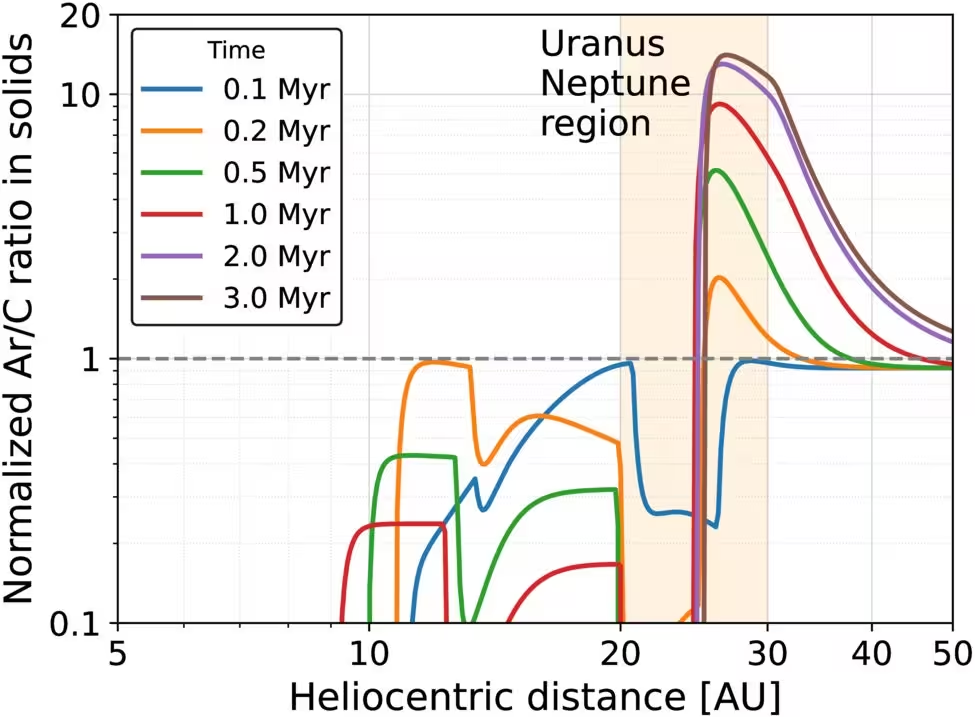
This wide range suggests that the history of Uranus and Neptune is written into their chemical composition. If a probe were to find an excess of argon-36—an isotope that does not originate from radioactive decay—it would confirm a large primordial contribution, helping researchers subtract that “noise” and isolate the signal of the planetary rock.
The Path Toward a Future Mission
Since the flybys of Voyager 2 in the 1980s, direct sampling of the atmospheres of Uranus and Neptune has remained a primary goal for planetary scientists. A future descent probe equipped with a mass spectrometer would be the definitive tool for distinguishing between these argon isotopes.
Drawing on lessons from NASA’s Galileo mission to Jupiter, which provided a benchmark for noble gas measurements, the researchers emphasize the need for precision. While the Galileo probe did not detect argon-40, modern sensors could provide the sensitivity required to distinguish the subtle ratios of argon-36 to argon-40. Such a measurement would do more than just refine our understanding of these two specific worlds; it would offer a vital comparative study, potentially revealing whether Uranus and Neptune were forged under similar conditions or if their distinct chemical profiles point toward different origins.
Ultimately, by comparing these noble gas ratios with other markers like nitrogen and carbon, future missions could effectively “strip back the layers” of the ice giants, revealing the rocky foundations that have been hidden for billions of years.
Further Reading
This article has been fact checked for accuracy, with information verified against reputable sources. Learn more about us and our editorial process.
Last reviewed on .
Article history
- Latest version
Reference(s)
- “Southwest Research Institute | R&D From Deep Sea to Deep Space.” <https://www.swri.org/>.
Cite this page:
- Posted by Aisha Ahmed