Wild Mammals Reveal Surprising Sex and Habitat Twists in Cellular Aging
Biotechnology

Wild Mammals Reveal Surprising Sex and Habitat Twists in Cellular Aging

A large-scale study on Soay sheep and roe deer shows that the cost of growing up fast depends heavily on sex and environmental quality.
By Robert Brown
Published:
Email this Article
Wild Mammals Reveal Surprising Sex and Habitat Twists in Cellular Aging
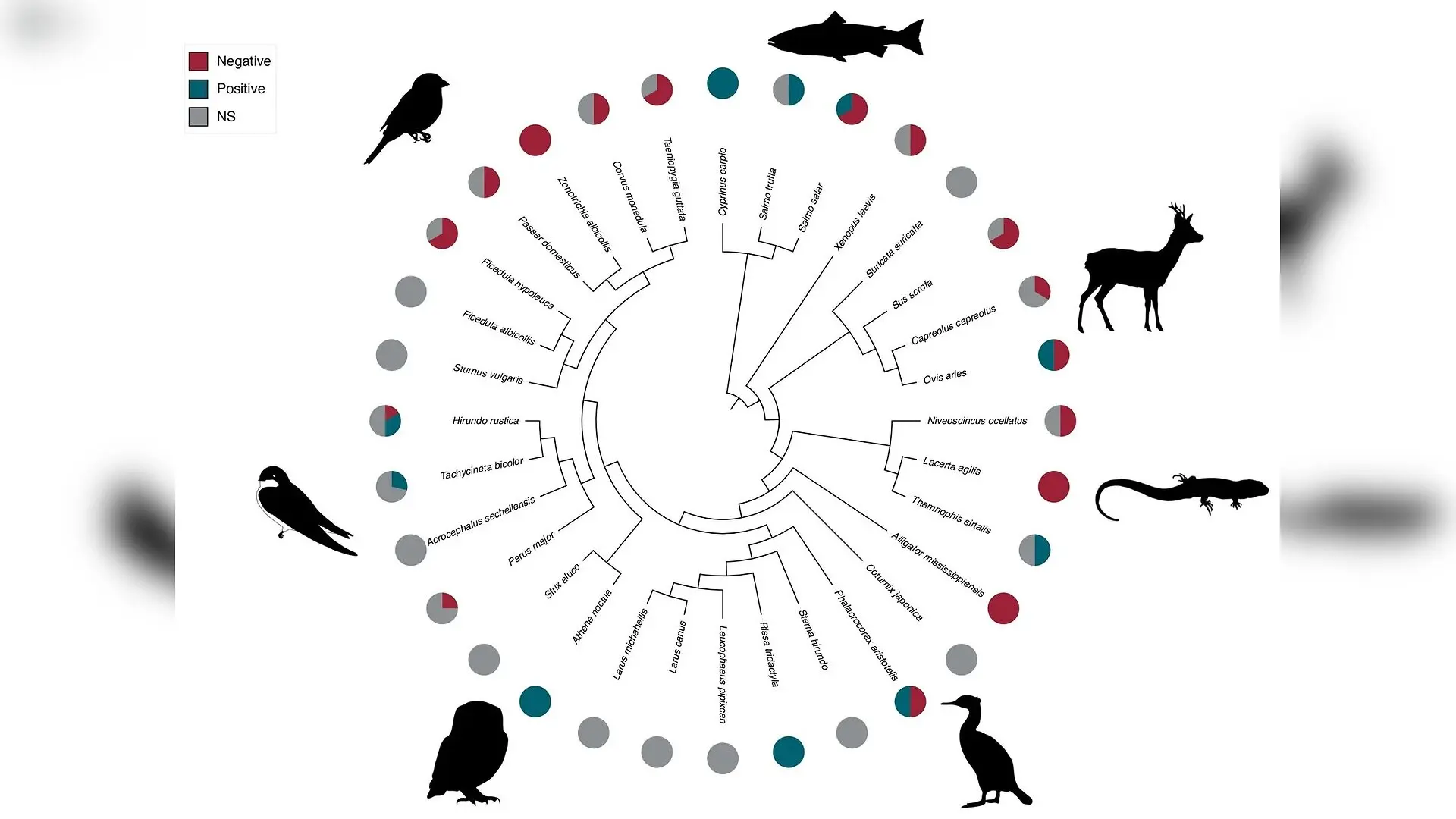
Phylogenetic distribution of the observed relationships between early growth and telomere length (TL) in vertebrates in the wild. The phylogenetic tree summarizes 46 studies examining the association between early-life mass or size and TL in wild and semi-captive non-model species. Pie charts at the branch tips represent the proportion of reported effects for each species: negative (red), positive (blue) and not statistically significant (NS) associations (grey). Note that data for Soay sheep (Ovis aries) and roe deer (Capreolus capreolus) incorporate the findings of the present study. The complete review table is available in supplementary material, table S1 . Florentin Remot et al. / Philosophical transactions of the Royal Society of London. Series B, Biological sciences

Rapid early-life growth in wild mammals carries a hidden cellular price tag, but whether it actually shrinks the protective caps at the ends of chromosomes depends heavily on sex and environmental quality. While scientists traditionally assumed that growing up fast universally accelerates aging by shortening telomeres, a team of researchers has found that this relationship is far more complex in nature. The findings demonstrate that sex differences and habitat harshness shape how juvenile development impacts cellular health.

To untangle why past studies on animal growth and telomeres produced conflicting results, Florentin Remot and colleagues performed an updated systematic literature synthesis covering 46 studies across various wild vertebrates. The results, published in Philosophical Transactions of the Royal Society of London Series B Biological Sciences, showed that exactly half of the previously reported relationships between body growth and telomere length were not statistically significant, while one-third were negative and the rest were positive. This lack of broad consensus prompted the team to look closer at large herbivores.

How Wild Sheep Reveal Hidden Sex Differences in Cellular Aging

The researchers investigated two intensively monitored wild ungulate populations, starting with Soay sheep living on the remote St Kilda archipelago in Scotland. Because Soay rams experience intense mating competition, males must grow much larger and faster than females during their first four months of life. The team tracked birth mass, juvenile mass at four months, and relative telomere length from blood samples of 841 individual lambs.
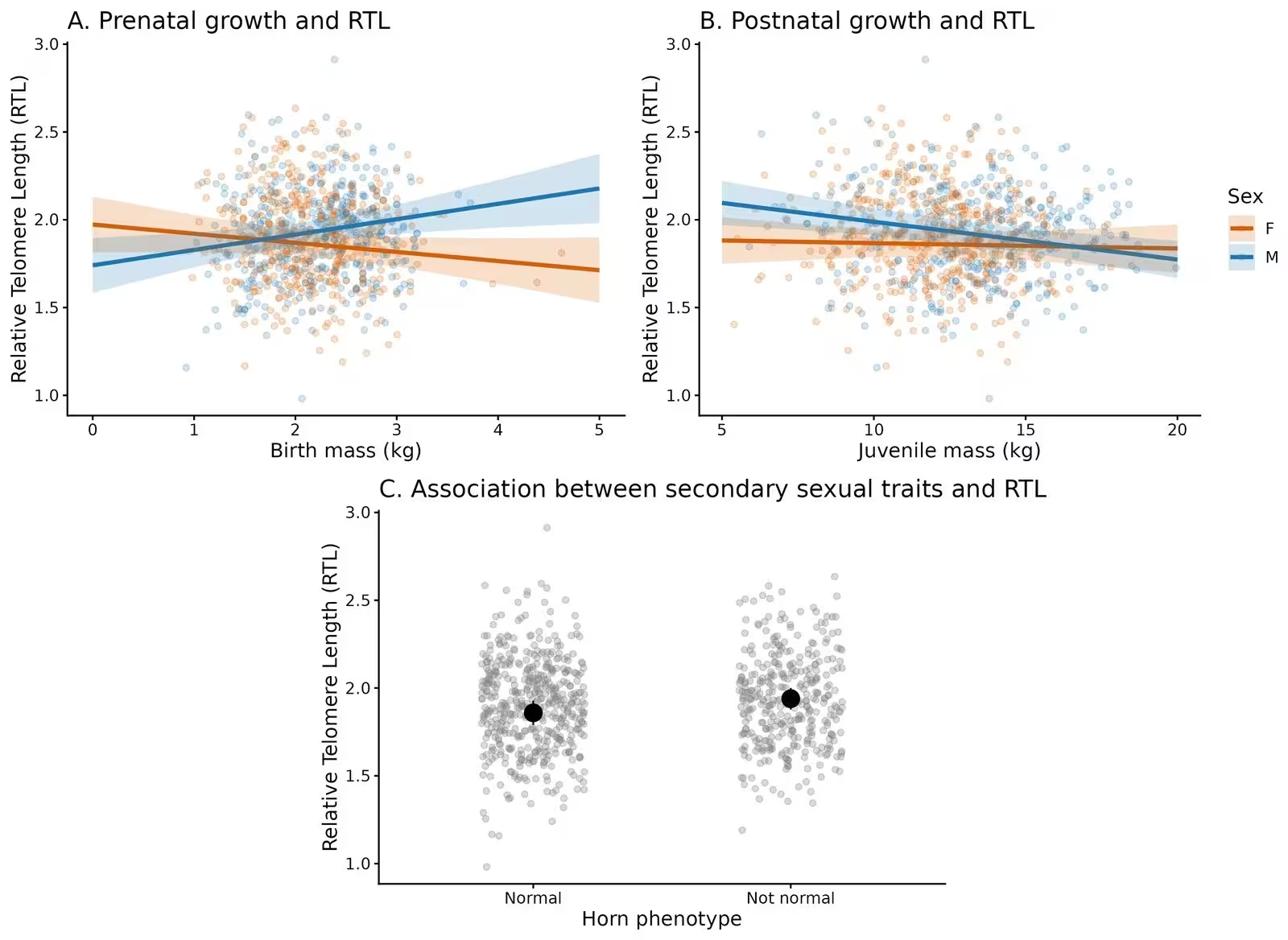
Figure 2: Sex-specific effects of early-life growth and secondary sexual traits on relative telomere length (RTL) in the Soay sheep. (A) Scatterplot representing the interactive effect of birth mass and sex on RTL. (B) Scatterplot representing the interactive effect of postnatal growth (juvenile mass coryrected for birth mass) and sex on RTL. For (A) and (B), solid regression lines and shaded areas represent the marginal predicted means and 95% confidence intervals extracted from the global model. Predictions were computed by holding all other fixed effects present in the global model constant at their mean values or reference levels. (C) Jitter plot illustrating the association between secondary sexual traits and RTL, showing the distribution of RTL across horn phenotypes (Normal versus Not normal). Semi-transparent points represent raw data; large markers and associated vertical lines represent the group means and s.e.
Sex-specific effects of early-life growth and secondary sexual traits on relative telomere length (RTL) in the Soay sheep. (A) Scatterplot representing the interactive effect of birth mass and sex on RTL. (B) Scatterplot representing the interactive effect of postnatal growth (juvenile mass coryrected for birth mass) and sex on RTL. For (A) and (B), solid regression lines and shaded areas represent the marginal predicted means and 95% confidence intervals extracted from the global model. Predictions were computed by holding all other fixed effects present in the global model constant at their mean values or reference levels. (C) Jitter plot illustrating the association between secondary sexual traits and RTL, showing the distribution of RTL across horn phenotypes (Normal versus Not normal). Semi-transparent points represent raw data; large markers and associated vertical lines represent the group means and s.e. Credit: Florentin Remot et al. / Philosophical transactions of the Royal Society of London. Series B, Biological sciences

The analysis revealed that rapid postnatal mass gain correlated with shorter telomeres in male lambs, but showed no such effect in females. However, males that were heavier at birth appeared buffered against this rapid growth cost. Male lambs with a higher birth mass possessed longer telomeres, suggesting that greater early maternal investment helps cushion the cellular toll of subsequent fast growth.

Why Rich Habitats Can Bring Unexpected Costs for Roe Deer

The researchers also evaluated European roe deer across two contrasting French forest populations managed by the Office Français de la Biodiversité. Trois-Fontaines offers a high-quality environment with rich soil and abundant food, whereas Chizé represents a resource-limited habitat prone to summer droughts. By examining telomere length in relation to winter fawn mass, the team discovered that heavier fawns at eight months old had shorter telomeres only in the high-quality environment of Trois-Fontaines.
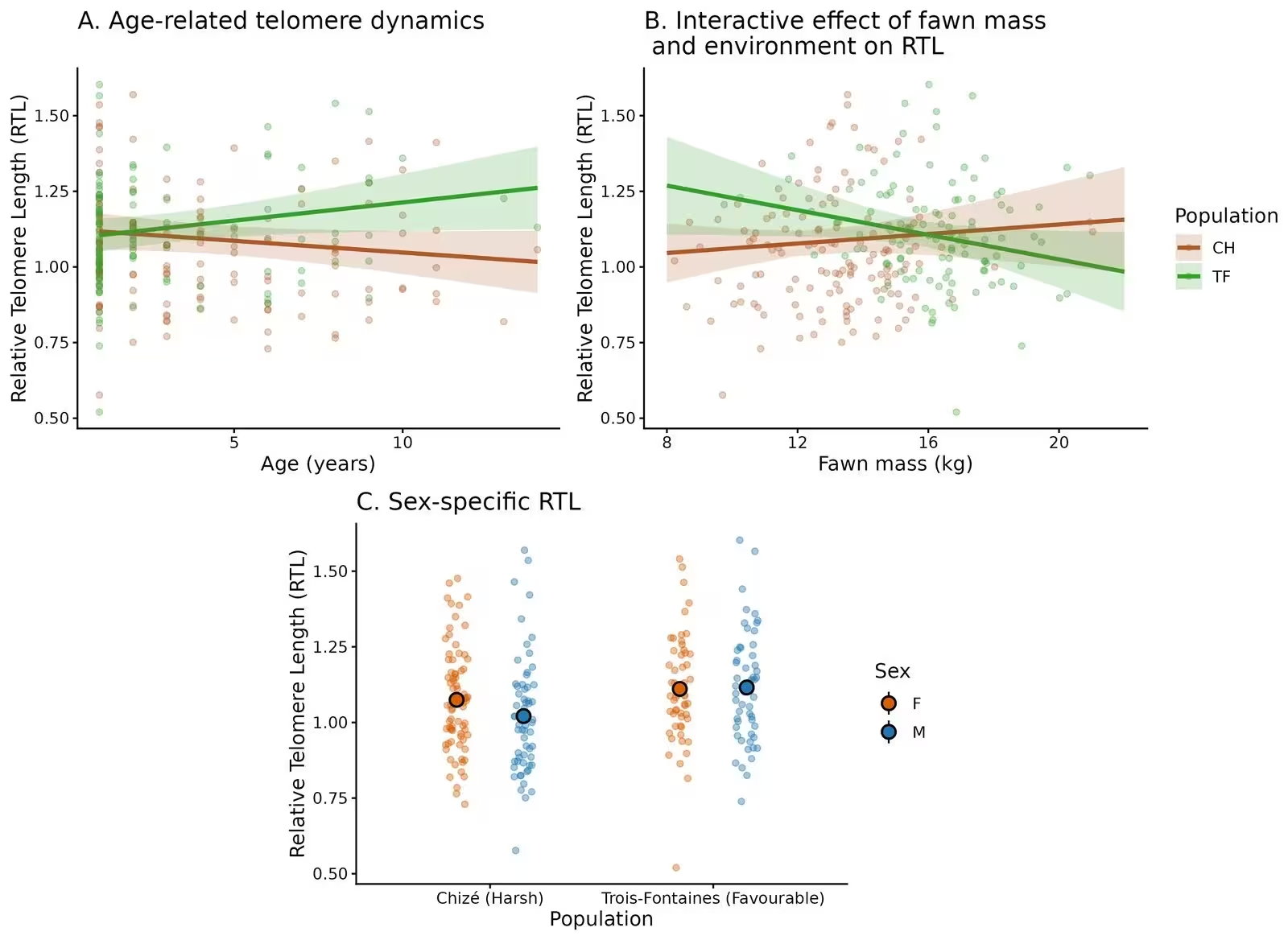
Figure 3: Environmentally modulated effects of age, mass at eight months of age, and sex on relative telomere length (RTL) in the roe deer. (A) Scatterplot illustrating the interactive effect of age and population on RTL. (B) Scatterplot representing the interactive effect of fawn mass at eight months of age and population on RTL. For (A) and (B), solid regression lines and shaded areas represent the marginal predicted means and 95% confidence intervals extracted from the global model. Predictions were computed by holding all other fixed effects present in the global model constant at their mean values or reference levels. (C) Jitter plot illustrating sex-specific RTL per population. Semi-transparent points represent raw data; large markers and associated vertical lines represent the group means and standard errors (s.e.). CH, Chizé; TF, Trois-Fontaines.
Environmentally modulated effects of age, mass at eight months of age, and sex on relative telomere length (RTL) in the roe deer. (A) Scatterplot illustrating the interactive effect of age and population on RTL. (B) Scatterplot representing the interactive effect of fawn mass at eight months of age and population on RTL. For (A) and (B), solid regression lines and shaded areas represent the marginal predicted means and 95% confidence intervals extracted from the global model. Predictions were computed by holding all other fixed effects present in the global model constant at their mean values or reference levels. (C) Jitter plot illustrating sex-specific RTL per population. Semi-transparent points represent raw data; large markers and associated vertical lines represent the group means and standard errors (s.e.). CH, Chizé; TF, Trois-Fontaines. Credit: Florentin Remot et al. / Philosophical transactions of the Royal Society of London. Series B, Biological sciences

In the harsher environment of Chizé, fast growth and heavy weights were largely absent, and no negative relationship with telomere length emerged. This unexpected pattern suggests that when fawns reach their maximal physiological growth potential in rich habitats, the intense metabolic pace increases oxidative damage and accelerates telomere attrition. By contrast, environmental constraints in poorer habitats prevent animals from hitting those high metabolic thresholds.

What These Cellular Trade-Offs Mean for Mammal Lifespan

Unlike many birds and cold-blooded animals that maintain telomerase activity throughout life, most large mammals shut down somatic telomerase shortly after development to prevent tumors. This biological constraint leaves mammals particularly vulnerable to early-life telomere loss because they cannot easily repair or lengthen chromosomes later on. The study underscores that population context and individual sex must be factored into evolutionary biology models, as overlooking these variables can completely obscure how early development shapes aging in the wild.

The research was published in Philosophical transactions of the Royal Society of London. Series B, Biological sciences on November 12, 2026.

Fact Checked

This article has been fact checked for accuracy, with information verified against reputable sources. Learn more about us and our editorial process.

Last reviewed on .

Article history

  • Latest version

Reference(s)

  1. Remot, Florentin., et al. “Sex and population mediate the ‘fast growth–short telomere’ association in two species of large herbivores monitored in the wild.” Philosophical Transactions of the Royal Society B: Biological Sciences, vol. 381, no. 1963, November 12, 2026 The Royal Society, doi: 10.1098/rstb.2025.0334. <https://doi.org/10.1098/rstb.2025.0334>.

Cite this page:

Brown, Robert. “Wild Mammals Reveal Surprising Sex and Habitat Twists in Cellular Aging.” BioScience. BioScience ISSN 2521-5760, 13 November 2026. <https://www.bioscience.com.pk/en/subject/biotechnology/sex-and-population-mediate-the-fast-growth-short-telomere-association-in-two-species-of-large-herbivores-monitored-in-the-wild>. Brown, R. (2026, November 13). “Wild Mammals Reveal Surprising Sex and Habitat Twists in Cellular Aging.” BioScience. ISSN 2521-5760. Retrieved November 13, 2026 from https://www.bioscience.com.pk/en/subject/biotechnology/sex-and-population-mediate-the-fast-growth-short-telomere-association-in-two-species-of-large-herbivores-monitored-in-the-wild Brown, Robert. “Wild Mammals Reveal Surprising Sex and Habitat Twists in Cellular Aging.” BioScience. ISSN 2521-5760. https://www.bioscience.com.pk/en/subject/biotechnology/sex-and-population-mediate-the-fast-growth-short-telomere-association-in-two-species-of-large-herbivores-monitored-in-the-wild (accessed November 13, 2026).
End of the article