Microfluidic Tool Unveils How Competing DNA Loops Shape Gene Regulation
New single-molecule sequencing data reveals that cooperative and competitive enhancer clusters divide human genes into distinct regulatory classes.“, _meta_description: ”New microfluidic biotechnology tool Drop-t maps higher-order chromatin interactions, revealing how competing and cooperative enhancers regulate human genes.
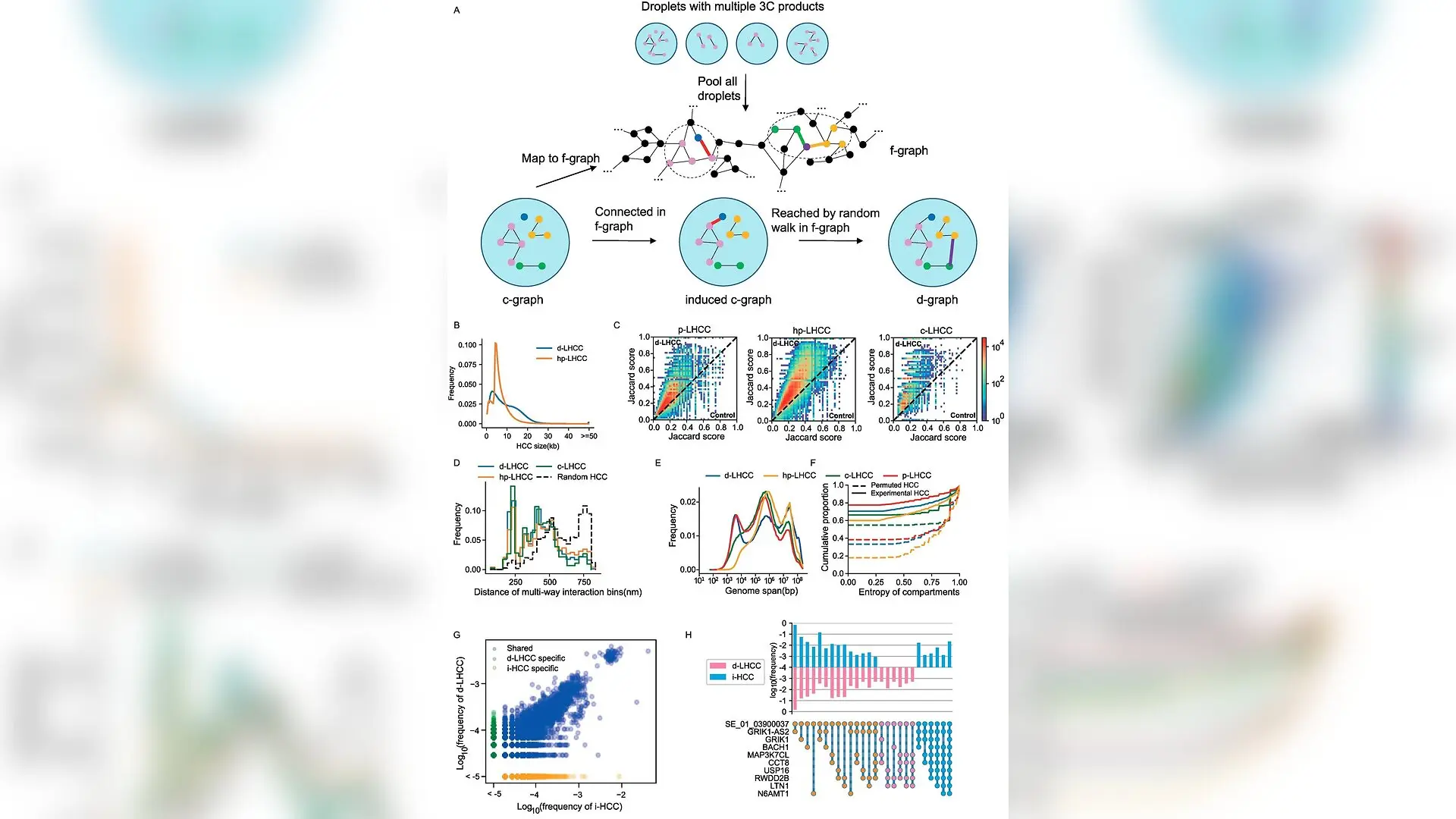
A new microfluidics-based biotechnology tool called Drop-t has solved a long-standing mystery in genomics by capturing complex networks of physical interactions between distant regulatory elements inside human cells. Researchers developed the technique to map higher-order chromatin architecture, revealing how multiple enhancers coordinate to control gene expression at the single-molecule scale.
Understanding how genes are switched on and off in eukaryotic genomes requires mapping three-dimensional chromatin loops, where distant DNA regions known as enhancers make physical contact with gene promoters. Traditional laboratory techniques struggle to record these multi-way interactions because they typically capture only pairs of regions at a time, leaving researchers unable to determine whether multiple enhancers work together cooperatively or fight one another competitively. The study was published in Nucleic Acids Research by Zhihua Zhang and colleagues from the Chinese Academy of Sciences and partner institutions, introducing an experimental approach designed to bypass these technical hurdles.
The innovation behind Drop-t relies on exploiting DNA entanglements that naturally form during chromosome conformation capture experiments. While standard sequencing methods often suffer from clogging and data loss due to these tangled molecules, Drop-t uses microfluidic droplets to capture heavy DNA complexes together. By co-encapsulating spatially proximal genomic fragments into droplets, the system preserves high-resolution structural data without losing the physical context needed to analyze multi-way interactions.
Using this technology in human leukemia cells and lymphoblastoid cell lines, the team identified millions of enhancer-promoter interactions. Their analysis showed that a large fraction of these contacts are transient and non-specific, acting as background noise that can compete with specific regulatory connections. When too many competing interactions occur around a single gene promoter, transcriptional stability drops and gene expression noise increases, suggesting that non-specific contacts interfere with precise cellular control.
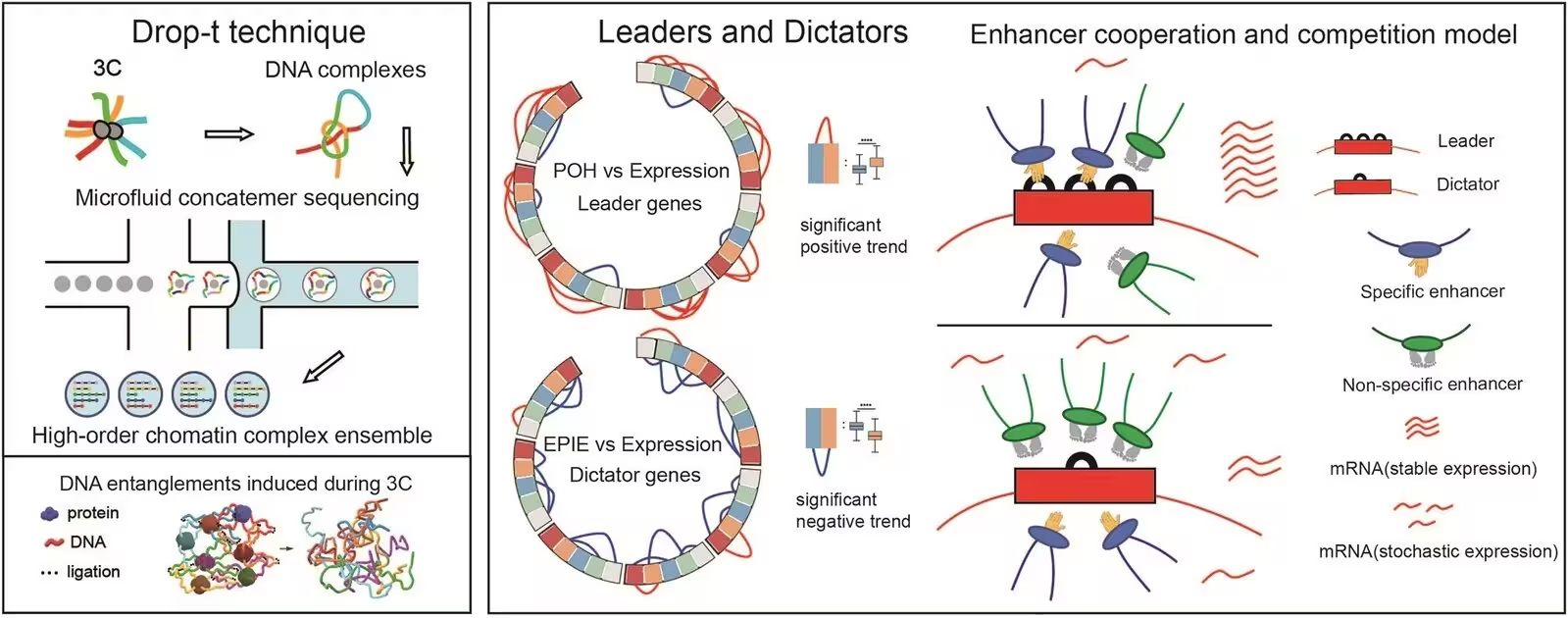
To make sense of these complex dynamics, the investigators categorized genes into two distinct regulatory archetypes based on how their promoters interact with enhancers. Dictator genes rely on a limited number of specific enhancers and exhibit high competition, which correlates with greater transcriptional variability and cell-specific developmental functions. Leader genes interact with extensive networks of cooperative enhancers, utilizing multiple transcription factor binding sites as molecular docking berths to buffer against stochastic noise and maintain stable expression.
The authors note that while Drop-t provides unprecedented insight into spatial genomic organization, the current method relies on indirect capture patterns rather than direct visualization of living nuclei. Future integration with super-resolution imaging and single-cell multi-omics will help clarify the precise mechanical links between higher-order nuclear structures and cellular function.
The research was published in Nucleic acids research on November 10, 2026.
This article has been fact checked for accuracy, with information verified against reputable sources. Learn more about us and our editorial process.
Last reviewed on .
Article history
- Latest version
Reference(s)
- Chen, Qiwen., et al. “Microfluidic concatemer sequencing unveils cooperative and competitive enhancer clusters in gene regulation.” Nucleic Acids Research, vol. 54, no. 21, November 10, 2026 Oxford University Press (OUP), doi: 10.1093/nar/gkag1146. <https://doi.org/10.1093/nar/gkag1146>.
Cite this page:
- Posted by Robert Brown