Plant Fibers and Perovskite Crystals Form Unbreakable Security Keys
A novel lead-free perovskite security platform leverages plant fiber chaos and shifting light emissions to block artificial intelligence hackers.
Securing digital supply chains and physical currency against counterfeiting could soon get a major upgrade thanks to a sustainable, lead-free security tag that leverages the natural chaos of plant fibers and light-responsive chemicals. Traditional security systems rely on computer algorithms and static barcodes that are increasingly vulnerable to sophisticated hacking tools and artificial intelligence. To solve this problem, a research team developed a hardware-based security device that exploits unpredictable physical variations baked right into its material structure, making it virtually impossible to replicate or hack.
Physical unclonable functions serve as cryptographic anchors that generate unique challenge-response pairs, functioning much like an electronic fingerprint. While earlier optical security tags used random surface patterns, they often suffered from environmental toxicity or lacked the complexity to resist advanced machine learning attacks. The new approach, published in Advanced Science, combines eco-friendly halide perovskites with traditional Korean cellulose paper known as Hanji to create a resilient, multiband optical security platform.
How Plant Fibers and Water-Cast Crystals Create Unbreakable Security Keys
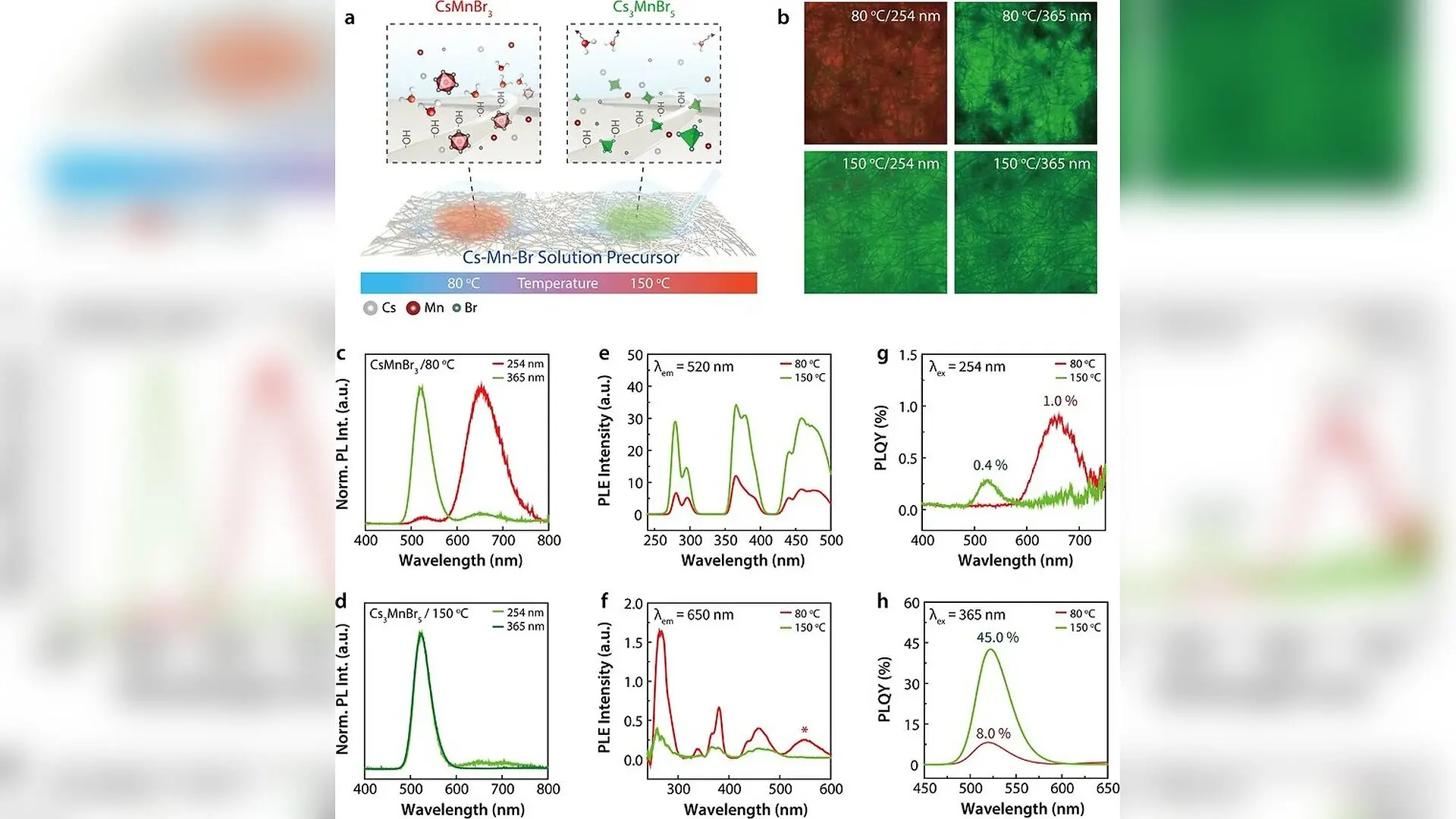
The manufacturing process relies on an environmentally benign water-based drop-casting technique rather than energy-intensive industrial fabrication. Researchers dissolved cesium and manganese bromide precursors in water and applied the solution directly onto cellulose membranes. As the solvent evaporated under controlled annealing temperatures between 80 degrees Celsius and 150 degrees Celsius, the materials spontaneously formed mixed-phase perovskite crystals interlaced within the microscopic network of cellulose fibers.
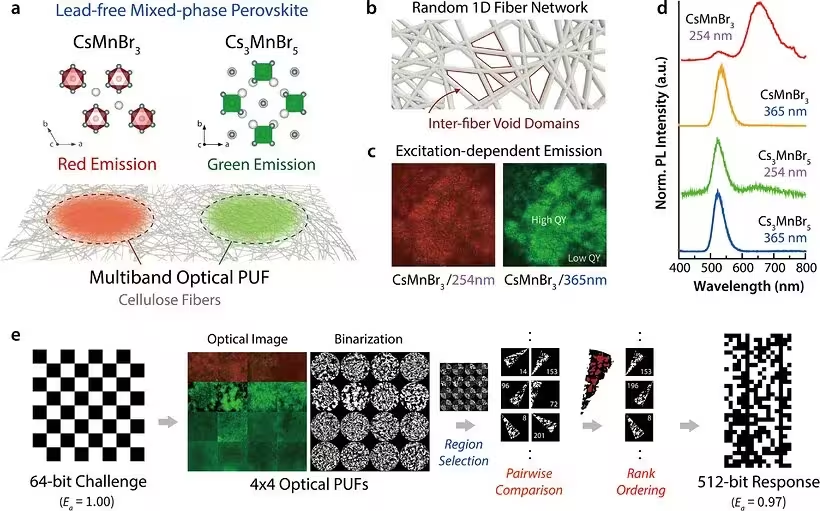
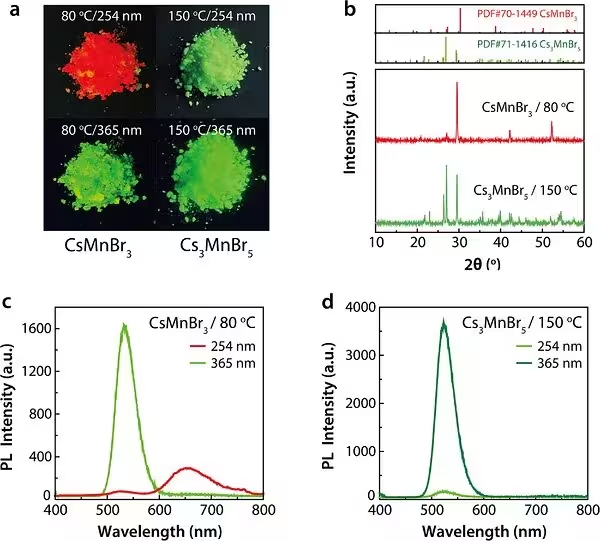
The resulting security tags derive their physical randomness from two distinct sources working together. At the microscopic level, the tangled one-dimensional cellulose fibers form irregular polygonal void domains that create chaotic spatial patterns. At the chemical level, the perovskite layer exhibits multilevel luminescence that shifts depending on the wavelength of ultraviolet light used to illuminate it. Under 254 nanometre ultraviolet light, regions dominated by the cesium manganese tribromide phase emit red luminescence, whereas 365 nanometre light triggers green emission.
What Happens When Security Tags Face Artificial Intelligence Attacks
To test how well the security platform stands up against digital threats, the authors evaluated the system using a support vector machine, a type of artificial intelligence algorithm designed to predict and crack cryptographic keys. While traditional electrical security architectures like arbiter physical unclonable functions are easily compromised once the algorithm is trained on roughly one thousand challenge-response datasets, the new optical platform completely resisted machine learning attacks. Even after feeding the artificial intelligence model 100,000 training datasets, prediction accuracy remained stuck at approximately 55 percent, just slightly above the ideal security baseline of 50 percent.
The team demonstrated two practical use cases for the technology, including currency authentication and secure image encryption. When two microscopic security tags were integrated onto a 50,000 Korean won banknote, they remained nearly invisible under normal ambient lighting. When illuminated with ultraviolet light, however, the tags revealed complex, multicolored emission patterns that verified the authenticity of the currency. Furthermore, cryptographic keys generated from a single tag successfully encrypted digital image data into randomized bit streams, which could only be recovered when the exact keys were applied in the correct sequence.
What Limits Remain for Real-World Deployment
Although accelerated aging tests under high humidity and elevated temperatures showed that the cellulose and perovskite structures retained their optical integrity for up to one hour, real-world deployment will require broader durability testing across extended timeframes and harsher outdoor conditions. The researchers noted that certain crystal phases, particularly the red-emitting components, are more susceptible to environmental degradation than others. Scaling up the water-assisted fabrication process for mass manufacturing while ensuring uniform crystal growth across large sheets represents another important step before commercial adoption.
Despite these current limitations, the combination of sustainable materials, high encoding capacities reaching up to 1.59 multiplied by ten to the fifteenth power, and robust resistance to computational cloning establishes a promising framework for next-generation hardware security technologies. By turning everyday plant fibers and non-toxic metal halides into multidimensional cryptographic primitives, the work points toward a greener and more secure digital future.
The research was published in Advanced science (Weinheim, Baden-Wurttemberg, Germany) on November 10, 2026.
This article has been fact checked for accuracy, with information verified against reputable sources. Learn more about us and our editorial process.
Last reviewed on .
Article history
- Latest version
Reference(s)
- Park, Seungbeom., et al. “Multiband Optical Physical Unclonable Functions Based on Mixed‐Phase Multilevel Emissive Perovskites.” Advanced Science, November 10, 2026 Wiley, doi: 10.1002/advs.78505. <https://doi.org/10.1002/advs.78505>.
Cite this page:
- Posted by Rohan Kumar