Simple Blood Test Predicts Early Organ Failure in Sepsis Patients
A standard immune cell ratio measured at hospital admission signals rapid clinical deterioration hours before traditional scoring systems catch up.
When patients arrive at the emergency department with a severe infection, doctors face an urgent race to predict who will rapidly deteriorate and who will stabilize. Researchers have discovered that a simple routine blood test calculation, known as the neutrophil-to-lymphocyte ratio, can signal within the first 24 hours which septic patients are headed toward dangerous organ failure.
What is the Neutrophil-to-Lymphocyte Ratio and Why Does it Matter?
The human immune system reacts to severe infections by unleashing a dual wave of activity that can easily throw the body off balance. Neutrophils are white blood cells that act as rapid responders to fight off invading pathogens through intense inflammation, while lymphocytes are immune cells responsible for targeted defense and regulation. By dividing the absolute count of neutrophils by the count of lymphocytes, clinicians obtain a single numerical value that reflects both hyperinflammation and immune suppression.
Writing in Critical Care Explorations, a team led by investigators at Limoges University Hospital Center in France evaluated 364 patients who met strict international criteria for sepsis or septic shock. The team tracked how each patient’s organ function evolved during their first day in the hospital by measuring changes in their Sequential Organ Failure Assessment score, a standard medical scoring system that evaluates the performance of the lungs, liver, kidneys, and cardiovascular system.
How the Study Tracked Patient Deterioration
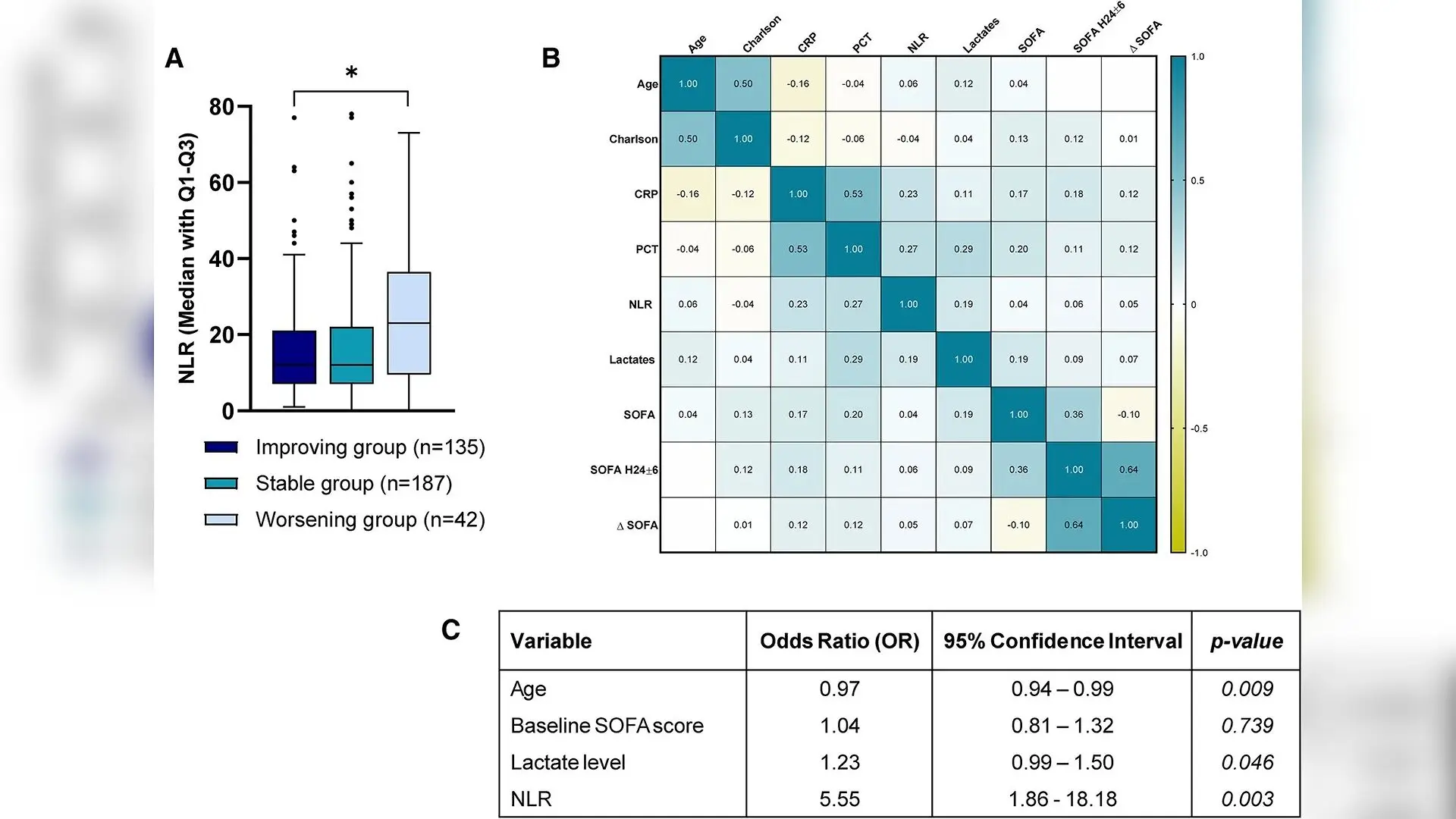
Out of the 364 participants analyzed in the cohort, researchers categorized patient trajectories into three distinct groups based on how their Sequential Organ Failure Assessment scores shifted within the initial 24 hours. A total of 135 individuals, or 37 percent, showed improving scores, while 187 individuals, or 51 percent, remained stable. However, 42 patients, making up 12 percent of the total group, experienced a worsening trajectory defined by a score increase of two points or more.
Patients who experienced worsening organ dysfunction showed striking differences upon arrival compared to those who improved or stabilized. While standard metrics such as age and overall comorbidity scores were similar across all groups, the deteriorating patients arrived with significantly higher blood lactate concentrations and lower blood pressure readings. More importantly, their median neutrophil-to-lymphocyte ratio at admission was 23, compared to just 12 for both the improving and stable patient groups.
Why Traditional Scores Miss Early Immune Dysregulation
In standard emergency care, physicians rely heavily on clinical scoring systems and conventional markers like C-reactive protein to gauge disease severity. However, the study revealed that the neutrophil-to-lymphocyte ratio demonstrated only weak correlations with these traditional indicators, proving that it captures entirely separate biological information regarding the body’s immune response.
When the authors performed multivariable logistic regression adjusted for age, initial lactate levels, and baseline disease severity, an elevated neutrophil-to-lymphocyte ratio remained independently associated with worsening organ dysfunction, carrying an odds ratio of 5.55. In contrast, the baseline severity score itself did not reliably predict who would deteriorate during that crucial 24-hour window. Furthermore, patients who suffered this early aggravation of organ dysfunction required intensive care unit admission far more frequently, at 26 percent compared to 4 or 5 percent for the other groups, and faced a 28-day mortality rate of 36 percent.
Limitations and Next Steps for Emergency Medicine
The study authors emphasize that because this was a retrospective secondary analysis conducted at a single center, the findings should be viewed as exploratory. The number of patients who experienced worsening organ dysfunction was relatively small, and the ratio was only measured upon initial admission without ongoing longitudinal tracking throughout the hospital stay. Furthermore, the 24-hour organ score changes can occasionally be influenced by early medical interventions administered in the emergency room.
Despite these caveats, the research points to a practical, inexpensive method already embedded within standard complete blood count panels that could soon help emergency physicians identify vulnerable sepsis patients hours before traditional clinical decline becomes obvious. Larger multicentric studies will now be needed to validate these ratios and confirm how best to integrate them into routine critical care protocols.
The research was published in Critical care explorations on November 1, 2026.
This article has been fact checked for accuracy, with information verified against reputable sources. Learn more about us and our editorial process.
Last reviewed on .
Article history
- Latest version
Reference(s)
- Lafon, Thomas., et al. “Elevated Neutrophil-to-Lymphocyte Ratio Predicts Early Aggravation of Organ Dysfunction in Septic Patients in the Emergency Department.” Critical Care Explorations, vol. 8, no. 11, November 10, 2026, pp. e1511 Ovid Technologies (Wolters Kluwer Health), doi: 10.1097/CCE.0000000000001511. <https://doi.org/10.1097/CCE.0000000000001511>.
Cite this page:
- Posted by Hassan Raza