Deep-Sea Microbial Discovery Reveals Tough New Enzyme for Genome Editing
Biotechnology

Deep-Sea Microbial Discovery Reveals Tough New Enzyme for Genome Editing

A newly characterized hydrothermal meganuclease bypasses delivery bottlenecks by generating unique cohesive ends at elevated temperatures.
By Rohan Kumar
Published:
Email this Article
Deep-Sea Microbial Discovery Reveals Tough New Enzyme for Genome Editing
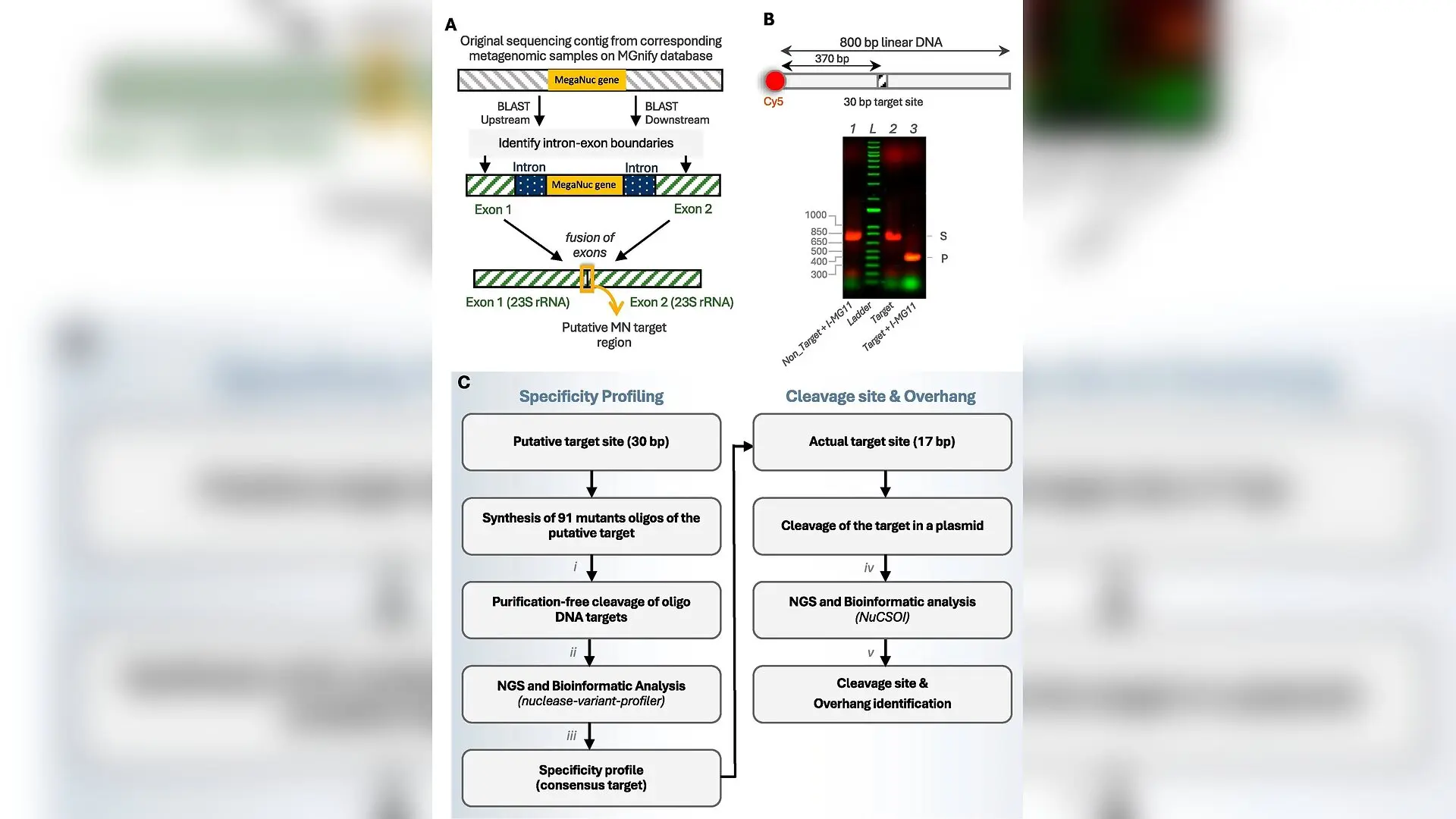
Identification of target site and cell-free characterization of intron encoded HE I-MG11. (A) By inspection of metagenomic sequencing contig, and identification of intron-exon boundaries via nucleotide BLAST (Supplementary Fig. S2), and virtually removing the intron sequences by fusing the exon sequences, the putative cleavage site can be reconstructed. The putative 30 bp target of I-MG11 in the exon fusion site is cloned into a plasmid. (B) A linear dsDNA containing the HE cleavage site was amplified from the plasmid using Cy5-linked primers. Cleavage of the putative target is confirmed by running the samples on 1% agarose gel. Lane 1: Control1 as non-target DNA (I-SceI target site) treated with cell-free lysate expressing the I-MG11 enzyme; Lane L: 1 Kb Plus DNA Ladder (Invitrogen); Lane 2: Control2 as target DNA treated with only cell-free lysate (no-enzyme control); Lane 3: Target DNA incubated with cell-free lysate expressing the I-MG11 enzyme for 1 h. Fluorescence images of the C Gol Mohammad Dorrazehi et al. / Nucleic acids research

Deep-sea microorganisms are yielding tough new enzymes that could solve major delivery bottlenecks in precision genome editing. Researchers discovered a remarkably stable monomeric meganuclease originating from a hydrothermal vent environment, showcasing unique cleavage capabilities that expand the molecular toolkit for synthetic biology.

Meganucleases are specialized endonuclease enzymes capable of recognizing and cleaving extended DNA sequences with high fidelity. While tools like CRISPR-Cas systems have revolutionized genetic engineering, their bulky multicomponent structures often suffer from low delivery efficiency inside target cells. In contrast, compact meganucleases under 1 kilobase in size offer a promising alternative, particularly for demanding applications such as mitochondrial genome editing, where delivering guide RNA remains exceptionally difficult.

Historically, discovering new meganucleases meant laboriously culturing microbes in a laboratory. Because fewer than one percent of microbial species can be grown this way, scientists are increasingly turning to metagenomic databases containing billions of uncultured protein sequences. However, traditional homology searches usually just recover slight variations of already known enzymes, missing entirely novel activities. To overcome this limitation, a team led by scientists at AstraZeneca and the University of Cambridge developed a streamlined two-week discovery pipeline combining cell-free protein expression with deep sequencing.
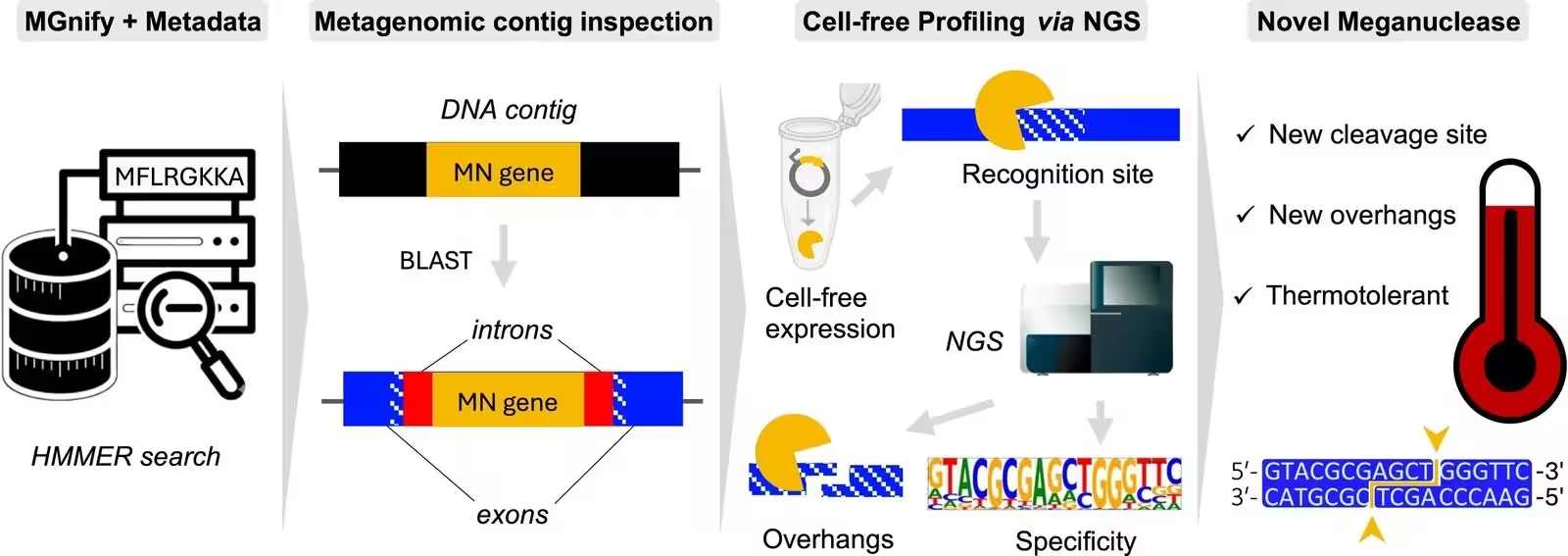
Graphical Abstract
Credit: Gol Mohammad Dorrazehi et al. / Nucleic acids research

The workflow bypassed the usual protein purification bottlenecks by utilizing cell-free extracts to produce candidate enzymes directly from synthetic DNA templates. Screening sequences harvested from the MGnify microbiome database, the team identified a novel enzyme designated as I-MG11. Originating from subseafloor sediment in the Guaymas Basin, I-MG11 shares only 28.3 percent sequence identity with the classic meganuclease I-SceI and bears no significant matches to annotated proteins in standard uniprot databases.

Detailed functional characterization, published in Nucleic Acids Research, revealed that I-MG11 recognizes a 17-base-pair sequence and creates four-nucleotide palindromic three-prime overhangs. This makes it the first known monomeric meganuclease to generate such cohesive ends from a non-palindromic target site. These overhangs are especially valuable because they facilitate precise gene insertion through homology-directed repair while avoiding the error-prone outcomes typical of non-homologous end joining.
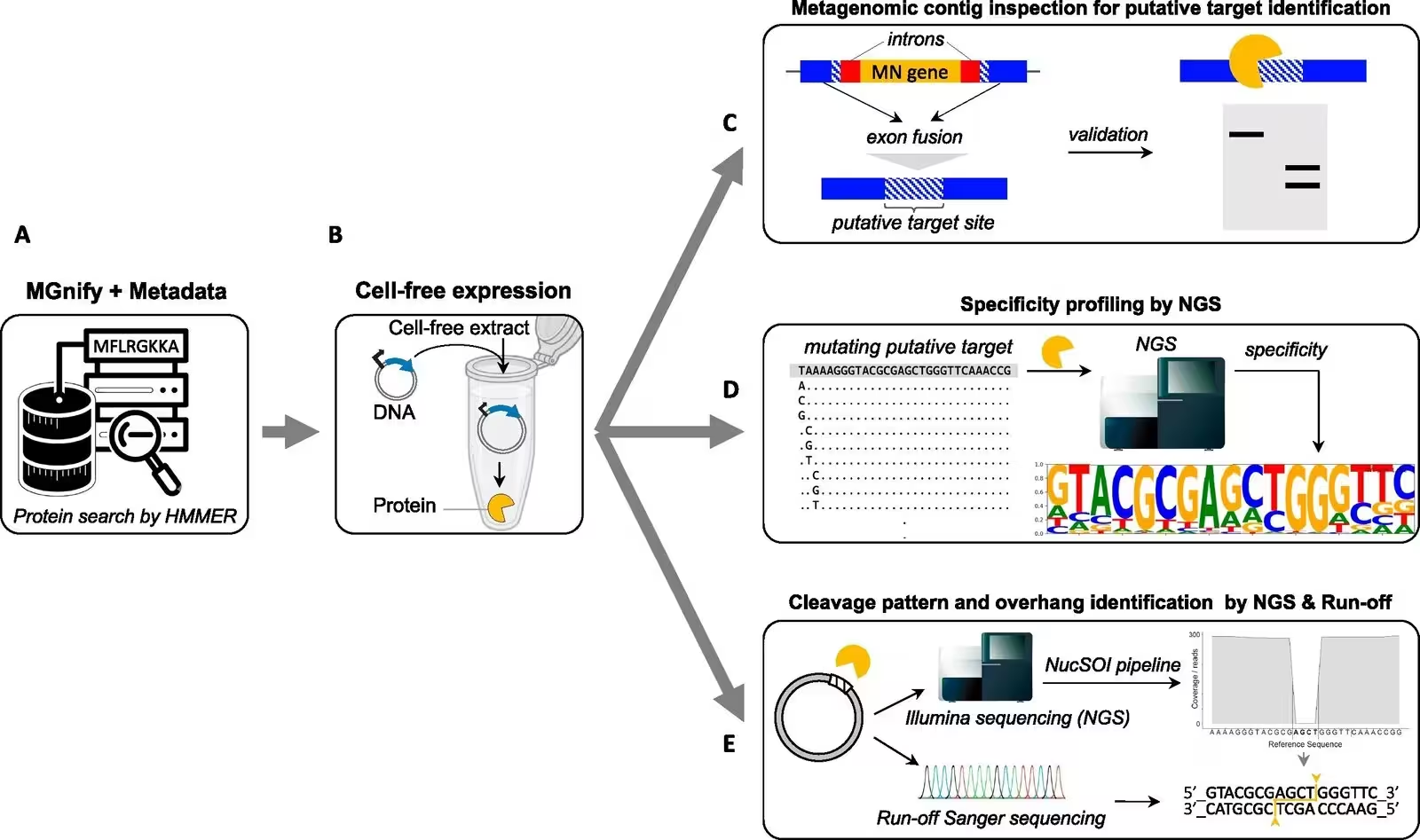
Figure 1: Overview of cell-free and next-generation sequencing (NGS)-based metagenomic discovery of meganuclease enzymes in this work. Our approach includes: (A) extracting functionally homologous proteins and related metadata from the MGnify database (by HMMER search using a query enzyme, i.e. I-SceI); (B) synthesizing DNA sequences of the extracted proteins followed by protein production by cell-free expression; (C) identifying putative target of the meganuclease by inspecting the metagenomic sequencing DNA contig (see Supplementary Fig. S2), and validating the activity by cell-free expressed enzyme and electrophoretic analysis; (D) specificity profiling of the enzyme by deep sequencing that involves mutating the putative target, cleavage by the cell-free-produced enzyme, and NGS; (E) identifying cleavage pattern and overhang sequence by cleaving the target within a supercoiled plasmid DNA by the cell-free-expressed enzyme, followed by DNA clean-up and either (i) enzymatic removal of overhangs
Overview of cell-free and next-generation sequencing (NGS)-based metagenomic discovery of meganuclease enzymes in this work. Our approach includes: (A) extracting functionally homologous proteins and related metadata from the MGnify database (by HMMER search using a query enzyme, i.e. I-SceI); (B) synthesizing DNA sequences of the extracted proteins followed by protein production by cell-free expression; (C) identifying putative target of the meganuclease by inspecting the metagenomic sequencing DNA contig (see Supplementary Fig. S2), and validating the activity by cell-free expressed enzyme and electrophoretic analysis; (D) specificity profiling of the enzyme by deep sequencing that involves mutating the putative target, cleavage by the cell-free-produced enzyme, and NGS; (E) identifying cleavage pattern and overhang sequence by cleaving the target within a supercoiled plasmid DNA by the cell-free-expressed enzyme, followed by DNA clean-up and either (i) enzymatic removal of overhangs Credit: Gol Mohammad Dorrazehi et al. / Nucleic acids research

Biochemical assays demonstrated that I-MG11 is exceptionally thermostable, showing optimal DNA cleavage activity at temperatures between 55 and 65 degrees Celsius and a melting temperature of 74 degrees Celsius. The enzyme also displayed an alkaline pH optimum around pH 10, which researchers attribute to its high isoelectric point helping it diffuse efficiently along DNA molecules. Structural modeling using artificial intelligence tools suggested that its high stability and unique specificity stem from specific amino acid insertions and deletions within its DNA-binding pocket.

While these laboratory findings highlight the potential of deep-sea enzymes for biotechnology, further research is required to evaluate their performance in living mammalian cells and to test their precision against off-target genomic sites. The new cell-free screening framework provides a robust blueprint for mining the vast sequence space of unculturable microbes to uncover custom molecular tools.

The research was published in Nucleic acids research on November 10, 2026.

Fact Checked

This article has been fact checked for accuracy, with information verified against reputable sources. Learn more about us and our editorial process.

Last reviewed on .

Article history

  • Latest version

Reference(s)

  1. Dorrazehi, Gol Mohammad., et al. “Cell-free expression and NGS-powered substrate profiling reveal a thermostable metagenomic meganuclease from an extreme environment with novel specificity.” Nucleic Acids Research, vol. 54, no. 21, November 10, 2026 Oxford University Press (OUP), doi: 10.1093/nar/gkag992. <https://doi.org/10.1093/nar/gkag992>.

Cite this page:

Kumar, Rohan. “Deep-Sea Microbial Discovery Reveals Tough New Enzyme for Genome Editing.” BioScience. BioScience ISSN 2521-5760, 11 November 2026. <https://www.bioscience.com.pk/en/subject/biotechnology/cell-free-expression-and-ngs-powered-substrate-profiling-reveal-a-thermostable-metagenomic-meganuclease-from-an-extreme-environment-with-novel-specificity>. Kumar, R. (2026, November 11). “Deep-Sea Microbial Discovery Reveals Tough New Enzyme for Genome Editing.” BioScience. ISSN 2521-5760. Retrieved November 11, 2026 from https://www.bioscience.com.pk/en/subject/biotechnology/cell-free-expression-and-ngs-powered-substrate-profiling-reveal-a-thermostable-metagenomic-meganuclease-from-an-extreme-environment-with-novel-specificity Kumar, Rohan. “Deep-Sea Microbial Discovery Reveals Tough New Enzyme for Genome Editing.” BioScience. ISSN 2521-5760. https://www.bioscience.com.pk/en/subject/biotechnology/cell-free-expression-and-ngs-powered-substrate-profiling-reveal-a-thermostable-metagenomic-meganuclease-from-an-extreme-environment-with-novel-specificity (accessed November 11, 2026).
End of the article