Synthetic Polymers Custom-Built to Trap Elusive Biological Nanoparticles
A new review examines how engineered polymeric interfaces could solve the challenge of detecting extracellular vesicles and viruses without relying on fragile antibodies.
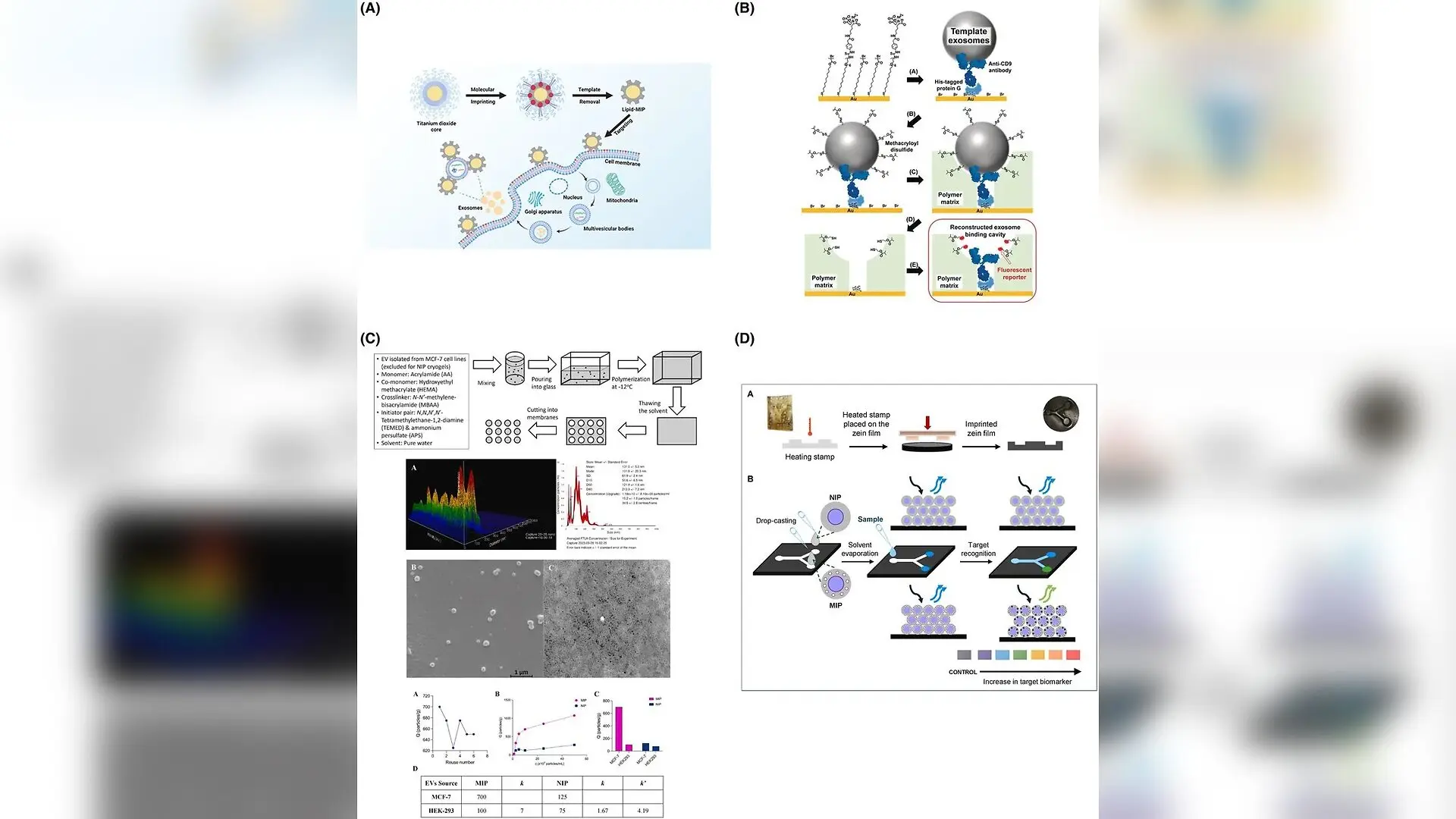
Catching tiny membrane-bound vesicles in complex biological fluids has long frustrated scientists because these nanoscale packages share nearly identical sizes and surface lipids. A team of researchers has mapped out how rationally engineered synthetic polymers can be customized to recognize and capture these elusive biological structures without relying on fragile natural antibodies. The study sheds light on designing artificial receptors that fit the soft, deformable surfaces of extracellular vesicles, viruses, and drug delivery nanoparticles.
The comprehensive review was published in FEBS Open Bio, detailing the physicochemical hurdles involved in creating tailor-made polymer cavities for biological targets. Natural recognition elements such as antibodies offer high binding affinity, but they suffer from high production costs and poor stability under extreme environmental conditions. Synthetic alternatives built through molecular imprinting provide a robust, cost-effective framework that withstands high temperatures and harsh chemical environments.
How Artificial Polymers Mimic Biological Receptors
Molecularly imprinted polymers are created by assembling functional monomers around a target template before cross-linking them into a solid network. Once the template is removed, three-dimensional cavities remain behind that match the specific shape, size, and chemical layout of the original target. While this technique was traditionally reserved for small, rigid molecules, adapting it to soft nanoscale vesicles requires innovative surface imprinting and membrane-component strategies.
Vesicular agents typically measure between 30 and 1000 nanometers across and feature dynamic exterior surfaces populated by lipids, proteins, and glycans. Because intact vesicles can deform during the manufacturing process, researchers rely on surface-accessible recognition layers, macroporous cryogels, and core-shell architectures to ensure target accessibility. These specialized designs prevent the template vesicles from getting trapped deep inside densely cross-linked polymer matrices.
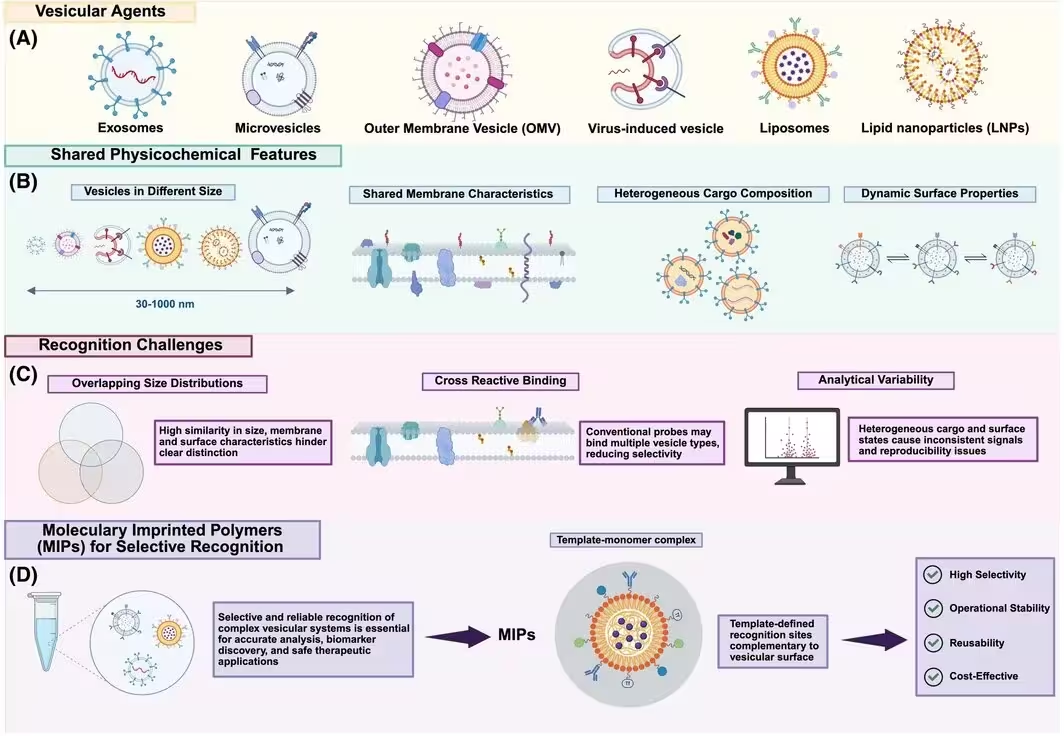
Overcoming Physical Barriers in Vesicle Detection
Sensing systems targeting vesicles must account for complex mass transport limitations due to the exceptionally low diffusion coefficients of nanoscale particles in aqueous solutions. To accelerate binding, modern bioanalytical platforms integrate microfluidic channels that use convective flow to drive particles toward the recognition interface. Techniques such as herringbone mixing and electrokinetic pre-concentration help push vesicle-surface contact rates significantly higher than passive diffusion allows.
The review highlights several successful implementations, including impedimetric sensors that detect lung cancer exosomes with detection limits as low as 2.03 times 10 to the third particles per milliliter. Other platforms utilize solid-phase imprinted nanoparticles on portable surface plasmon resonance chips to spot intact viral particles like SARS-CoV-2. However, translating these laboratory successes into routine clinical and industrial applications will require establishing strict standardization frameworks for vesicle quality and synthesis reproducibility.
The research was published in FEBS open bio on November 12, 2026.
This article has been fact checked for accuracy, with information verified against reputable sources. Learn more about us and our editorial process.
Last reviewed on .
Article history
- Latest version
Reference(s)
- Erdem, Özgecan., et al. “Rationally engineered polymeric interfaces for selective and dynamic recognition of vesicular agents.” FEBS Open Bio, November 12, 2026 Wiley, doi: 10.1002/2211-5463.70365. <https://doi.org/10.1002/2211-5463.70365>.
Cite this page:
- Posted by Rohan Kumar