When Genomes Burn: How DNA Damage and Immune Signals Drive Ageing
A newly synthesized framework reveals how unresolved DNA damage and chronic inflammation lock cells into a self-amplifying stress loop that accelerates multi-organ decline.
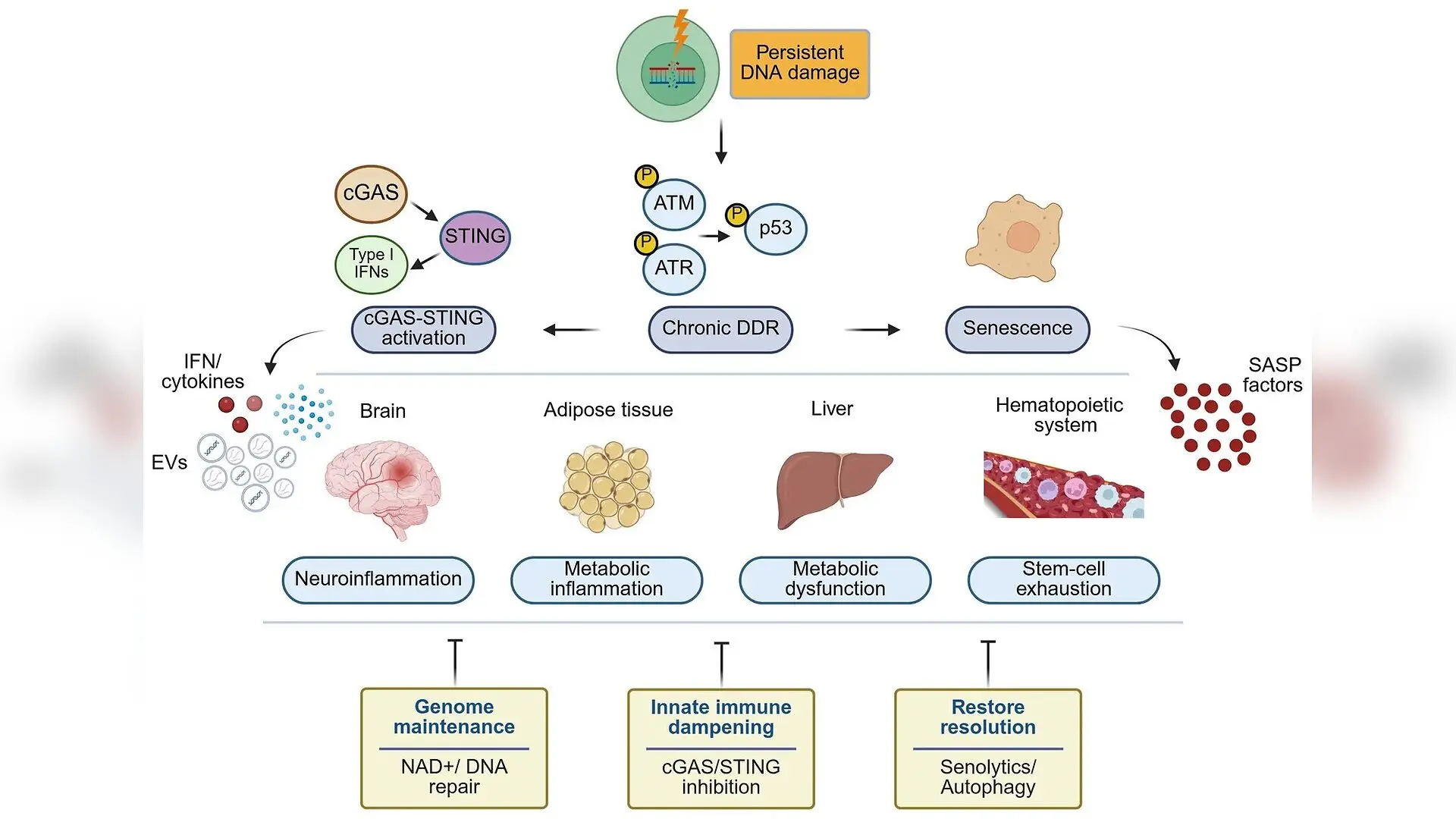
Persistent DNA damage and chronic inflammation fuel a self-amplifying biological loop that drives mammalian ageing, according to a comprehensive review published in Philosophical transactions of the Royal Society of London. Series B, Biological sciences. Researchers Emmanouil Theodorakis and George A. Garinis from the University of Crete and the Foundation for Research and Technology-Hellas examined how cellular stress pathways, originally designed for transient repair and host defense, become chronically engaged over time and accelerate multi-organ decline.
How Genomic Instability Ignites Immune Activation
Ageing is characterized by a gradual loss of physiological homeostasis driven by interconnected molecular stress responses. Two central hallmarks of this decline are genome instability, which involves the accumulation of unhealed DNA lesions and chromosomal abnormalities, and chronic low-grade inflammation known as inflammaging. While traditionally viewed as separate processes, the review indicates that DNA damage and immune signaling are deeply interdependent and self-reinforcing. When DNA repair mechanisms fail or become overwhelmed, persistent lesions trigger sustained activation of the DNA damage response.
This prolonged activation does more than just arrest cell division. It causes nuclear architecture to weaken and drives the leakage of nuclear and mitochondrial DNA into the cellular cytosol. Cytosolic DNA is perceived by the cell as a dangerous pathogen signal, activating innate immune pathways such as the cGAS-STING axis. Once triggered, this pathway stimulates the production of inflammatory interferons and cytokines, transforming a local repair mechanism into a paracrine danger-signaling cascade that propagates stress to neighboring healthy cells.
The Destructive Feedback Loop Between Damage and Inflammation
The relationship quickly turns into a two-way street because inflammation itself acts as a potent genotoxic stressor. Activated immune cells such as neutrophils and macrophages flood surrounding tissues with reactive oxygen and nitrogen species. These reactive molecules generate fresh oxidative and nitrative DNA lesions, directly compounding genome instability. Furthermore, inflammatory cytokines can alter how cells process DNA damage, biasing repair pathways toward error-prone mechanisms and increasing mutation rates.
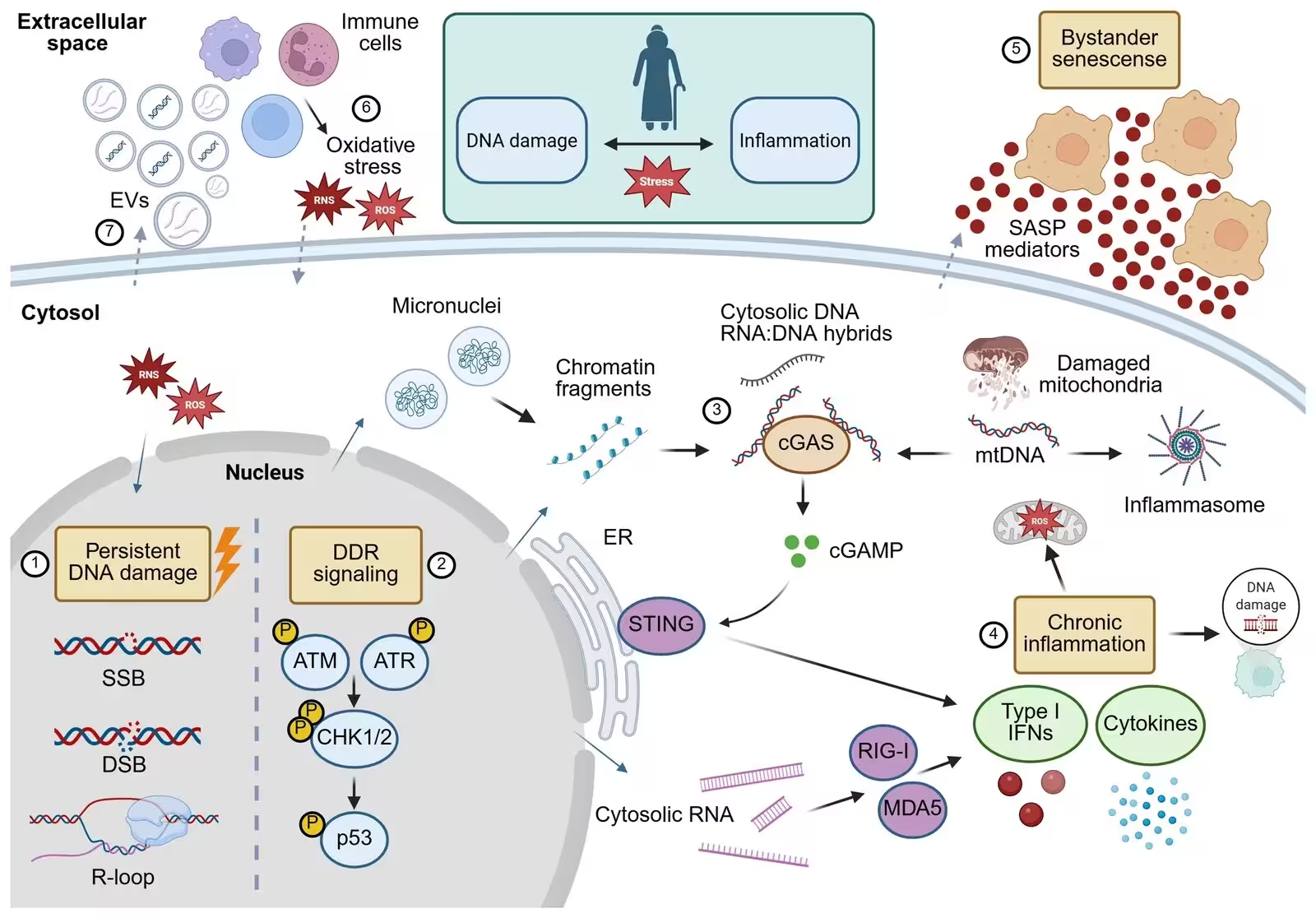
The authors outline how this feedback loop extends across entire organ systems through mobile stress vectors. Senescent cells and damaged tissues release extracellular vesicles carrying inflammatory RNAs, chromatin fragments, and mitochondrial DNA that travel through circulation. These mobile vectors engage immune receptors in distant organs, establishing a distributed low-grade alarm state throughout the body. In metabolic organs, this axis contributes to insulin resistance and tissue degeneration, while in the brain, it promotes neuroinflammation and microglial dysfunction.
Potential Therapeutic Strategies to Break the Ageing Circuit
Understanding ageing as a self-sustaining loop between genome instability and inflammation changes how scientists approach therapeutic interventions. The authors propose three interdependent pillars for future gerotherapeutics: enhancing genome maintenance, dampening aberrant nucleic-acid sensing, and restoring homeostatic resolution.
Interventions that restore cellular energy metabolites like NAD+ can improve DNA repair capacity and nuclear-mitochondrial communication. Similarly, targeting mitochondrial quality control through mitophagy inducers can clear damaged organelles and limit the release of immunostimulatory mitochondrial DNA. Other promising avenues include pharmacological inhibition of the cGAS-STING pathway and the use of senolytics to clear out lingering senescent cells that drive systemic inflammation. By shifting the medical goal from suppressing isolated symptoms to breaking the self-reinforcing damage-inflammation axis, researchers hope to design next-generation interventions that extend healthy lifespan.
The research was published in Philosophical transactions of the Royal Society of London. Series B, Biological sciences on November 12, 2026.
This article has been fact checked for accuracy, with information verified against reputable sources. Learn more about us and our editorial process.
Last reviewed on .
Article history
- Latest version
Reference(s)
- Theodorakis, Emmanouil., et al. “When genomes burn: how DNA damage ignites inflammation and fuels ageing.” Philosophical Transactions of the Royal Society B: Biological Sciences, vol. 381, no. 1963, November 12, 2026 The Royal Society, doi: 10.1098/rstb.2025.0337. <https://doi.org/10.1098/rstb.2025.0337>.
Cite this page:
- Posted by Rohan Kumar