Astronomers Detect Mysterious Radio Pulses From A Sun Like Binary System 5,000 Light Years Away
Astronomers have detected rhythmic radio pulses from a distant binary system, revealing a rare white dwarf located over 5,000 light-years away.
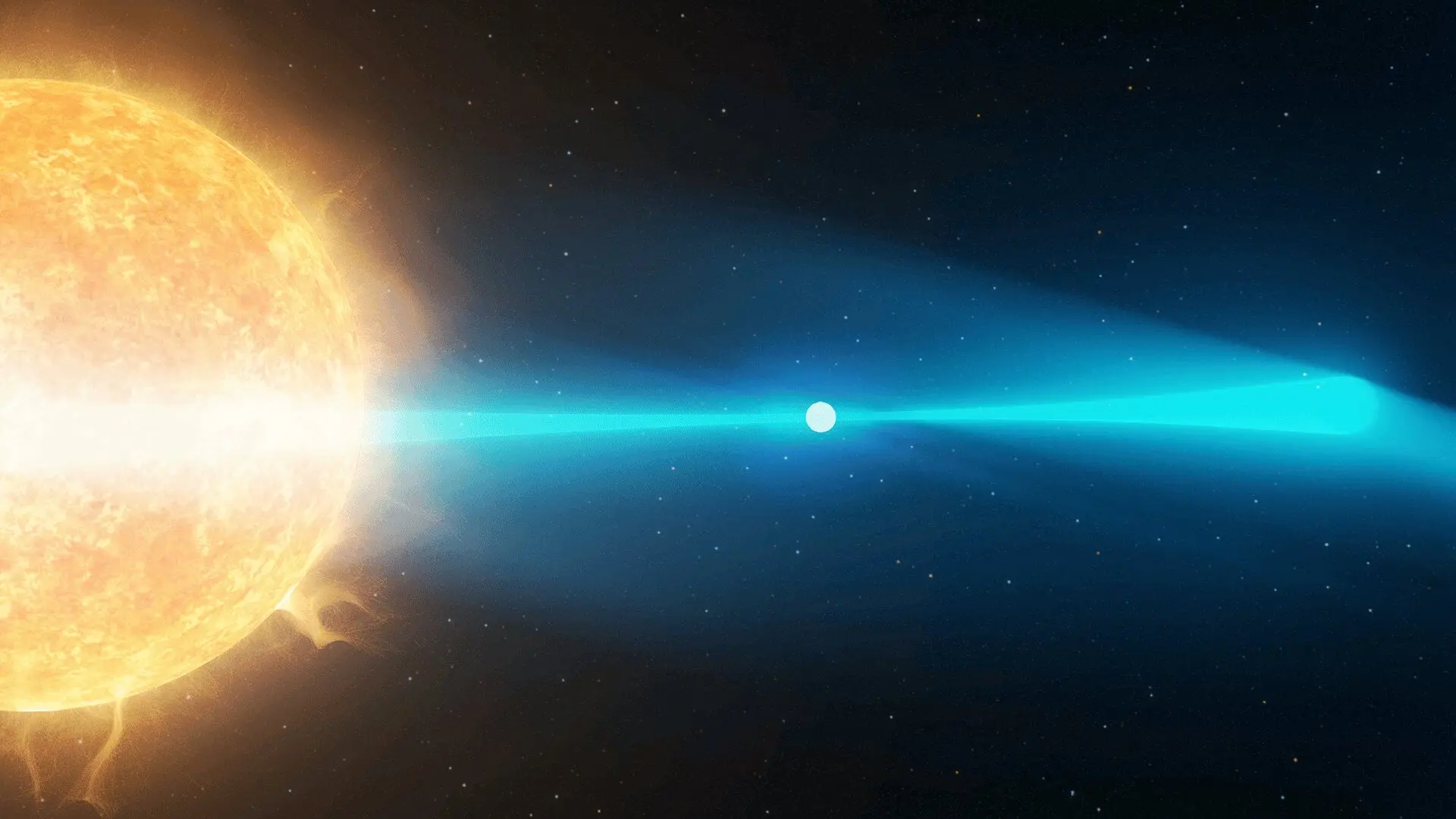
Astronomers have detected a series of mysterious, short-lived radio pulses emanating from a binary system located over 5,000 light-years away. The signals, which originate from a system designated GPM J071507−114153, are providing researchers with a rare window into the complex interactions between a dense white dwarf and a Sun-like star.
The study, published in Nature Astronomy, describes a set of rhythmic radio flashes that lasted only seconds each. During periods of high activity, these pulses occurred at intervals of roughly eight minutes. By analyzing the subtle timing shifts in these signals, the international research team determined that the pulses were being emitted by a source orbiting a G-type star, which shares similar characteristics with our own Sun.
Decoding Cosmic Clocks
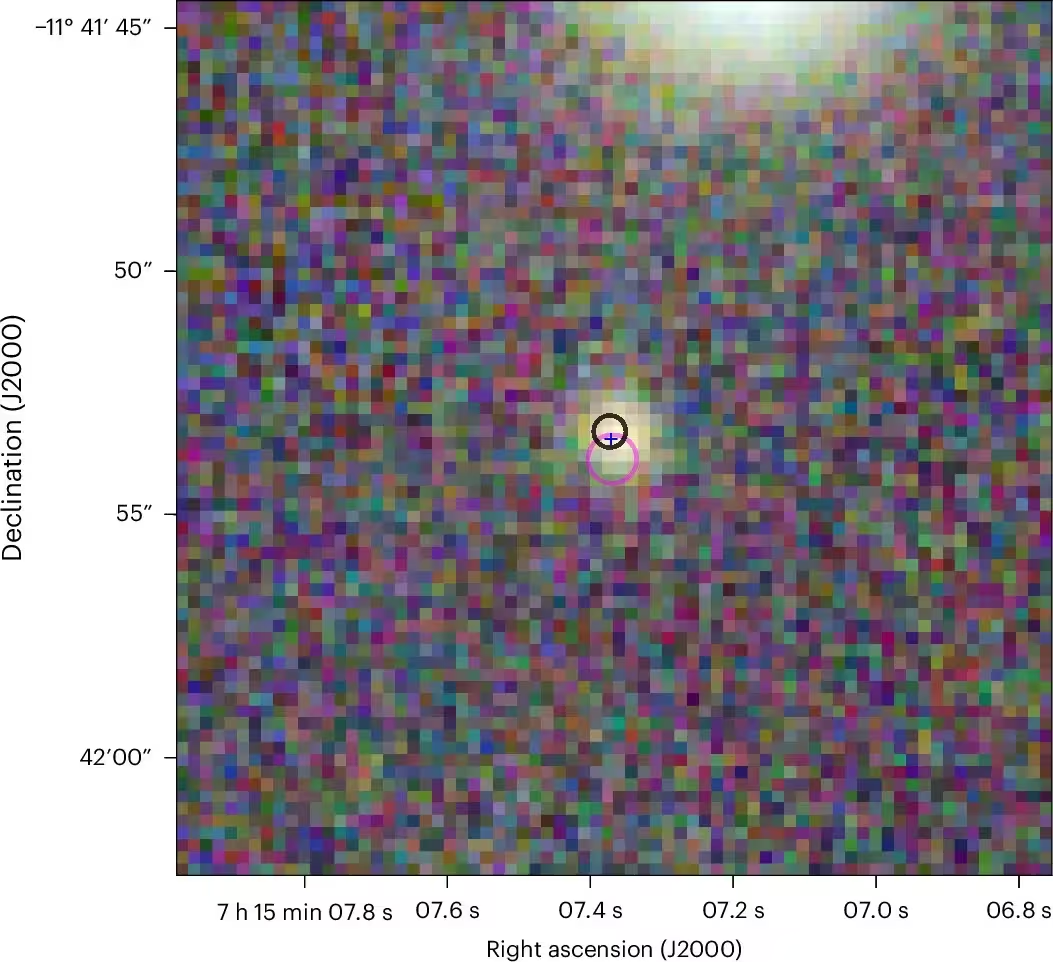
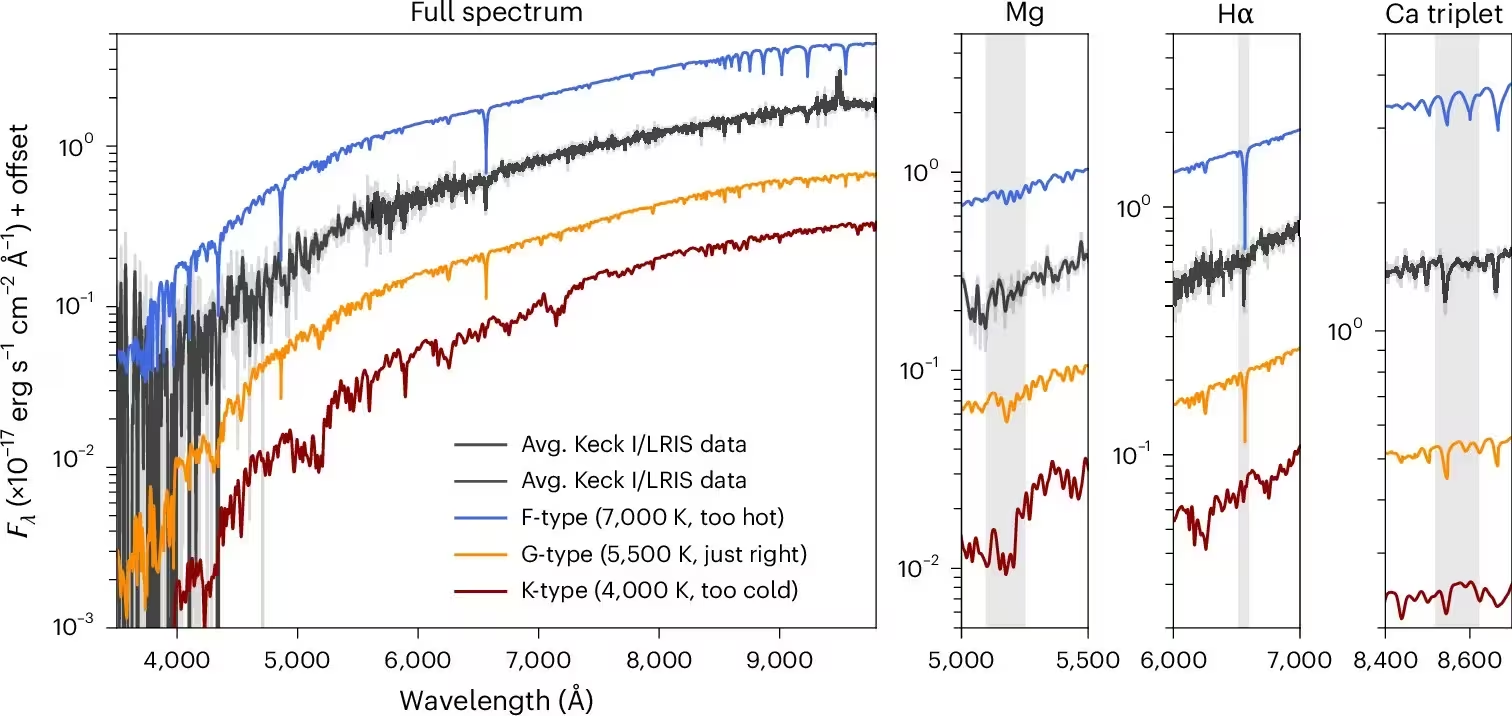
The discovery was made possible through a multi-instrument approach. The Murchison Widefield Array first captured 214 pulses between late 2024 and September 2025. Follow-up observations from the MeerKAT telescope in South Africa provided more precise localization, while optical data from the W. M. Keck Observatory confirmed that the companion star is a G-type star with a temperature of approximately 5,500 Kelvin.
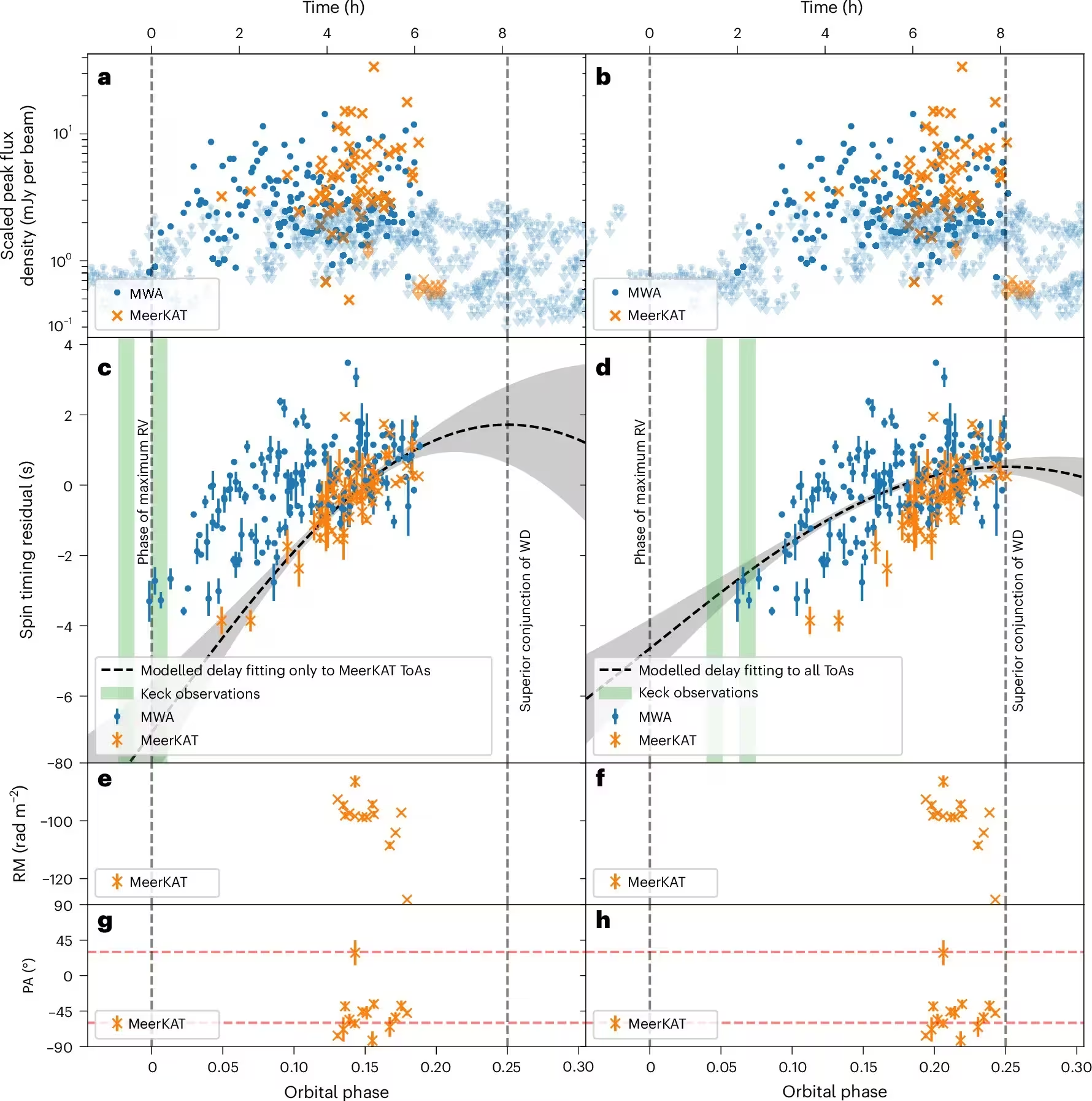
The team identified two distinct temporal rhythms at play. The first, a roughly 7.9-minute period, is believed to represent the spin of the white dwarf. The second rhythm—an active window lasting six hours that recurs every 32.47 hours—matches the orbital period of the two stars. This dual-rhythm structure suggests that the system’s geometry plays a critical role in when and how the pulses reach Earth.
By processing over 100 hours of radio data at the Pawsey Supercomputing Research Centre, researchers measured “light travel time delays.” These small fluctuations in arrival time, caused by the emitting source moving toward or away from Earth in its orbit, allowed the team to map the motion of the source with high precision.
Magnetic Interactions and Stellar Weather
Beyond timing, the polarization of the radio waves offered a look into the extreme magnetic environment surrounding the pair. As the pulses traveled through the system, their polarization shifted—a phenomenon known as Faraday rotation—likely as they passed through the corona of the Sun-like companion.
“The pattern is consistent with pulses passing through the companion’s corona,” the researchers noted. This suggests that phenomena similar to solar flares or plasma loops on our own Sun may be impacting the radio signals, providing a natural laboratory to study magnetic activity in distant star systems.
Expanding the Map of Stellar Binaries
Most previously studied white dwarf binaries in this class have involved smaller, cooler companions. The inclusion of a Sun-like star in this system provides a broader perspective for testing theories about how white dwarfs interact with stellar companions. Future observations will aim to map the magnetic environment more thoroughly, looking for recurring changes in polarization that would indicate stable magnetic structures or, conversely, transient activity caused by unpredictable stellar eruptions.
The research was spearheaded by Sam McSweeney, who began the work while at the Curtin University node of the International Centre for Radio Astronomy Research, and is now affiliated with the Square Kilometre Array Observatory.
Further Reading
- Link between long-period transients and white dwarf pulsars
- A long-period radio transient active for three decades
- A 5.3-min-period pulsing white dwarf in a binary detected from radio to X-rays
- A radio transient with unusually slow periodic emission
- A radio-pulsing white dwarf binary star
This article has been fact checked for accuracy, with information verified against reputable sources. Learn more about us and our editorial process.
Last reviewed on .
Article history
- Latest version
Reference(s)
- McSweeney, Samuel. “A long-period transient with a Sun-like companion - Nature Astronomy.”, November 12, 2026, pp. 1-9. Nature, doi: 10.1038/s41550-026-03016-z. <https://www.nature.com/articles/s41550-026-03016-z>.
- “Home - MWA Telescope.”, August 9, 2022 MWA Telescope <https://www.mwatelescope.org/>.
- “W. M. Keck Observatory.”, October 8, 2026 <https://keckobservatory.org/>.
- “Pawsey Supercomputing Research Centre.”, July 2, 2018 Pawsey Supercomputing Research Centre <https://pawsey.org.au/>.
- “Curtin University | Make tomorrow better.”, September 22, 2026 <https://www.curtin.edu.au/>.
- <https://www.icrar.org/>.
- “Explore | SKAO.” <https://www.skao.int/en>.
- “Link between long-period transients and white dwarf pulsars - Nature Astronomy.”, vol. 10, no. 4, pp. 481-482. Nature, doi: 10.1038/s41550-026-02776-y. <https://www.nature.com/articles/s41550-026-02776-y>.
- Hurley-Walker, N.. “A long-period radio transient active for three decades - Nature.”, vol. 619, no. 7970, pp. 487-490. Nature, doi: 10.1038/s41586-023-06202-5. <https://www.nature.com/articles/s41586-023-06202-5>.
- Pelisoli, Ingrid. “A 5.3-min-period pulsing white dwarf in a binary detected from radio to X-rays - Nature Astronomy.”, vol. 7, no. 8, pp. 931-942. Nature, doi: 10.1038/s41550-023-01995-x. <https://www.nature.com/articles/s41550-023-01995-x>.
- Hurley-Walker, N.. “A radio transient with unusually slow periodic emission - Nature.”, vol. 601, no. 7894, pp. 526-530. Nature, doi: 10.1038/s41586-021-04272-x. <https://www.nature.com/articles/s41586-021-04272-x>.
- Marsh, T.. “A radio-pulsing white dwarf binary star - Nature.”, vol. 537, no. 7620, pp. 374-377. Nature, doi: 10.1038/nature18620. <https://www.nature.com/articles/nature18620>.
Cite this page:
- Posted by Nida Rehman