Giant Bow Shock Radio Galaxy Unveiled by Citizen Scientist in LOFAR Survey
New bow-and-arrow radio galaxy reveals a vivid cosmic shockwave as a galaxy dives into a cluster, offering a rare clear view of the phenomenon.
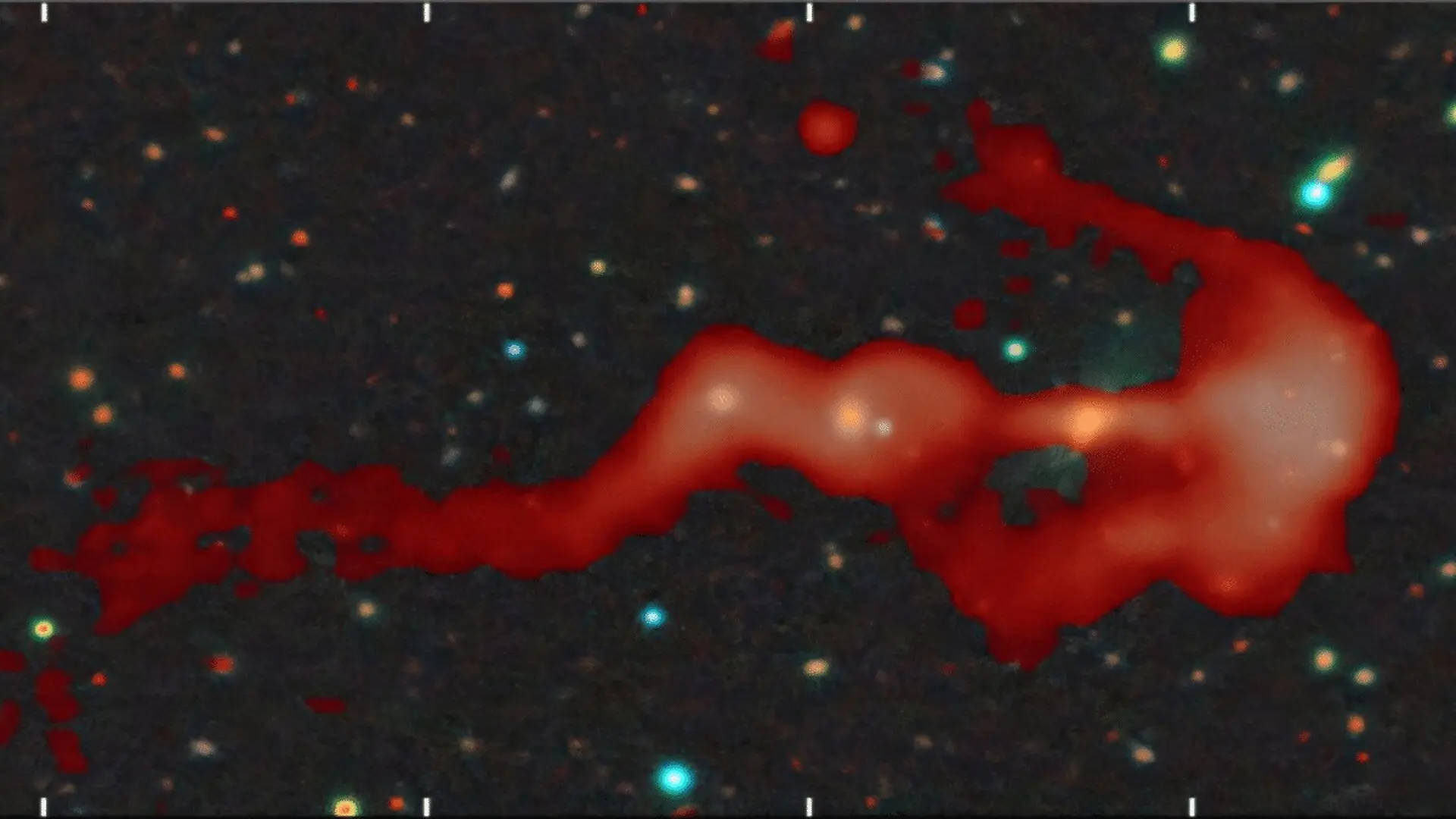
Astronomers have identified a spectacular radio galaxy, dubbed RAD-BAARG, whose bow‑shaped radio emission stretches almost 1.8 million light‑years. The structure may represent one of the clearest instances of a massive bow shock produced as a galaxy plunges through a cluster at supersonic speed. The discovery, described in Monthly Notices of the Royal Astronomical Society, offers a fresh perspective on how galaxies interact with the hot, diffuse gas that fills the space between clusters.
LOFAR Survey Uncovers an Unusual Radio Source
Data from the Low‑Frequency Array (LOFAR) – one of the most sensitive radio networks on Earth – revealed the object while members of the RAD@home Astronomy Collaboratory examined the LOFAR Two‑Metre Sky Survey (LoTSS). Unlike typical radio galaxies that show symmetric jets from a central black hole, RAD‑BAARG displays a highly distorted morphology. One side contains a narrow jet feeding a broad, sector‑shaped region that leads to a giant arc about 560 kiloparsecs long, while the opposite side bends into an S‑shaped feature that tapers into a long tail. This geometry does not fit standard models of radio‑galaxy evolution, suggesting that large‑scale environmental forces are shaping the emission.
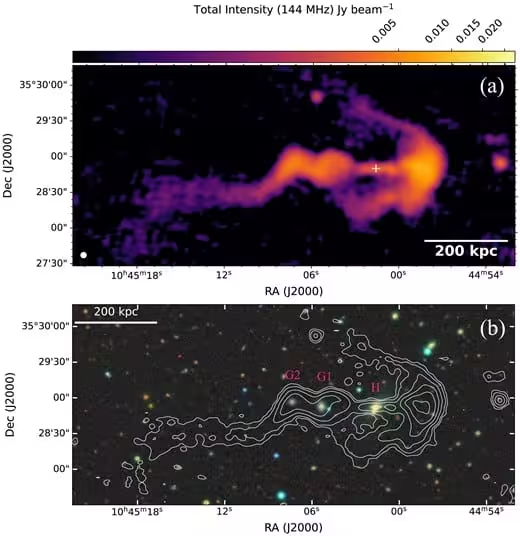
Evidence of a Giant Bow Shock Around an Infalling Galaxy
The team proposes that the bow‑shaped arc traces a shock front generated as the host galaxy moves through the intracluster medium toward a nearby cluster. In analogy to the sonic boom of a supersonic aircraft, such a shock forms when an object exceeds the local sound speed in the surrounding hot gas. Because the intracluster medium is faint, detecting these shocks is challenging; in RAD‑BAARG the radio‑bright plasma from the jets appears to illuminate the shock, making it visible at low frequencies.
Lead author Dr Ananda Hota, founder and director of the RAD@home Astronomy Collaboratory, noted the rarity of the morphology. “The structure of this source is unlike any radio galaxy I have seen in the last 25 years,” he said. “Its remarkable shape seems to record the interaction between relativistic plasma and a large‑scale shock generated during the galaxy’s infall into a nearby cluster.” If confirmed, the object would provide an unprecedented radio view of a bow shock associated with an infalling galaxy.
Why This Object Is Capturing Attention
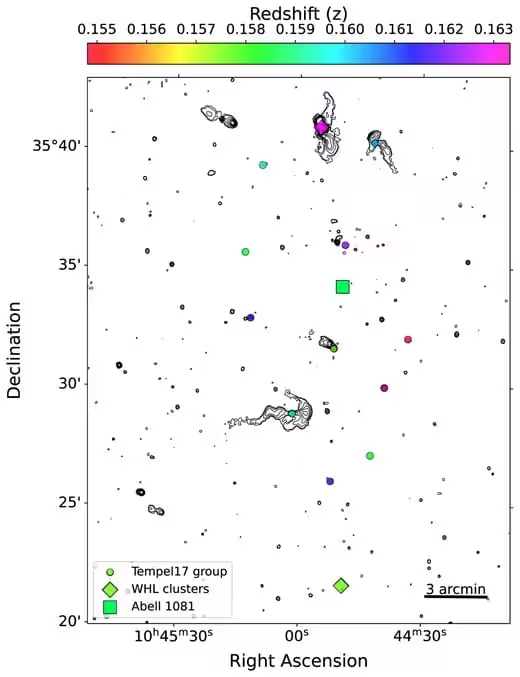
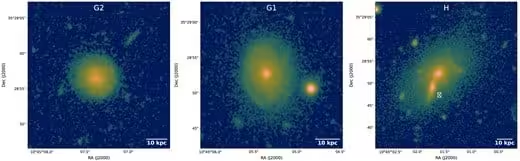
The study, published in Monthly Notices of the Royal Astronomical Society, highlights a more complex environment than previously assumed. The host galaxy resides amid several nearby cluster‑scale structures, creating a setting where gas flows, large‑scale motions and shock compression can all influence jet development. Such conditions are thought to be crucial for galaxy growth and for redistributing energy throughout clusters.
Understanding the coupling between active galactic nuclei and their surroundings remains a central challenge in astrophysics. Feedback from powerful jets can suppress star formation, alter gas cooling, and reshape the evolution of massive cosmic structures. RAD‑BAARG offers a natural laboratory where these processes can be observed together, with radio imaging providing clues about how jets respond when they encounter massive environmental forces. The morphology thus allows researchers to test theoretical models that have relied largely on simulations.
Next‑Generation Radio Telescopes Poised to Find More Systems
The find underscores the power of modern radio facilities to reveal faint, extended emission that older telescopes missed. Co‑lead author Dr Pratik Dabhade of the National Centre for Nuclear Research in Poland emphasized LOFAR’s role. “LOFAR lets us detect this low‑surface‑brightness emission in extraordinary detail. With LoTSS DR3 and the upcoming Square Kilometre Array Observatory (SKAO), we expect to uncover many more examples where jets, galaxies and their environments interact visibly.”
The SKAO, currently under construction, will become the most sensitive radio array ever built. Its capabilities could reveal a large population of objects like RAD‑BAARG, helping astronomers assess how common shock‑driven interactions are across cosmic time and refining models of galaxy‑environment feedback.
Citizen Science Leads to a Potential New Class of Objects
The initial detection was made by citizen scientist Pranim Limbo, who spotted the odd shape while reviewing LoTSS images through the RAD@home platform. This example shows how distributed collaborations can contribute directly to frontline research, even from participants far from major observatories. The team suggests that RAD‑BAARG may be the first clearly imaged member of a broader class of galaxies shaped by large‑scale shock fronts.
“The reported observation reveals the first direct imaging of characteristic arc‑shape morphology in radio frequency in regard to supersonically infalling radio‑galaxy (most likely) onto a cluster medium—a spectacular textbook example of a large bow shock.” He added, “Discovery of more such sources and their study during the SKAO era will provide much deeper insight about jet‑ambient medium interaction and consequent feedback processes.”
This article has been fact checked for accuracy, with information verified against reputable sources. Learn more about us and our editorial process.
Last reviewed on .
Article history
- Latest version
Cite this page:
- Posted by Aisha Ahmed