Ancient Ears of Nebula NGC 6563 Predate Main Shell and Suggest Hidden Binary Past
New observations show NGC 6563’s unusual ’ears’ formed millennia before its main nebula, overturning assumptions about its evolution.
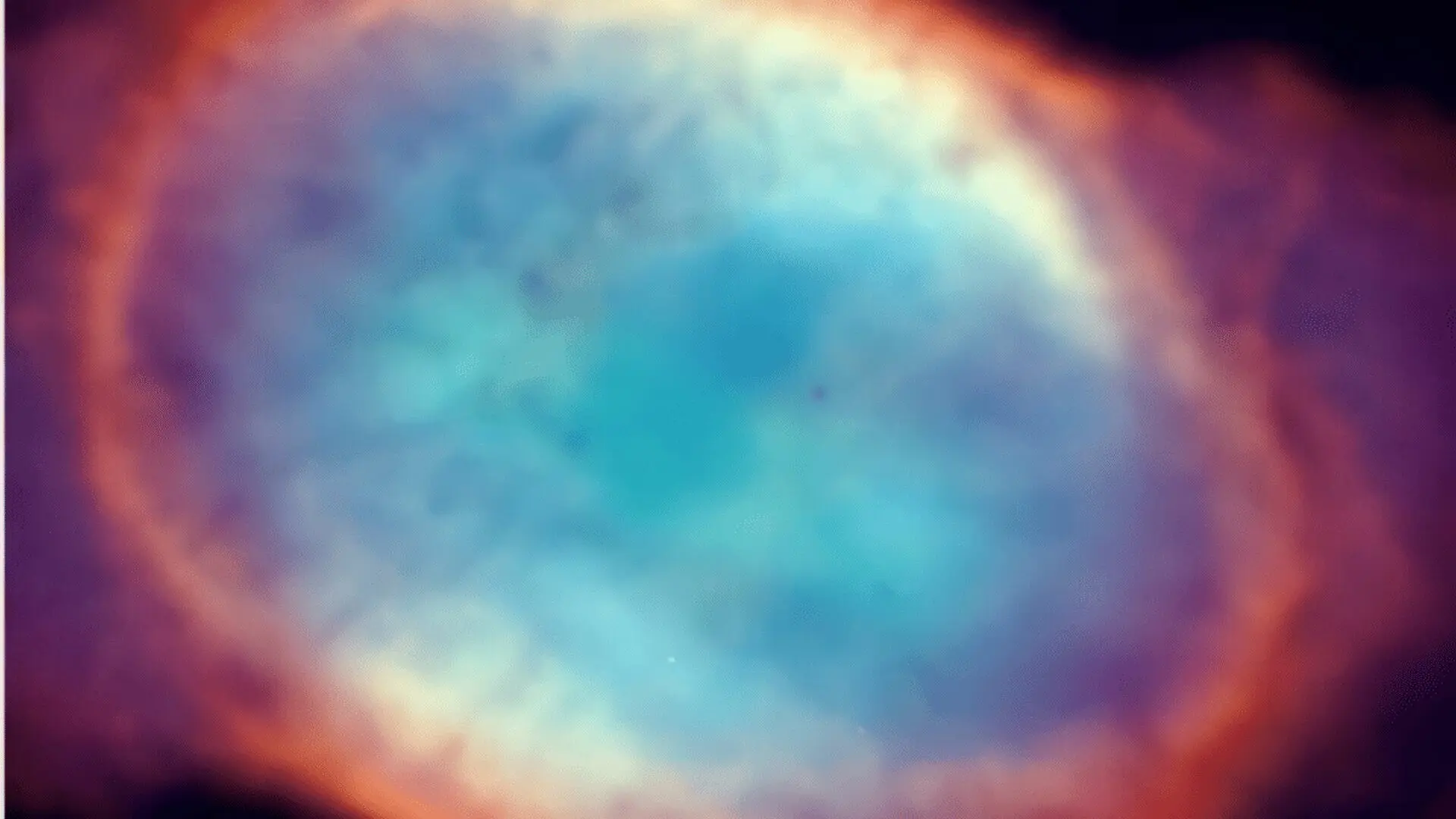
A recent spectroscopic campaign has shown that the striking “ears” of planetary nebula NGC 6563 predate its bright central shell by several millennia. By combining data from the VLT’s MUSE instrument in Chile with observations from the MES spectrograph on Mexico’s Arcadio Poveda Telescope, an international team reconstructed the nebula’s expansion history and uncovered a multi‑stage mass‑loss sequence that challenges conventional models of stellar death.
Re‑examining a Classic Object Reveals an Earlier Epoch
NGC 6563 lies roughly 5,400 light‑years away in Sagittarius and has been catalogued since 1826. Its elongated, egg‑shaped core is flanked by two slender protrusions that have long been described as “ears.” While planetary nebulae generally arise when Sun‑like stars shed their outer layers, the asymmetric morphology of NGC 6563 has made it a subject of particular interest.
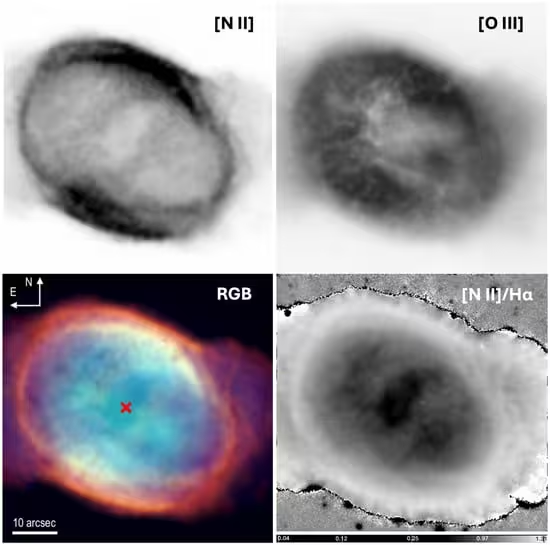
To probe the nebula’s dynamics, Zahra Al and colleagues from Istanbul University mapped the velocity of ionised gas across the entire structure. The MUSE integral‑field spectrograph delivered detailed emission‑line images, while the MES provided high‑resolution velocity profiles that together delivered one of the most comprehensive kinematic analyses of this target to date.
Ear‑Shaped Lobes Proven to Be Ancient Relics
Kinematic measurements show the central ellipsoidal shell expanding at roughly 22 km s⁻¹, while the nebula as a whole drifts through the Galaxy at about –25 km s⁻¹. Age estimates derived from these velocities indicate that the main shell and its accompanying ring are approximately 3,700 years old. In contrast, the ear‑like extensions are markedly older, with formation times ranging between 7,500 and 8,800 years.
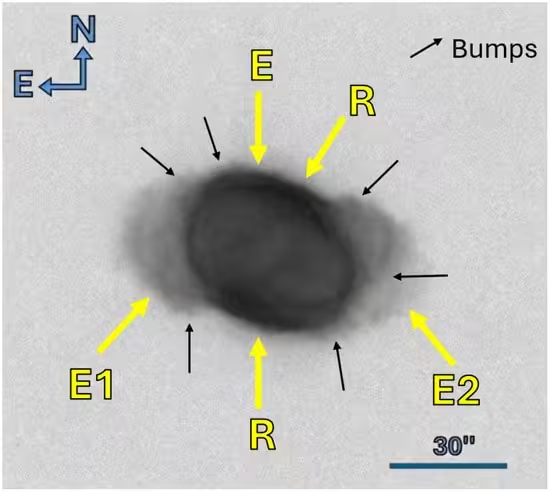
These results overturn the assumption that all visible components were produced in a single ejection event. Instead, the data support a scenario in which collimated outflows—likely linked to a past binary interaction—shaped the ears long before the dense shell surrounding the central star was expelled.
“This supports a scenario in which the ears originated from earlier collimated outflows, likely associated with a binary interaction phase preceding the ejection of the dense shell,” the authors of the paper published in the Galaxies journal wrote.
If the binary‑driven hypothesis holds, NGC 6563 preserves a fossil record of stellar companionship that predates the nebula’s current configuration by several thousand years.
Asymmetric Expansion Hints at a Turbulent Surroundings
Further analysis uncovered a noticeable velocity gradient: one side of the nebula expands faster than its counterpart, creating a kinematic imbalance. Localised bright spots and surface distortions point to interactions with an uneven ambient medium, suggesting that density variations in the surrounding interstellar material have influenced the nebula’s growth.
Such environmental effects, while insufficient to explain the full asymmetry, likely combine with internal mechanisms—stellar winds, thin‑shell instabilities, and possible binary‑driven mass‑loss episodes—to produce the observed complexity.
Implications for the Late Stages of Stellar Evolution
Planetary nebulae exist for only a few tens of thousands of years, making them valuable probes of the final phases of Sun‑like stars. The layered history of NGC 6563 demonstrates that multiple, temporally separated processes can leave distinct imprints on a single object.
The authors conclude that “internal wind interaction, thin‑shell instabilities, binary‑driven mass‑loss episodes, and environmental effects may therefore all contribute to the present morphology, operating at different epochs and spatial scales. Further observational and theoretical studies will be necessary to better constrain the relative contributions of these mechanisms.”
Over two centuries after its discovery, NGC 6563 continues to challenge astronomers, offering a rare glimpse into the intricate choreography that shapes dying stars.
This article has been fact checked for accuracy, with information verified against reputable sources. Learn more about us and our editorial process.
Last reviewed on .
Article history
- Latest version
Cite this page:
- Posted by Aisha Ahmed