Mars’s Moon Phobos Faces a Faster End Than We Thought, and It Will Be Explosive
Phobos is hurtling towards its certain doom, yet researchers have stumbled upon an unexpected revelation about its fate. Might it shatter prematurely?
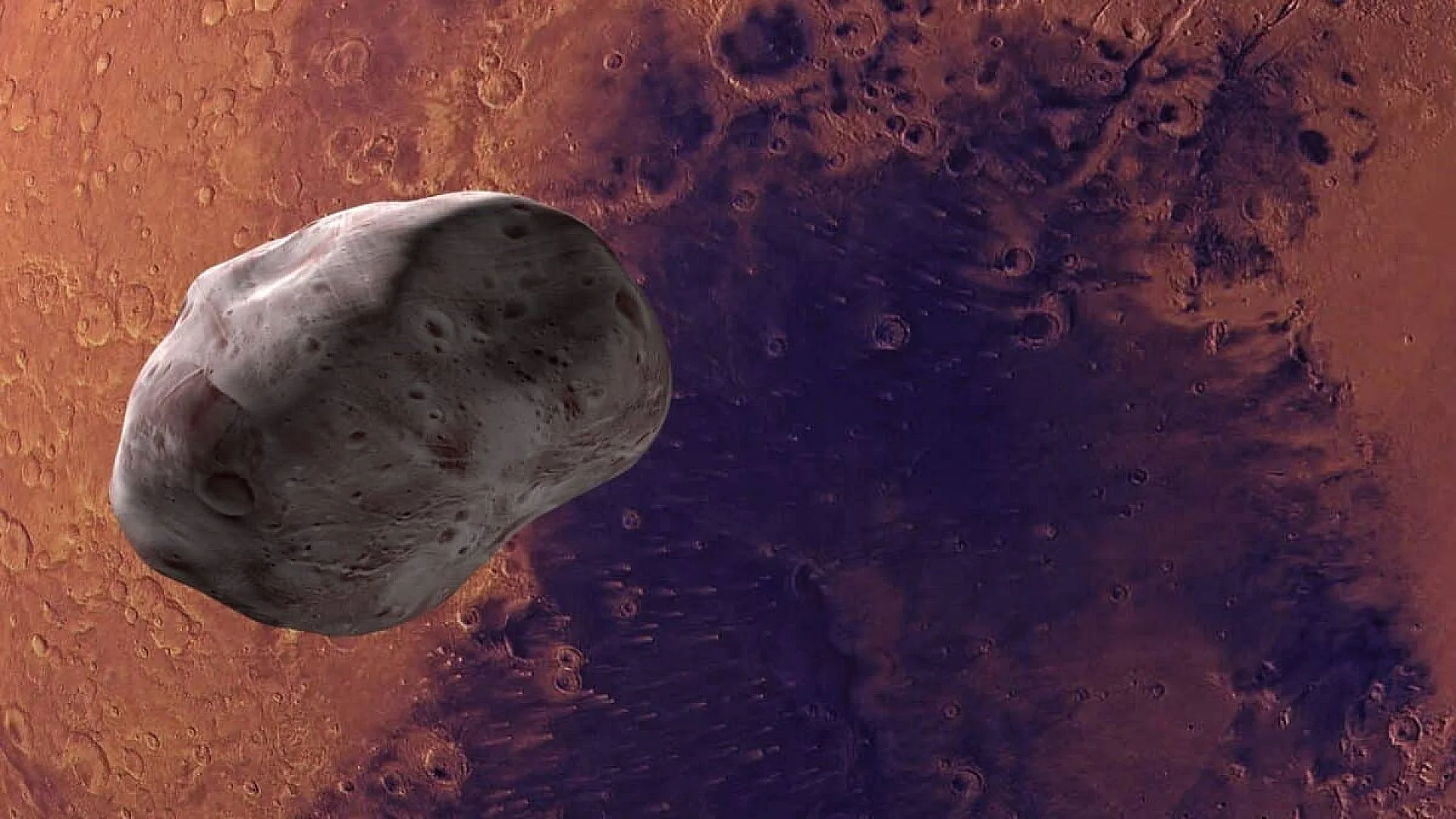
Mars’s moon, Phobos, has long been a subject of fascination for astronomers due to its mysterious origin and impending destruction. While it was once thought to face a slow and steady demise due to tidal forces, new research suggests that its destruction might be a far more dramatic and violent process.
Phobos, the larger and innermost of Mars’s two moons, has been orbiting the Red Planet at an incredibly close distance, making its fate closely tied to the tidal forces exerted by Mars. As the moon’s orbit decays, it’s expected to break apart in a catastrophic event, with its surface material shedding off in chunks due to the tidal forces acting on it.
The Shrinking Orbit of Phobos
Phobos’s orbit is shrinking slowly due to the tidal forces between the moon and Mars, which are pulling the moon closer to the planet by draining its orbital energy. According to Harrison Agrusa and Patrick Michel from the Observatoire de la Côte d’Azur, this inward spiral could lead to the moon’s destruction much sooner than anticipated.
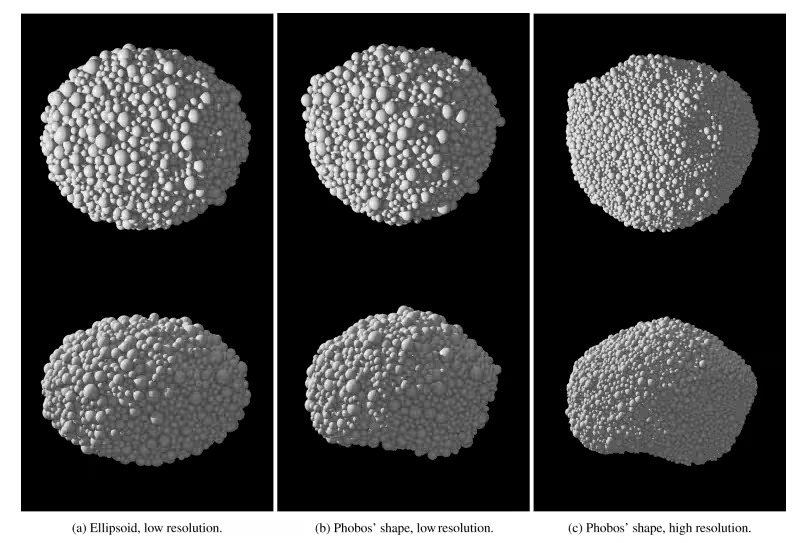
As BBC Sky at Night reports, Phobos’s composition plays a key role in this process: it’s not a solid body but a collection of loose debris, known as a rubble-pile structure. This makes the moon especially vulnerable to the tidal forces exerted by Mars. As its orbit decays, pieces of its surface begin to break off, starting at around 2.25 times the radius of Mars (2.25RM), well before it reaches the Roche limit.
A Catastrophic Fate for Phobos
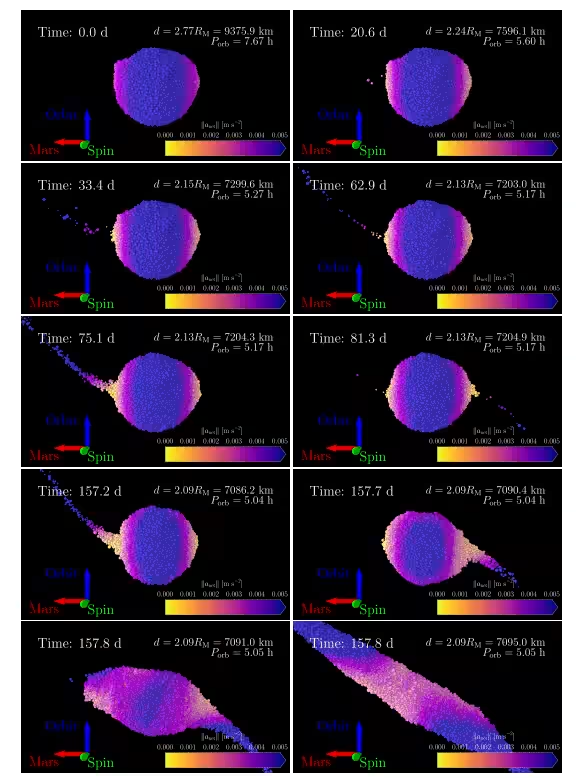
According to the new research, avaliable on Astronomy & Astrophysics, the material on Phobos’s surface will start to break off in chunks due to the tidal forces acting on the moon. These initial shedding events will happen around 2.25RM, followed by larger events at 2.15RM and 2.13RM. As the potato-shaped moon approaches 2.09RM, its structure will become unstable, and the moon will break apart.
This process will create debris that enters orbit around Mars. Over time, this debris will collide back into Phobos with great force, accelerating its disintegration. Researchers suggest this could lead to a “sesquinary catastrophe,” in which Mars’s satellite is obliterated by its own fragments.
The Unanswered Questions
We still don’t know exactly how Phobos’s internal structure will react to these forces or when it will break apart. That’s why the upcoming Japanese Martian Moons eXploration (MMX) mission, launching in 2026, is so important. The MMX mission will give us more detailed info about Phobos’s makeup, helping us better predict what will happen to it.
This mission will be key in helping us understand the larger moon of the Red Planet and its eventual destruction. It will provide valuable data on how Mars’s tidal forces are affecting the moon and give us a clearer idea of what’s in store for it.
— Astropics (@astropics) May 2, 2026
This article has been fact checked for accuracy, with information verified against reputable sources. Learn more about us and our editorial process.
Last reviewed on .
Article history
- Latest version
Reference(s)
- “Patrick Michel.”, March 3, 2026 <https://www.oca.eu/fr/patrick-michel/>.
- Dartnell, Lewis. “Mars will tear its own moon apart. Now scientists think it could be sooner – and more destructive – than expected.”, May 3, 2026 BBC Sky at Night Magazine <https://www.skyatnightmagazine.com/news/mars-tear-phobos-apart-could-happen-sooner>.
- Agrusa, Harrison. “Tidal disruptions of rubble piles: The case of Phobos.” arXiv.org, doi: 10.1051/0004-6361/202557988. <http://arxiv.org/abs/2602.21912>.
- “Aa57988 25.” <https://www.aanda.org/articles/aa/pdf/2026/02/aa57988-25.pdf>.
- “MMX - Martian Moons eXploration.” MMX - Martian Moons eXploration <https://www.mmx.jaxa.jp/en/>.
Cite this page:
- Posted by Aisha Ahmed