Roman Space Telescope Arrives in Florida, Begins Critical Pre Launch Preparations
NASA’s Roman Space Telescope lands in Florida, kicking off final prep for a mission to study billions of galaxies and thousands of distant worlds.
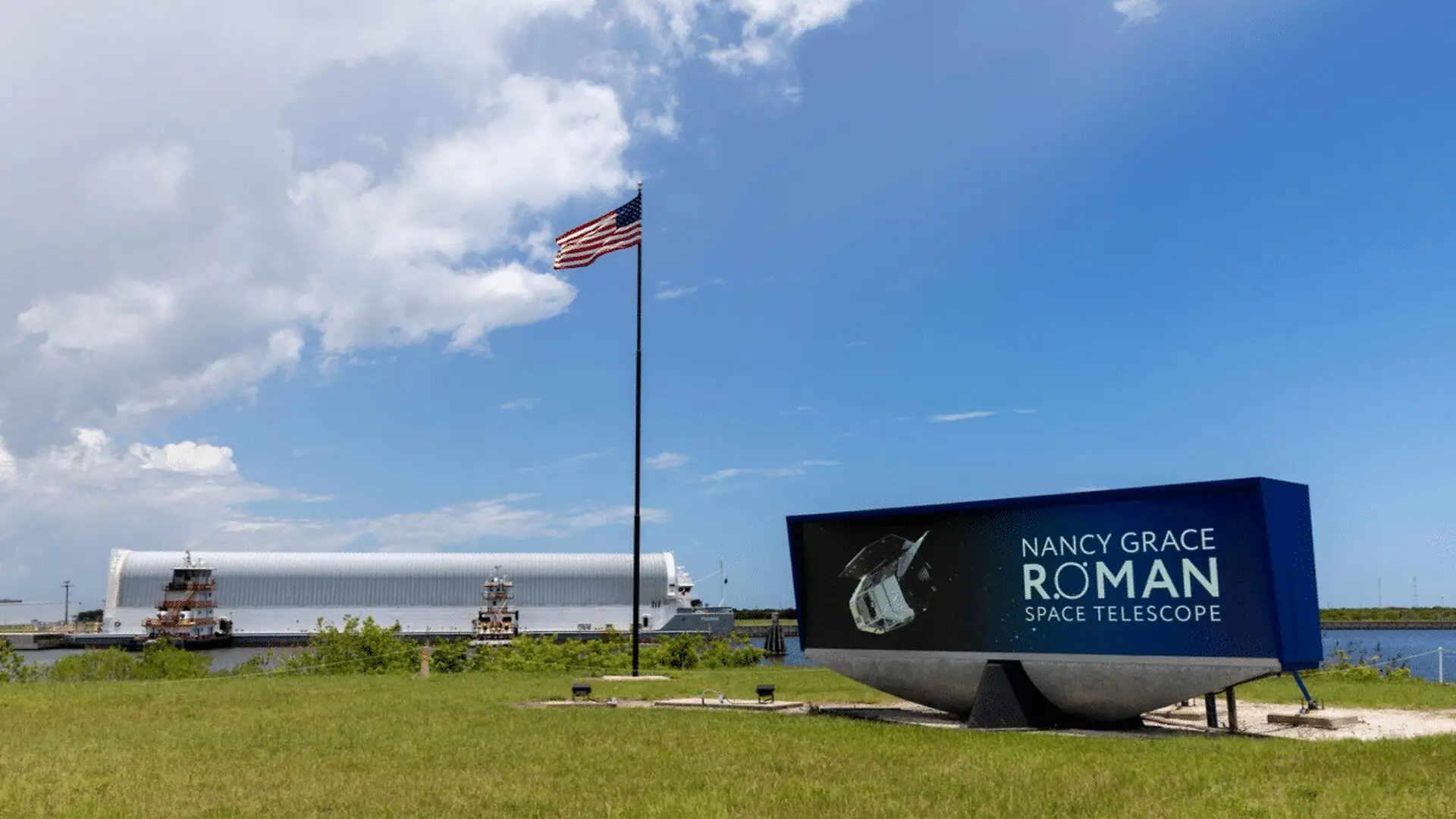
The NASANancy Grace Roman Space Telescope arrived at the Kennedy Space Center on June 21, where the team will begin the last series of preparations ahead of a summer launch. This arrival signals the shift from extensive development and testing to the final countdown for a mission poised to deepen knowledge of galaxies, exoplanets, black holes and the forces accelerating cosmic expansion.
Coast-to-Coast Transit of NASA’s Premier Telescope
The telescope’s journey began at NASA’s Goddard Space Flight Center in Maryland, where engineers completed integration and a battery of qualification tests. Encased in a climate‑controlled shipping container, the nearly 18,000‑pound instrument was moved to the Port of Baltimore and then loaded onto the agency’s NASA’s Pegasus barge, a vessel routinely used to ferry large scientific hardware along the Atlantic seaboard.
The Nancy Grace Roman Space Telescope has arrived at the Space Coast! Carried inside NASA’s Pegasus barge, this new telescope is set to launch on Falcon Heavy later this year. pic.twitter.com/D3KSl1LWTD
— Jerry Pike (@JerryPikePhoto) June 20, 2026
Preparing the Observatory for Liftoff
At Kennedy’s Payload Hazardous Servicing Facility, technicians will guide the spacecraft into a clean‑room environment, where a series of decontamination steps will strip any residues picked up during the trek. Inside the processing bay, the observatory will be stood upright for detailed examinations of its six solar panels, thermal shielding and insulation. A critical step will be the loading of roughly 290 gallons of hydrazine propellant into its tanks, providing the thrust needed for trajectory tweaks and station‑keeping throughout the mission. Each activity follows rigorously defined procedures to certify the telescope for the rigors of launch and deep‑space operation.
Mission Objectives and Expected Scientific Impact
NASA plans to lift the telescope aboard a SpaceX Falcon Heavy rocket, with the earliest launch window set for August 30. Once in space, the observatory will settle at the Sun‑Earth L2 Lagrange Point, a stable zone about one million miles from our planet. From that perch, Roman will execute expansive sky surveys, capturing billions of galaxies to trace the universe’s evolution. The data are expected to shed light on the elusive dark energy driving cosmic acceleration, while also informing studies of dark matter, galaxy assembly and the large‑scale cosmic web.
Advancing the Hunt for Distant Worlds
According to NASA, Roman’s payload includes a 300‑megapixel camera capable of sweeping vast swaths of the sky in a single exposure, a capability that should reveal hundreds of thousands of new exoplanets. In addition, the mission will trial a coronagraph—an instrument designed to mask starlight so that nearby planets and protoplanetary disks can be directly imaged. Though the coronagraph is a technology demonstrator, its performance could lay the groundwork for future missions aimed at capturing images of Earth‑like worlds orbiting distant stars.
This article has been fact checked for accuracy, with information verified against reputable sources. Learn more about us and our editorial process.
Last reviewed on .
Article history
- Latest version
Reference(s)
- “https://twitter.com/JerryPikePhoto/status/2068482866493751633/video/1.” <https://t.co/D3KSl1LWTD>.
- Niles-Carnes, Elyna. “NASA’s Next Generation Telescope Arrives in Florida Ahead of Launch - NASA Science.”, June 21, 2026 NASA <https://science.nasa.gov/blogs/roman/2026/06/21/nasas-next-generation-telescope-arrives-in-florida-ahead-of-launch/>.
Cite this page:
- Posted by Aisha Ahmed