SETI Conducts Most Comprehensive Scan of Interstellar Comet 3I Atlas, Finds No Alien Signals
A rare interstellar object sparked an unprecedented technosignature hunt, pulling astronomers into one of this year’s most compelling investigations.

A comprehensive radio search of the interstellar comet 3I/Atlas has returned a clean result: no technosignatures were detected. The study, now appearing in the Astronomical Journal, represents one of the most detailed SETI examinations of an object from another star system and underscores the growing capability of modern alien‑search programs.
What Made 3I/Atlas a Scientific Sensation
The identification of 3I/Atlas sparked immediate interest because interstellar visitors are exceedingly uncommon. It became only the third confirmed object to enter the solar system from beyond the Sun’s gravitational reach, offering a rare glimpse of material that formed in a distant stellar nursery, potentially billions of years before our own system emerged.
Although speculation briefly suggested the comet might be artificial, no credible evidence supported that notion. Nonetheless, the prospect of catching an engineered signal from a star‑hopping object motivated astronomers to conduct a thorough investigation.
During its inner‑solar‑system passage the comet skimmed within about 19 million miles of Mars. While it never approached Earth closely, the window allowed multiple ground‑based telescopes and space assets to monitor its trajectory. Size estimates range from roughly 440 meters to 5.6 kilometers, and its age could be as great as 11 billion years, predating the Sun itself.
SETI’s Massive Radio Hunt Across Millions of Frequencies
The SETI Institute coordinated the effort from its Northern California radio facilities, dedicating over seven hours of observation soon after the comet’s discovery. Researchers scanned a broad swath of the radio spectrum, seeking narrow‑band emissions that might betray an artificial origin.
The campaign generated a colossal dataset: nearly 74 million narrow‑band hits were recorded. Such signals are prized because human‑made transmitters can produce them more readily than most natural astrophysical phenomena. The main challenge lay in separating genuine candidates from the flood of terrestrial radio interference that constantly surrounds Earth.
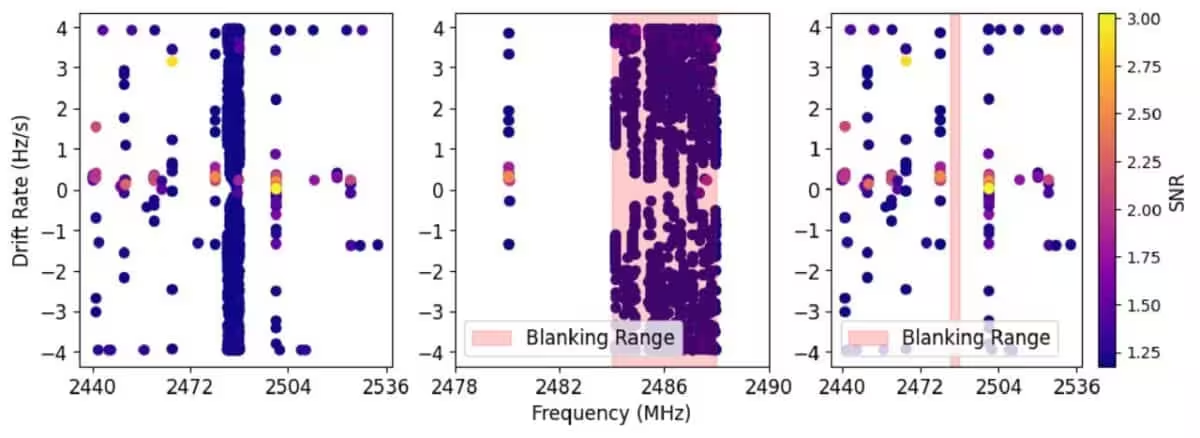
Advanced filtering algorithms were applied to strip away signals linked to Earth‑based technology. By analyzing drift rates, frequency stability, and motion signatures, the team reduced the candidate list to just over 200 events worthy of deeper review.
A final cross‑check revealed that every remaining signal originated from terrestrial transmitters or orbiting satellites. No transmission could be traced back to 3I/Atlas itself. The full results appear in the Astronomical Journal, marking a landmark in technosignature research on an interstellar body.
Implications for Future Technosignature Searches
While the null detection may seem anticlimactic, the study demonstrates that astronomers now possess the tools to systematically probe exotic objects for signs of intelligence. Processing tens of millions of signals and isolating a handful of candidates validates methods that can be deployed on future interstellar visitors or more distant targets.
“These results show how realistic it is to detect a signal with the technology we have today,” co‑author Valeria Garcia Lopez of Furman University said in a statement. “That is why it is important to keep searching for technosignatures, even from objects we might not expect to have signals.”
The sentiment reflects a core principle of SETI: not every oddball object will harbor artificial emissions, but each search hones analytical techniques, refines interference mitigation, and builds confidence that a truly anomalous signal could be recognized if it ever appears.

A Mirror of Humanity’s Own Interstellar Probes
The investigation also highlighted a tangible link between alien technosignature searches and our own deep‑space missions. The twin Voyager probes, launched in the 1970s, have already crossed the heliosphere and now travel through the interstellar medium. In distant future they will pass through other stellar neighborhoods, effectively becoming interstellar objects from an external viewpoint.
Researchers used this fact to argue that looking for technological artifacts among interstellar visitors is not mere speculation; it rests on a proven example of human‑made hardware traveling between stars.
“Voyager and similar probes will eventually become interstellar objects in other stellar systems. We thus know that no extrapolation is needed for the idea of interstellar technological objects, as we have a proof by existence,” the authors wrote.
This perspective grounds the search for alien technology in observable reality: if humanity can launch devices that eventually roam other star systems, other civilizations might do the same.
The Long‑Term Voyage of 3I/Atlas
Today 3I/Atlas is receding from the Sun, now about 1.3 billion kilometers away, and is unlikely to return. Although the comet showed no signs of artificial activity, its brief sojourn through our neighborhood offered an unprecedented testbed for SETI methodologies.
Its extraordinary age, probable formation around a distant star, and fleeting passage through the inner solar system have already secured a place in astronomical lore. The recent radio survey adds a new chapter, demonstrating how modern observatories can rigorously evaluate even the most unconventional hypotheses while staying firmly anchored in empirical evidence.
In the absence of detected technosignatures, 3I/Atlas remains classified as a natural interstellar comet. Yet the analytical techniques refined during this campaign will be ready for the next cosmic wanderer that ventures into our celestial backyard.
This article has been fact checked for accuracy, with information verified against reputable sources. Learn more about us and our editorial process.
Last reviewed on .
Article history
- Latest version
Reference(s)
- Sheikh, Sofia Z.., et al. “A Search for Radio Technosignatures from Interstellar Object 3I/ATLAS with the Allen Telescope Array.” The Astronomical Journal, vol. 172, no. 1, June 3, 2026, pp. 1 American Astronomical Society, doi: 10.3847/1538-3881/ae6651. <https://iopscience.iop.org/article/10.3847/1538-3881/ae6651>.
Cite this page:
- Posted by Aisha Ahmed